


Detection of Bacillus Species with Arsenic Resistance and Plant Growth Promoting Efficacy from Agricultural Soils of Nepal
- PMID: 35909656
- PMCID: PMC9325649
- DOI: 10.1155/2022/9675041
Detection of Bacillus Species with Arsenic Resistance and Plant Growth Promoting Efficacy from Agricultural Soils of Nepal
Abstract
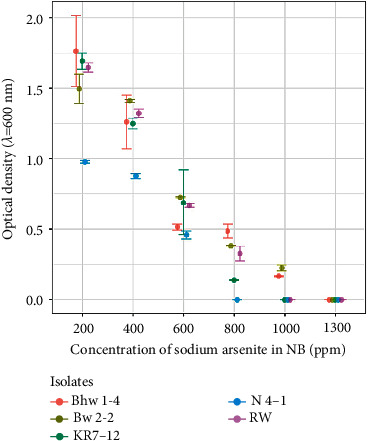
Arsenic contamination in soil and water is one of the major environmental problems in multiple countries including Nepal imposing a serious threat to the ecosystem and public health. Many soil bacteria can detoxify arsenic, including genus Bacillus. With an objective to gauge the plant growth-promoting activities of arsenic-resistant Bacillus species, 36 samples (soil, rice, cauliflower, and beans) were collected from the Terai region of Nepal. For selective isolation of Bacillus species, each sample was heated at 80°C for 15 min before the inoculation into nutrient agar (NA). Following the standard protocol, arsenic-resistant Bacillus species were screened using NA supplemented with 100 ppm sodium arsenate and sodium arsenite. Among 158 randomly selected isolates, only five isolates were able to tolerate sodium arsenite concentration up to 600 ppm. Notably, all five isolates were able to produce indole acetic acid (IAA), a plant hormone, and solubilize phosphate. Based on biochemical analysis and 16S rRNA gene sequencing, isolates N4-1, RW, KR7-12, Bhw1-4, and BW2-2 were identified as B. subtilis subsp. stercosis, B. flexus, B. licheniformis, B. cereus, and B. flexus, respectively. To the best of our knowledge, this is the first study showing the presence of arsenic-resistant B. flexus in Nepalese soil with plant growth-promoting traits. Possible utilization of these Bacillus strains could facilitate the novel bioremediation pathway to reduce the toxic effect of arsenic from the soil and water in the Terai region of Nepal.
Copyright © 2022 Lil Budha Magar et al.
Conflict of interest statement
The authors declare no conflicts of interest.
Figures


References
-
- Panda S. K., Upadhyay R. K., Nath S. Arsenic stress in plants. Journal of Agronomy and Crop Science . 2010;196(3):161–174.
-
- Choong T. S. Y., Chuah T. G., Robiah Y., Gregory Koay F. L., Azni I. Arsenic toxicity, health hazards and removal techniques from water: an overview. Desalination . 2007;217(1–3):139–166. doi: 10.1016/j.desal.2007.01.015. - DOI
-
- Le X. C., Lu X., Li X.-F. Analytical Chemistry . 1. Vol. 76. A; Jan. 2004. Peer reviewed: arsenic speciation; pp. 26–33.
LinkOut - more resources
Full Text Sources
Molecular Biology Databases
