


Dealing With Stress in Cats: What Is New About the Olfactory Strategy?
- PMID: 35909687
- PMCID: PMC9334771
- DOI: 10.3389/fvets.2022.928943
Dealing With Stress in Cats: What Is New About the Olfactory Strategy?
Abstract
Domestic cats are descended from solitary wild species and rely heavily on the olfaction system and chemical signals for daily activities. Cats kept as companion animals may experience stress due to a lack of predictability in their physical or social environment. The olfactory system is intimately connected to the brain regions controlling stress response, thus providing unique opportunities for olfactory strategies to modify stress and related behavioral problems in cats. However, the olfactory intervention of stress in cats has been mainly focused on several analog chemical signals and studies often provide inconsistent and non-replicable results. Supportive evidence in the literature for the potentially effective olfactory stimuli (e.g., cheek and mammary gland secretions, and plant attractants) in treating stress in cats was reviewed. Limitations with some of the work and critical considerations from studies with natural or negative results were discussed as well. Current findings sometimes constitute weak evidence of a reproducible effect of cat odor therapy for stress. The welfare application of an olfactory stimulus in stress alleviation requires a better understanding of its biological function in cats and the mechanisms at play, which may be achieved in future studies through methodological improvement (e.g., experiment pre-registration and appropriate control setting) and in-depth investigation with modern techniques that integrate multisource data. Contributions from individual and environmental differences should be considered for the stress response of a single cat and its sensitivity to olfactory manipulation. Olfactory strategies customized for specific contexts and individual cats can be more effective in improving the welfare of cats in various stressful conditions.
Keywords: cat stress; chemical signals; olfaction; pheromone; welfare.
Copyright © 2022 Zhang, Bian, Liu and Deng.
Conflict of interest statement
The authors declare that the research was conducted in the absence of any commercial or financial relationships that could be construed as a potential conflict of interest.
Figures
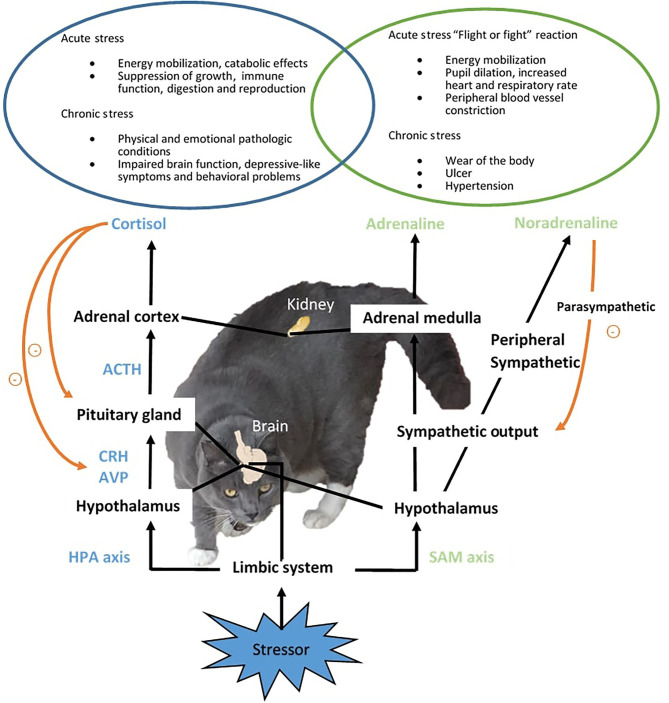
References
-
- Heath SE. Behavior problems and welfare. In: Rochlitz I, editor. The Welfare of Cats. London: Springer; (2007). p. 91–118. 10.1007/978-1-4020-3227-1_4 - DOI
-
- McCabe GP, Ecker C. Risk factors for relinquishment of cats. J Am Vet Med Assoc. (1996) 209:582–8. - PubMed
-
- Heidenberger E. Housing conditions and behavioral problems of indoor cats as assessed by their owners. Appl Anim Behav Sci. (1997) 52:345–64. 10.1016/S0168-1591(96)01134-3 - DOI
-
- Strickler BL, Shull EA. An owner survey of toys, activities, and behavior problems in indoor cats. J Vet Behav. (2014) 9:207–14. 10.1016/j.jveb.2014.06.005 - DOI
Publication types
LinkOut - more resources
Full Text Sources
Miscellaneous
