


Impact of histological clot composition on preprocedure imaging and mechanical thrombectomy
- PMID: 35909711
- PMCID: PMC9336592
- DOI: 10.4103/bc.bc_81_21
Impact of histological clot composition on preprocedure imaging and mechanical thrombectomy
Abstract
Introduction: We studied the relationship of acute ischemic stroke (AIS) large-vessel occlusion clot composition with vessel recanalization and preprocedure imaging.
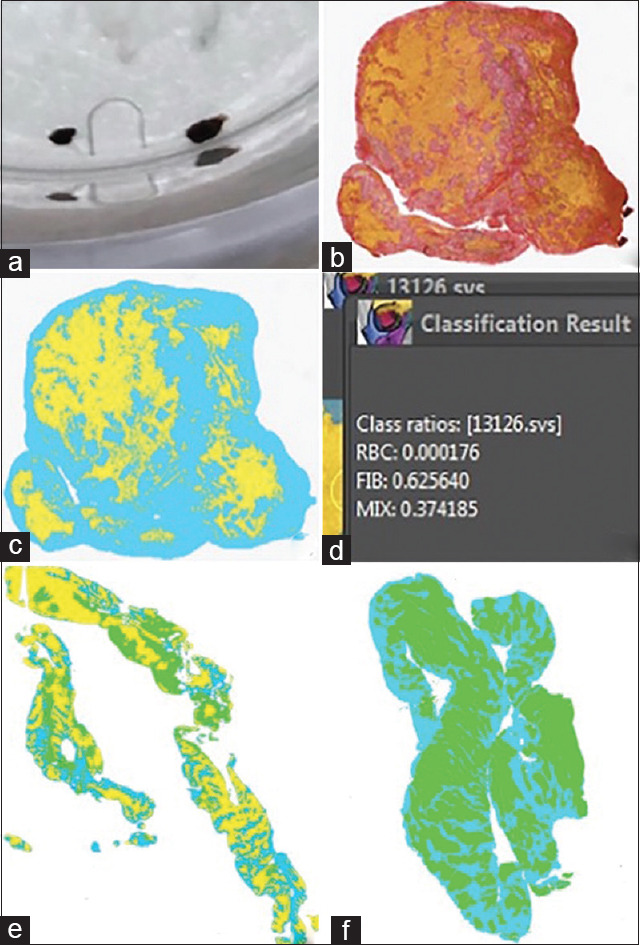
Subjects and methods: Individual clots from AIS patients who underwent mechanical thrombectomy (MT) between September 2016 and September 2018 were examined. Clot composition was analyzed histologically through a trichrome staining and image segmentation, and the area occupied by red blood cells (RBCs), fibrin, or mixed composition was quantified.
Results: Forty-three patients (65.4 ± 12.7 years, 39% of females) who underwent 92 retrieval passes (mean 2.14, range 1-6) were included in this study. Fibrin (44%) occupied the greatest area, followed by mixed composition (34%) and RBCs (22%). A stent retriever was deployed in 81% of cases, 20 patients (47%) achieved first-pass efficacy (FPE) (thrombolysis in cerebral infarction [TICI] 2b-3 after first pass), 41 (95%) achieved successful revascularization (TICI 2b-3), and 21 (49%) had good outcome (modified Rankin Scale [mRS] ≤2) at 90 days. Hyperdense artery sign (HAS) on initial computed tomography was correlated with mixed clot composition (P = 0.01) and lack of fibrin content (P = 0.03). In the univariate analysis, FPE was associated with RBC clot area, atrial fibrillation, and occlusion location but not with fibrin clot area, mixed clot area, stroke etiology, thrombectomy technique, distal emboli, or 90-day mRS. In the multivariate analysis, FPE was significantly correlated with low RBC clot area (odd ratio = 0.96, confidence interval [0.92.99], P = 0.034) but not with atrial fibrillation or location.
Conclusion: Our results suggest that HAS is correlated with mixed clot composition and lower fibrin content and that lower RBC clot composition is associated with FPE in patients undergoing MT.
Keywords: Acute ischemic stroke; clot; clot composition; fibrin; large-vessel occlusion; mechanical thrombectomy; red blood cell.
Copyright: © 2022 Brain Circulation.
Conflict of interest statement
There are no conflicts of interest.
Figures
References
-
- Berkhemer OA, Fransen PS, Beumer D, van den Berg LA, Lingsma HF, Yoo AJ, et al. A randomized trial of intraarterial treatment for acute ischemic stroke. N Engl J Med. 2015;372:11–20. - PubMed
-
- Goyal M, Demchuk AM, Menon BK, Eesa M, Rempel JL, Thornton J, et al. Randomized assessment of rapid endovascular treatment of ischemic stroke. N Engl J Med. 2015;372:1019–30. - PubMed
-
- Jovin TG, Chamorro A, Cobo E, de Miquel MA, Molina CA, Rovira A, et al. Thrombectomy within 8 hours after symptom onset in ischemic stroke. N Engl J Med. 2015;372:2296–306. - PubMed
-
- Saver JL, Goyal M, Bonafe A, Diener HC, Levy EI, Pereira VM, et al. Stent-retriever thrombectomy after intravenous t-PA vs.t-PA alone in stroke. N Engl J Med. 2015;372:2285–95. - PubMed
-
- Campbell BC, Mitchell PJ, Kleinig TJ, Dewey HM, Churilov L, Yassi N, et al. Endovascular therapy for ischemic stroke with perfusion-imaging selection. N Engl J Med. 2015;372:1009–18. - PubMed
LinkOut - more resources
Full Text Sources