. 2022 Jul 15:12:923915.
doi: 10.3389/fonc.2022.923915. eCollection 2022.

Ferroptosis: A Specific Vulnerability of RAS-Driven Cancers?

Affiliations

Ferroptosis: A Specific Vulnerability of RAS-Driven Cancers?

Cristina Andreani et al. Front Oncol. .

Abstract

Ferroptosis has emerged as a new type of programmed cell death that can be harnessed for cancer therapy. The concept of ferroptosis was for the first time proposed in in the early 2000s, as an iron-dependent mode of regulated cell death caused by unrestricted lipid peroxidation (LPO) and subsequent plasma membrane rupture. Since the discovery and characterization of ferroptosis, a wealth of research has improved our understanding of the main pathways regulating this process, leading to both the repurposing and the development of small molecules. However, ferroptosis is still little understood and several aspects remain to be investigated. For instance, it is unclear whether specific oncogenes, cells of origin or tumor niches impose specific susceptibility/resistance to ferroptosis or if there are some ferroptosis-related genes that may be used as bona fide pan-cancer targetable dependencies. In this context, even though RAS-driven cancer cell lines seemed to be selectively sensitive to ferroptosis inducers, subsequent studies have questioned these results, indicating that in some cases mutant RAS is necessary, but not sufficient to induce ferroptosis. In this perspective, based on publicly available genomic screening data and the literature, we discuss the relationship between RAS-mutation and ferroptosis susceptibility in cancer.

Keywords: CRISPR screening; RAS-driven cancer; cancer dependency map; cell death; ferroptosis.


Conflict of interest statement

The authors declare that the research was conducted in the absence of any commercial or financial relationships that could be construed as a potential conflict of interest.

Figures
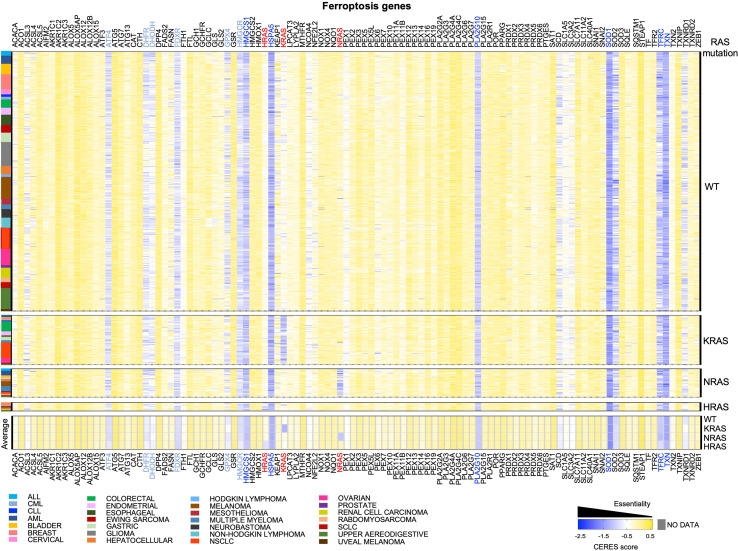
Figure 1
Figure 1
CRISPR knock-out screening from DepMap to identify dependencies on ferroptosis genes in RAS-WT and RAS-MUT cancer cells. The heatmap shows the median CERES dependency (DepMap_21Q3_Public,_CERES) from https://depmap.org/portal/ for the indicated ferroptosis genes (x axes) in the indicated type of cancer cell lines (y axis). The CERES score defines whether a given human cancer cell line is dependent on a given gene: a gene with CERES score of 0 or greater is considered non-essential, whereas a score lower than -0.5 indicates a likely dependency, with -1 indicating all common essential genes. Median CERES score was calculated for each lineage_2 parameter reported in the color legend. Cells were grouped according to the absence (RAS-WT) or the presence of mutations in of KRAS, NRAS, HRAS mutations. The bottom part of the heatmap displays the median CERES score for all the cancer cells of the indicated genotype. RAS genes are indicated in red, genes having an overall median CERES score of -1 or lower are indicated in dark blue and genes with a score between -0.8 and -0.9 are reported in light blue.
Figure 2
Figure 2
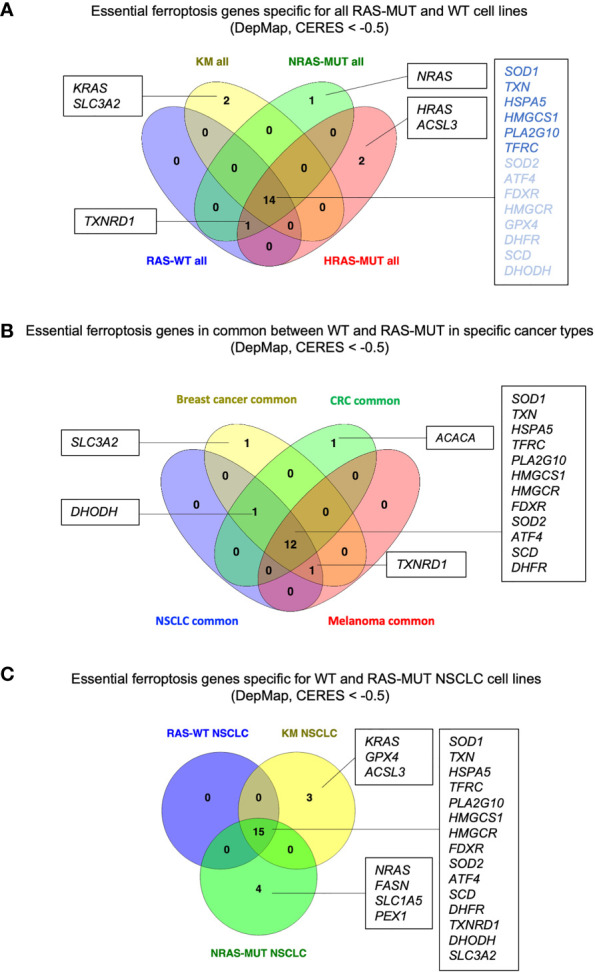
RAS- and cancer type-independent/dependent ferroptosis vulnerabilities. (A) Venn diagram summarizing the genes with CERES scores lower than -0.5 in cancer lines grouped for RAS mutation. RAS-independent genes with overall median CERES lower than -1 are indicated in dark blue. (B) Venn diagram for the RAS-independent genes with CERES scores lower that -0.5 in breast cancer, colorectal cancer (CRC), non-small cell lung cancer (NSCLC) and melanoma cell lines. (C) Venn diagram showing the ferroptosis genes with CERES score lower than -0.5 in NSCLC cell lines of the indicated genotype. Diagrams created using Venny 2.1 (86).

References

    1. Dixon SJ, Stockwell BR. The Hallmarks of Ferroptosis. Annu Rev Cancer Biol (2019) 3:35–54. doi: 10.1146/annurev-cancerbio-030518-055844 - DOI
    1. Dixon SJ, Lemberg KM, Lamprecht MR, Skouta R, Zaitsev EM, Gleason CE, et al. . Ferroptosis: An Iron-Dependent Form of Nonapoptotic Cell 6 Death. Cell (2012) 149:1060–72. doi: 10.1016/j.cell.2012.03.042 - DOI - PMC - PubMed
    1. Dolma S, Lessnick SL, Hahn WC, Stockwell BR. Identification of Genotype-Selective Antitumor Agents Using Synthetic Lethal Chemical Screening in Engineered Human Tumor 9 Cells. Cancer Cell (2003) 3:285–96. doi: 10.1016/S1535-6108(03)00050-3 - DOI - PubMed
    1. Yagoda N, Von Rechenberg M, Zaganjor E, Bauer AJ, Yang WS, Fridman DJ, et al. . RAS-RAF-MEK-Dependent Oxidative Cell Death Involving Voltage-Dependent Anion Channels. Nature (2007) 447:865–9. doi: 10.1038/nature05859 - DOI - PMC - PubMed
    1. Yang WS, Stockwell BR. Synthetic Lethal Screening Identifies Compounds Activating Iron-Dependent, Nonapoptotic Cell Death in Oncogenic-RAS-Harboring Cancer Cells. Chem Biol (2008) 3:234–45. doi: 10.1016/j.chembiol.2008.02.010 - DOI - PMC - PubMed

LinkOut - more resources