A Prospective Randomized Study to Compare Postoperative Drainage After Mastectomy Using Electrosurgical Bipolar Systems and Conventional Electro-Cautery
- PMID: 35914746
- PMCID: PMC9411027
- DOI: 10.4048/jbc.2022.25.e29
A Prospective Randomized Study to Compare Postoperative Drainage After Mastectomy Using Electrosurgical Bipolar Systems and Conventional Electro-Cautery
Abstract
Purpose: Advanced energy devices, including electrosurgical bipolar systems or ultrasonic shears, are widely used in various surgeries. An electrosurgical bipolar device allows surgeons to grasp and dissect tissues, as well as simultaneously ligate and cut vessels and lymphatics during surgery. This study aimed to evaluate the effects of advanced bipolar energy devices on the reduction in seroma formation during mastectomy, axillary staging, and/or reconstruction.
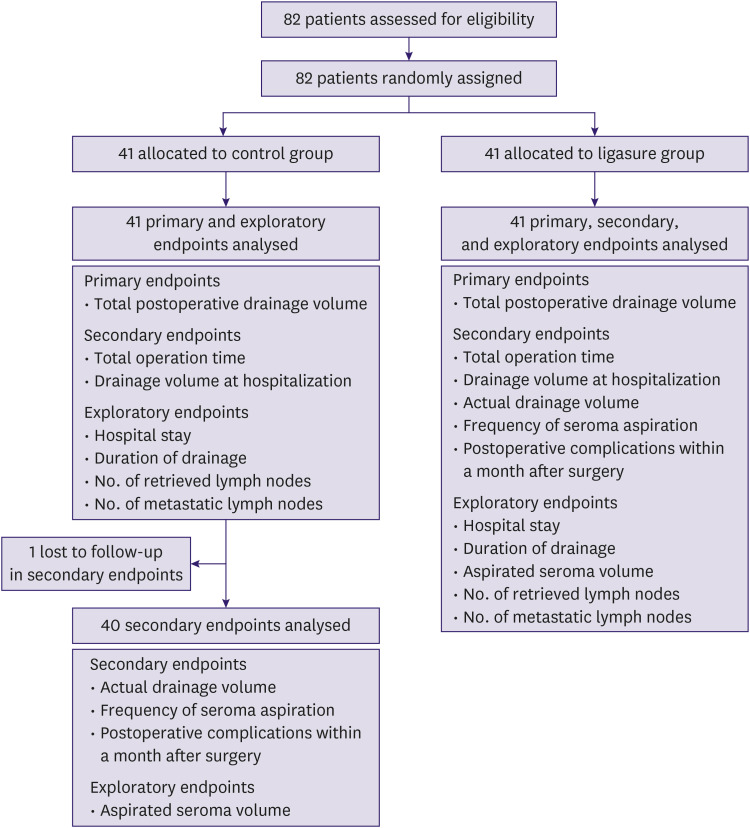
Methods: This prospective randomized clinical trial with a 1:1 ratio compared the use of an electrosurgical bipolar device, LigaSureTM (LGS), against conventional cut-and-ligate techniques in mastectomy with axillary procedures for patients with breast cancer. A total of 82 patients with breast cancer who underwent definitive surgery were enrolled in this study. The primary endpoint was the total drainage volume after surgery.
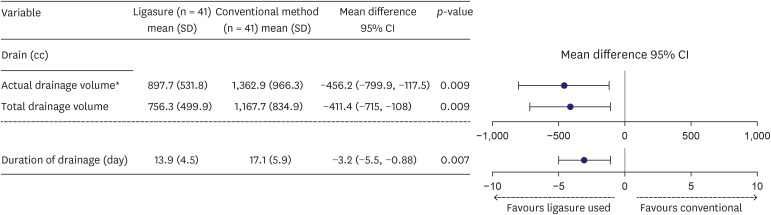
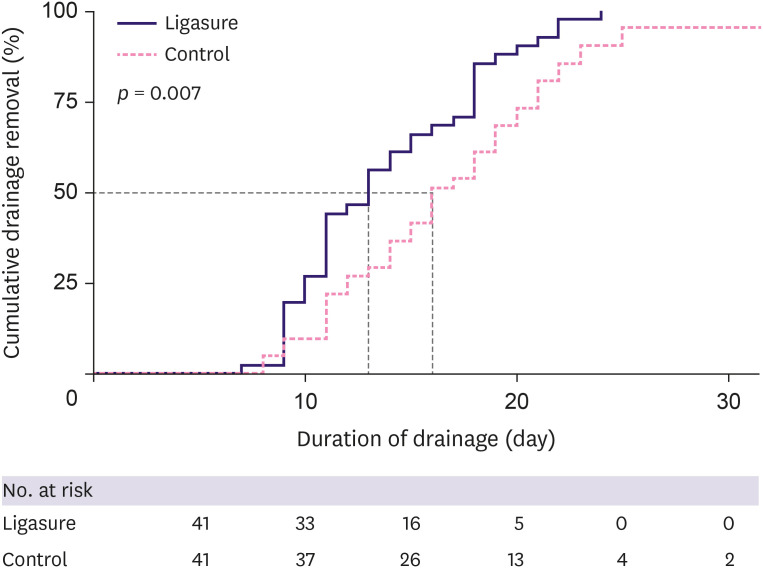
Results: The clinicopathological characteristics of the two groups were not significantly different. The total postoperative drainage volume was significantly lower in the LGS group than in the control group (756.26 mL vs. 1,167.74 mL, p = 0.009). The actual postoperative drainage volume and duration also decreased significantly in the LGS group compared with those in the control group (all p < 0.05). The rate of postoperative complications was lower in the LGS group than in the control group (9.8% vs. 27.5%, p = 0.05).
Conclusion: Electrosurgical bipolar devices showed better performance in terms of decreasing postoperative drainage during mastectomy and axillary staging and/or reconstruction.
Keywords: Breast Neoplasms; Postoperative Complications; Seroma; Surgical Procedures, Operative.
© 2022 Korean Breast Cancer Society.
Conflict of interest statement
This study was supported by Medtronic. The funding source was not involved in the study design, data collection, analyses, and manuscript writing. The funding was distributed: salary, support of authors, study coordinator, resident, fellow, statistician, secretary, or other; laboratory analyses/equipment; devices, medications or materials; and administration duties.
Figures
References
-
- van Bemmel AJ, van de Velde CJ, Schmitz RF, Liefers GJ. Prevention of seroma formation after axillary dissection in breast cancer: a systematic review. Eur J Surg Oncol. 2011;37:829–835. - PubMed
-
- Manouras A, Markogiannakis H, Genetzakis M, Filippakis GM, Lagoudianakis EE, Kafiri G, et al. Modified radical mastectomy with axillary dissection using the electrothermal bipolar vessel sealing system. Arch Surg. 2008;143:575–580. - PubMed
-
- Nespoli L, Antolini L, Stucchi C, Nespoli A, Valsecchi MG, Gianotti L. Axillary lymphadenectomy for breast cancer. A randomized controlled trial comparing a bipolar vessel sealing system to the conventional technique. Breast. 2012;21:739–745. - PubMed
-
- Cortadellas T, Córdoba O, Espinosa-Bravo M, Mendoza-Santin C, Rodríguez-Fernández J, Esgueva A, et al. Electrothermal bipolar vessel sealing system in axillary dissection: a prospective randomized clinical study. Int J Surg. 2011;9:636–640. - PubMed
-
- Lumachi F, Brandes AA, Burelli P, Basso SM, Iacobone M, Ermani M. Seroma prevention following axillary dissection in patients with breast cancer by using ultrasound scissors: a prospective clinical study. Eur J Surg Oncol. 2004;30:526–530. - PubMed
Grants and funding
LinkOut - more resources
Full Text Sources
Medical