


Characterization and correction of diffusion gradient-induced eddy currents in second-order motion-compensated echo-planar and spiral cardiac DTI
- PMID: 35916545
- PMCID: PMC9804234
- DOI: 10.1002/mrm.29378
Characterization and correction of diffusion gradient-induced eddy currents in second-order motion-compensated echo-planar and spiral cardiac DTI
Abstract
Purpose: Very high gradient amplitudes played out over extended time intervals as required for second-order motion-compensated cardiac DTI may violate the assumption of a linear time-invariant gradient system model. The aim of this work was to characterize diffusion gradient-related system nonlinearity and propose a correction approach for echo-planar and spiral spin-echo motion-compensated cardiac DTI.
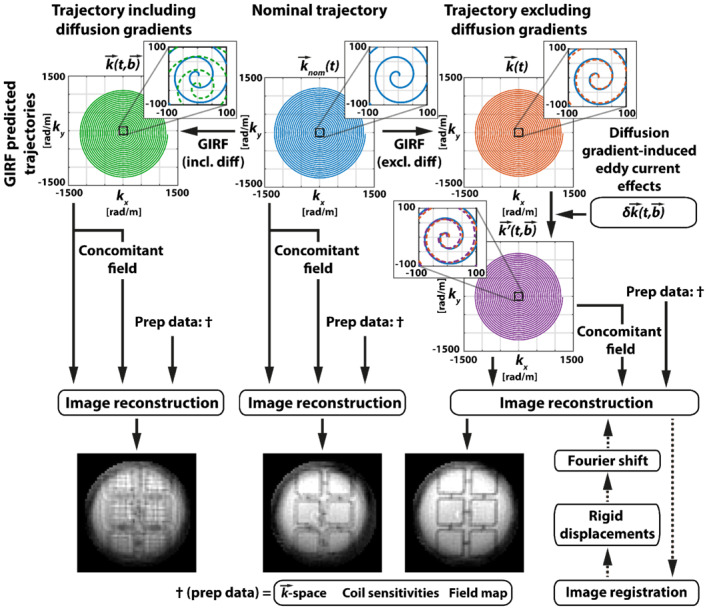
Methods: Diffusion gradient-induced eddy currents of 9 diffusion directions were characterized at b values of 150 s/mm2 and 450 s/mm2 for a 1.5 Tesla system and used to correct phantom, ex vivo, and in vivo motion-compensated cardiac DTI data acquired with echo-planar and spiral trajectories. Predicted trajectories were calculated using gradient impulse response function and diffusion gradient strength- and direction-dependent zeroth- and first-order eddy current responses. A reconstruction method was implemented using the predicted -space trajectories to additionally include off-resonances and concomitant fields. Resulting images were compared to a reference reconstruction omitting diffusion gradient-induced eddy current correction.
Results: Diffusion gradient-induced eddy currents exhibited nonlinear effects when scaling up the gradient amplitude and could not be described by a 3D basis alone. This indicates that a gradient impulse response function does not suffice to describe diffusion gradient-induced eddy currents. Zeroth- and first-order diffusion gradient-induced eddy current effects of up to -1.7 rad and -16 to +12 rad/m, respectively, were identified. Zeroth- and first-order diffusion gradient-induced eddy current correction yielded improved image quality upon image reconstruction.
Conclusion: The proposed approach offers correction of diffusion gradient-induced zeroth- and first-order eddy currents, reducing image distortions to promote improvements of second-order motion-compensated spin-echo cardiac DTI.
Keywords: EPI; GIRF; cardiac DTI; eddy currents; image reconstruction; spiral imaging.
© 2022 The Authors. Magnetic Resonance in Medicine published by Wiley Periodicals LLC on behalf of International Society for Magnetic Resonance in Medicine.
Figures


References
-
- Gotschy A, von Deuster C, Weber L, et al. CMR diffusion tensor imaging provides novel imaging markers of adverse myocardial remodeling in aortic stenosis. JACC Cardiovasc Imaging 2021;14:1472‐1474. - PubMed
Publication types
MeSH terms
LinkOut - more resources
Full Text Sources
