


Dexmedetomidine versus clonidine as an adjuvant to local anaesthetic in brachial plexus blocks: a meta-analysis of randomised controlled trials
- PMID: 35917846
- PMCID: PMC10533961
- DOI: 10.1016/j.bjane.2022.07.005
Dexmedetomidine versus clonidine as an adjuvant to local anaesthetic in brachial plexus blocks: a meta-analysis of randomised controlled trials
Abstract
Objective: This meta-analysis aimed to compare the efficacy and safety of dexmedetomidine and clonidine as an adjuvant to local anesthetics in BPBs.
Methods: Two investigators independently searched databases to identify all RCTs comparing the efficacy and/or safety of dexmedetomidine and clonidine as an adjuvant to local anesthetics in BPBs. All outcomes were pooled using the inverse variance method with a random-effect model. An I2 test was used to assess heterogeneity. The source of heterogeneity was explored through meta-regression. The quality of the evidence was assessed using the GRADE approach.
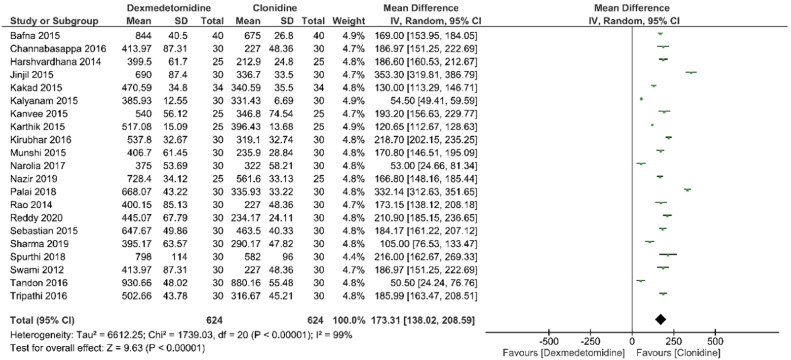
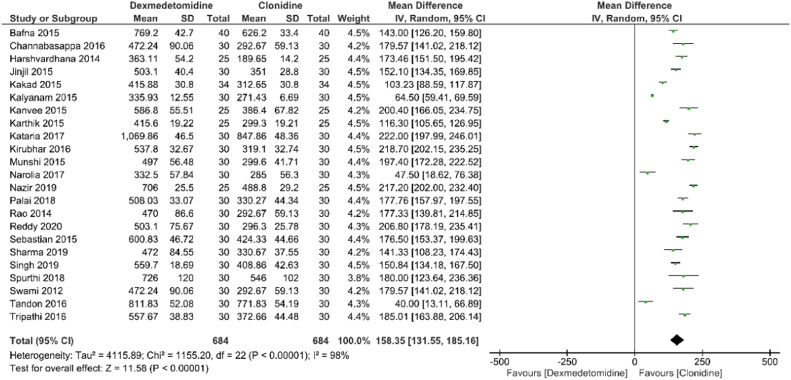
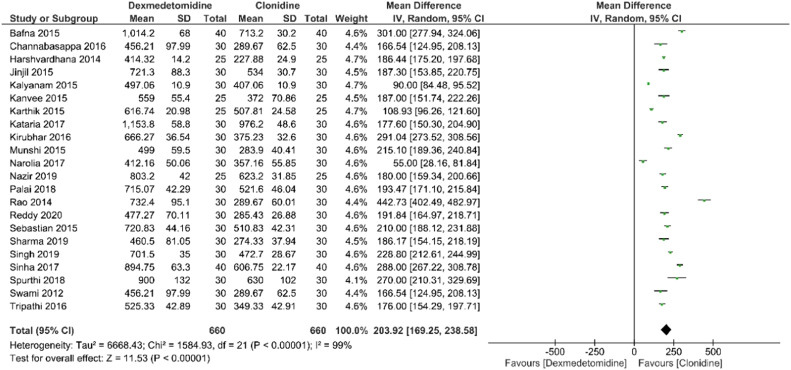
Results: Out of 123 full texts assessed, 24 studies (1448 patients) were included in the analysis. As compared to clonidine, dexmedetomidine groups showed significantly longer sensory block duration (MD = 173.31; 95% CI 138.02‒208.59; I2 = 99%; GRADE approach evidence: high); motor block duration (MD = 158.35; 95% CI 131.55‒185.16; I2 = 98%; GRADE approach evidence: high), duration of analgesia (MD = 203.92; 95% CI 169.25‒238.58; I2 = 99%; GRADE approach evidence- high), and provided higher grade quality of block (RR = 1.97; 95% CI 1.60‒2.41; I2 = 0%; GRADE approach evidence: moderate). The block positioning technique (regression coefficient: 51.45, p = 0.005) was observed as a significant predictor of the heterogeneity in the case of sensory block duration. No significant difference was observed for the risk of hypotension (RR = 2.59; 95% CI 0.63‒10.66; I2 = %).
Conclusion: Moderate to high-quality evidence suggests dexmedetomidine is a more efficacious adjuvant to local anesthetic in BPBs than clonidine.
Keywords: Brachial plexus block; Clonidine; Dexmedetomidine; Meta-analysis.
Copyright © 2022 Sociedade Brasileira de Anestesiologia. Published by Elsevier España S.L.U. All rights reserved.
Conflict of interest statement
Conflicts of interest The authors declare no conflicts of interest.
Figures

References
-
- Fischer HBJ. Churchill Livingstone; London: 2003. Brachial plexus anaesthesia. In principles and practice of regional anaesthesia; pp. 193–204. Wildsmitis JAW, Armitage EN, Mc Clure JH, editors, third edition.
-
- Damien B, Murhy Collin JL, Cartney Vincent WS. Novel analgesic adjuvants for brachial plexus block: A systemic review. Anesth Analg. 2000;90:1122–1128. - PubMed
-
- El-Hennawy AM, Abd-Elwahab AM, Abd-Elmaksoud AM, El-Ozairy HS. Addition of Clonidine or Dexmedetomidine to bupivacaine prolongs caudal analgesia in children. Br J Anaesth. 2009;103:268–274. - PubMed
-
- Popping DM, Elia N, Marret E, Wenk M, Tramèr MR. Clonidine as an adjuvant to local anaesthetic for peripheral nerve and plexus blocks: A meta-analysis of randomized trials. Anesthesiology. 2009;111:406–415. - PubMed
-
- Virtanein R, Savola JM, Saanov Nyman L. Characterization of the selectivity, specificity, and potency of dexmedetomidine as an alpha -2 adrenoceptor. Eur J Pharmacol. 1998;150:194. - PubMed
Publication types
LinkOut - more resources
Full Text Sources
Research Materials
