


Antepartum sleep quality, mental status, and postpartum depressive symptoms: a mediation analysis
- PMID: 35918689
- PMCID: PMC9344627
- DOI: 10.1186/s12888-022-04164-y
Antepartum sleep quality, mental status, and postpartum depressive symptoms: a mediation analysis
Abstract
Background: Poor sleep quality and maternal mood disturbances are common during pregnancy and may play pivotal roles in the development of postpartum depression. We aim to examine the trajectories of sleep quality and mental health in women from early pregnancy to delivery and explore the mediating effects of sleep quality and mental status on the link between antepartum depressive symptoms and postpartum depressive symptoms.
Methods: In an ongoing prospective birth cohort, 1301 women completed questionnaires in the first, second and third trimesters and at 6 weeks postpartum. In each trimester, sleep quality was measured utilizing the Pittsburgh Sleep Quality Index (PSQI), and mental health was assessed with the Center for Epidemiologic Studies Depression Scale (CES-D), the Self-Rating Anxiety Scale (SAS) and the Perceived Stress Scale (PSS). Postpartum depressive symptoms were evaluated by the Edinburgh Postnatal Depression Scale (EPDS). The bootstrap method was used to test the mediation effect.
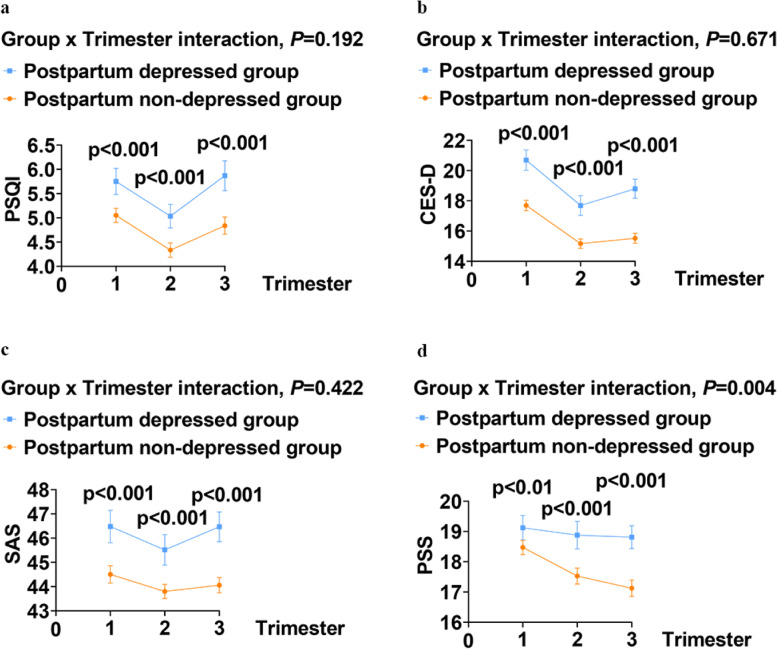
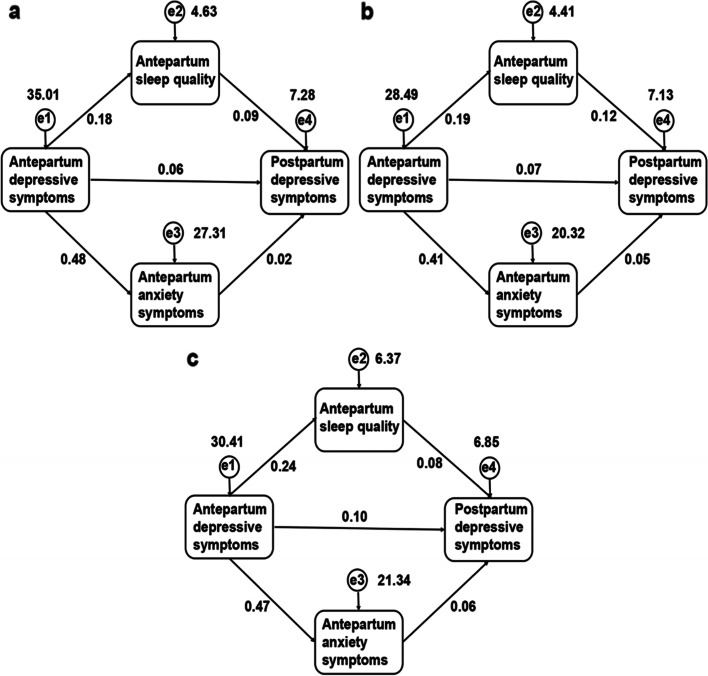
Results: The PSQI, CES-D, and SAS scores presented U-shaped curves across the antenatal period while the PSS score followed a descending trend. Antenatal sleep quality, depressive symptoms, anxiety symptoms and perceived stress all predicted depressive symptoms at 6 weeks postpartum. The influence of antepartum depressive symptoms on postpartum depressive symptoms was mediated by antepartum sleep quality and anxiety symptoms, which accounted for 32.14%, 39.25% and 31.25% in the first, second and third trimesters (P = 0.002, P = 0.001, P = 0.001, respectively).
Conclusions: Poor sleep quality and anxiety symptoms in pregnancy mediated the relationship between antepartum depressive symptoms and postpartum depressive symptoms. Interventions aimed at detecting and managing sleep quality and elevated anxiety among depressed women in pregnancy warrant further investigation as preventative strategies for postpartum depression.
Keywords: Mediating effect; Mental status; Perinatal depressive symptoms; Sleep quality.
© 2022. The Author(s).
Conflict of interest statement
The authors have no competing interests to declare.
Figures
Similar articles
-
Poor sleep quality increases symptoms of depression and anxiety in postpartum women.J Behav Med. 2018 Oct;41(5):703-710. doi: 10.1007/s10865-018-9950-7. Epub 2018 Jul 20. J Behav Med. 2018. PMID: 30030650 Free PMC article.
-
Association of sleep quality during pregnancy with stress and depression: a prospective birth cohort study in China.BMC Pregnancy Childbirth. 2019 Nov 27;19(1):444. doi: 10.1186/s12884-019-2583-1. BMC Pregnancy Childbirth. 2019. PMID: 31775666 Free PMC article.
-
Associations between poor subjective prenatal sleep quality and postnatal depression and anxiety symptoms.J Affect Disord. 2016 Sep 15;202:91-4. doi: 10.1016/j.jad.2016.05.028. Epub 2016 May 25. J Affect Disord. 2016. PMID: 27259080
-
A scoping review of non-pharmacological perinatal interventions impacting maternal sleep and maternal mental health.BMC Pregnancy Childbirth. 2022 Aug 23;22(1):659. doi: 10.1186/s12884-022-04844-3. BMC Pregnancy Childbirth. 2022. PMID: 35999501 Free PMC article.
-
Mental vulnerability before and depressive symptoms during pregnancy and postpartum: a prospective population-based cohort study from general practice.Nord J Psychiatry. 2022 May;76(4):243-249. doi: 10.1080/08039488.2021.1953583. Epub 2021 Aug 6. Nord J Psychiatry. 2022. PMID: 34355638 Review.
Cited by
-
Effects of psychosocial factors on postpartum depression: a half-longitudinal mediation analysis of cognitive reactivity.BMC Pregnancy Childbirth. 2025 Mar 15;25(1):296. doi: 10.1186/s12884-025-07364-y. BMC Pregnancy Childbirth. 2025. PMID: 40089721 Free PMC article.
-
Domestic Violence Experience, Past Depressive Disorder, Unplanned Pregnancy, and Suicide Risk in the First Year Postpartum: Mediating Effect of Postpartum Depression.Psychiatry Investig. 2024 Oct;21(10):1129-1136. doi: 10.30773/pi.2024.0105. Epub 2024 Oct 17. Psychiatry Investig. 2024. PMID: 39465239 Free PMC article.
-
Relationship between postpartum psychological disorders and emotion regulation strategies: A cross-sectional study.Medicine (Baltimore). 2024 May 31;103(22):e38294. doi: 10.1097/MD.0000000000038294. Medicine (Baltimore). 2024. PMID: 39259092 Free PMC article.
-
Evaluation of depression at 6 and 12 months postpartum by examining depressive symptoms and self-harm ideation during the early postpartum period: Tohoku Medical Megabank Project Birth and Three-Generation Cohort Study.PCN Rep. 2024 Nov 4;3(4):e70025. doi: 10.1002/pcn5.70025. eCollection 2024 Dec. PCN Rep. 2024. PMID: 39497795 Free PMC article.
-
Prevalence and Factors Associated With Antepartum Depression Among Pregnant Women in Latent Labor: A Multi-Facility Cross-Sectional Study in Rural Southwestern Uganda.Int J Womens Health. 2025 Mar 25;17:903-912. doi: 10.2147/IJWH.S508301. eCollection 2025. Int J Womens Health. 2025. PMID: 40162046 Free PMC article.
References
Publication types
MeSH terms
LinkOut - more resources
Full Text Sources
Medical
