Review
. 2022 Sep 7;30(9):2891-2908.
doi: 10.1016/j.ymthe.2022.07.016. Epub 2022 Aug 2.

Macrophages as a therapeutic target to promote diabetic wound healing

Affiliations
Review

Macrophages as a therapeutic target to promote diabetic wound healing

Maryam Sharifiaghdam et al. Mol Ther. .

Abstract

It is well‏ ‏established that macrophages are key regulators of wound healing, displaying impressive plasticity and an evolving phenotype, from an aggressive pro-inflammatory or "M1" phenotype to a pro-healing or "M2" phenotype, depending on the wound healing stage, to ensure proper healing. Because dysregulated macrophage responses have been linked to impaired healing of diabetic wounds, macrophages are being considered as a therapeutic target for improved wound healing. In this review, we first discuss the role of macrophages in a normal skin wound healing process and discuss the aberrations that occur in macrophages under diabetic conditions. Next we provide an overview of recent macrophage-based therapeutic approaches, including delivery of ex-vivo-activated macrophages and delivery of pharmacological strategies aimed at eliminating or re-educating local skin macrophages. In particular, we focus on strategies to silence key regulator genes to repolarize wound macrophages to the M2 phenotype, and we provide a discussion of their potential future clinical translation.

Keywords: IRF5; M1; M2; drug delivery; inflammation; macrophage; siRNA; wound healing.


Conflict of interest statement

Declaration of interests The authors declare no competing interests.

Figures
None
Graphical abstract
Figure 1
Figure 1
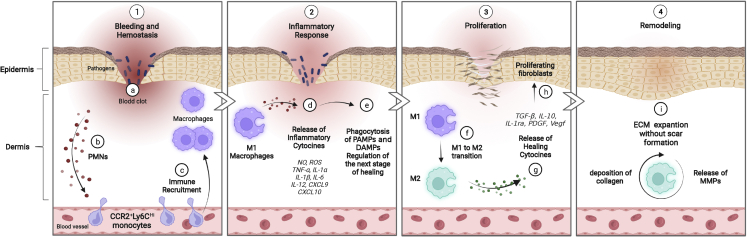
The role of macrophage cells in wound healing processes (1) a–c: hemostasis phase. An initial influx of polymorphonuclear leukocytes (PMNs) in the blood clot is followed by successive waves of infiltrating monocytes that differentiate into macrophages in the wound. Infiltration of immune cells characterizes the beginning of the inflammatory phase. (2) d and e: during this phase, the differentiated M1 macrophages clear pathogens and cell debris, like pathogen-associated modifying proteins (PAMPs) and damage-associated modifying proteins (DAMPs), and release nitric oxide (NO), reactive oxygen species (ROS), and pro-inflammatory cytokines, such as tumor necrosis factor alpha (TNF-α), interleukin-1α (IL-1α, IL-1β, IL-6, IL-12, CXCL9, and CXCL10, to prepare the wound bed for the next stage. (3) f–h: during the proliferation phase, the macrophage phenotype changes from an inflammatory to a healing state, releasing healing cytokines, such as transforming growth factor β (TGF-β), IL-10, IL-1 receptor antagonist (IL-1ra), platelet-derived growth factor (PDGF), epidermal growth factor (EGF), and vascular endothelial growth factor (Vegf). Proliferation, differentiation, and migration of keratinocytes, fibroblasts, and endothelial cells also take place. (4) i: the remodeling phase is the last stage of wound healing, in which macrophages still play a key role by releasing matrix metalloproteinases (MMPs) to the deposited ECM to restore tissue strength with minimal scar formation. Created with BioRender.
Figure 2
Figure 2
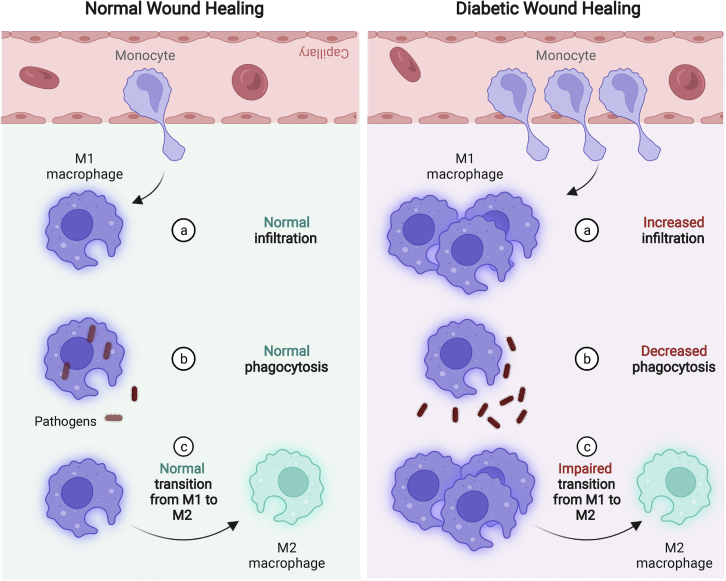
Macrophage dysregulation in diabetic wounds leads to delayed wound healing Compared with normal wounds, increased numbers of infiltrated BM-produced monocytes are present in diabetic wounds, which, in turn, leads to a higher number of macrophages (a). The capability of M1 macrophages to phagocytose pathogens is decreased in diabetic wounds (b). Macrophage transition from M1- to M2-like phenotypes is impaired in diabetic wounds, leading to an accumulation of inflammatory M1 macrophages (c). M1, macrophage with a pro-inflammatory phenotype; M2, macrophage with a pro-healing phenotype. Created with BioRender.
Figure 3
Figure 3
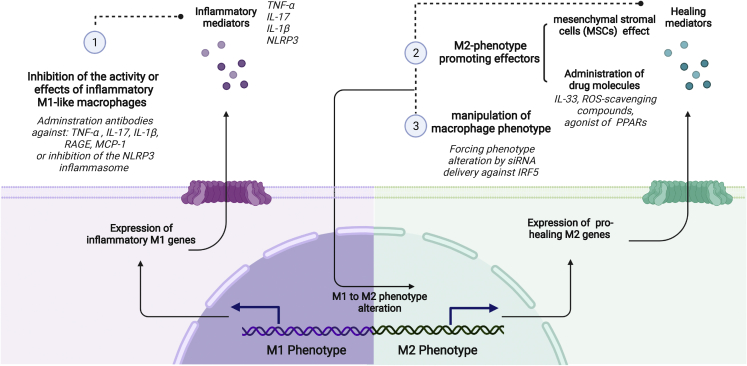
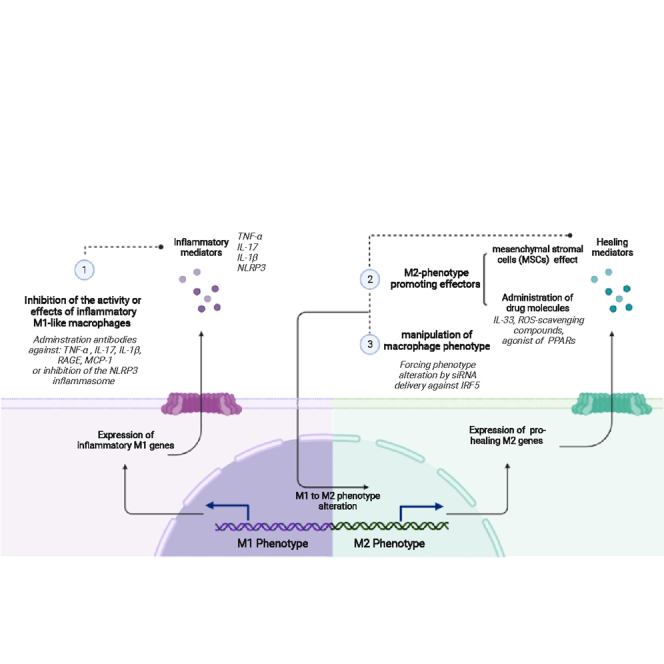
Pharmacological approaches to influence macrophage phenotype or activity (1) Inhibition of the activity or effects of inflammatory M1-like macrophages can be achieved by administration of therapeutic antibodies that inhibit effects of inflammatory mediators like TNF-α, IL-1β, IL-17, advanced glycosylation end products (AGEs), and the monocyte chemoattractant protein 1 (MCP-1) or Nod-like receptor protein 3 (NLRP3) inflammasome. (2) M2 phenotype-promoting strategies include use of mesenchymal stromal cells (MSCs) to induce anti-inflammatory M2 like characteristics in macrophages or administration of drugs like IL-33, ROS-scavenging compounds, and agonist of peroxisome proliferator-activated receptors (PPARs) to promote the M2 phenotype. (3) Manipulation of macrophage phenotype can be achieved by delivery of siRNA against interferon regulatory factor 5 (IRF5), which enforces phenotype alteration. Created with BioRender.
Figure 4
Figure 4
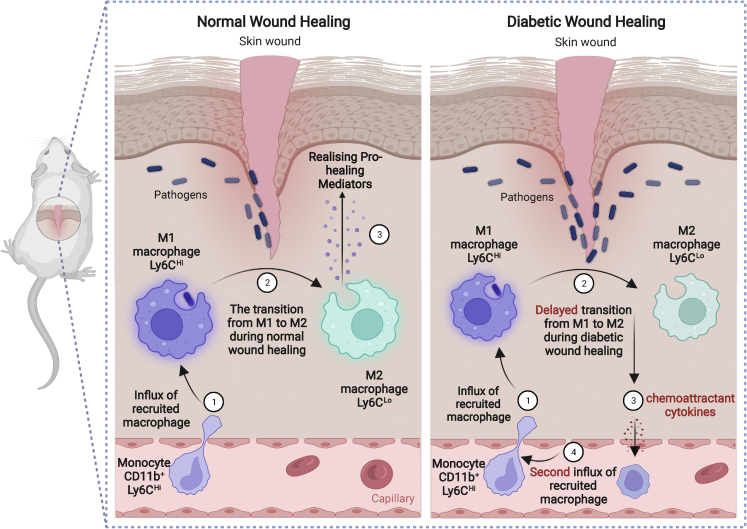
The influx of CD11b+Ly6CHi monocytes/macrophages during wound healing under normal and diabetic conditions During normal wound healing, monocyte-derived Ly6CHi macrophages are present within 48 h of injury and rapidly transition to Ly6CLo macrophages, releasing pro-healing mediators at the wound site. In diabetic wounds, transition of Ly6CHi to Ly6CLo macrophages is delayed, leading to a second influx of Ly6CHi monocyte/macrophages during the reparative phase. Created with BioRender.
Figure 5
Figure 5
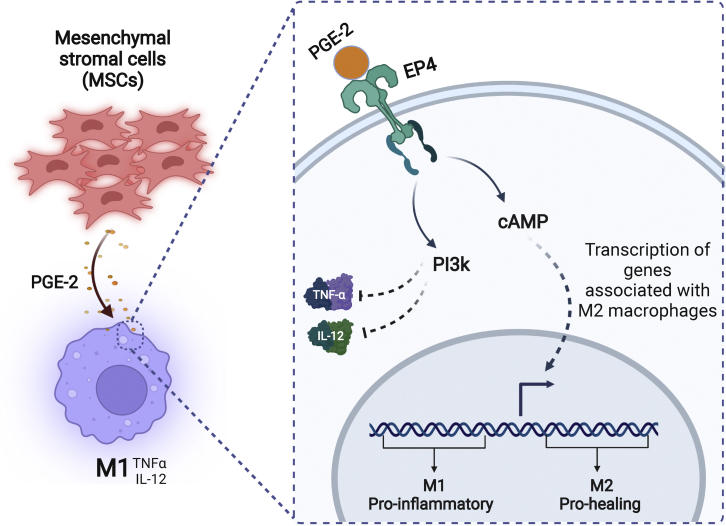
MSC-educated M2 macrophages Prostaglandin E-2 (PGE-2), secreted from MSCs, can bind to EP4 receptors on M1 macrophages at the wound site and repolarize them to pro-healing M2 macrophages via two independent pathways: (1) the phosphatidylinositol 3-kinase (PI3K) pathway, which inhibits TNF-α and IL-12, and (2) the cyclic adenosine monophosphate (cAMP) pathway, which leads to activation of transcription of genes associated with the M2 macrophage phenotype. Created with BioRender.
Figure 6
Figure 6
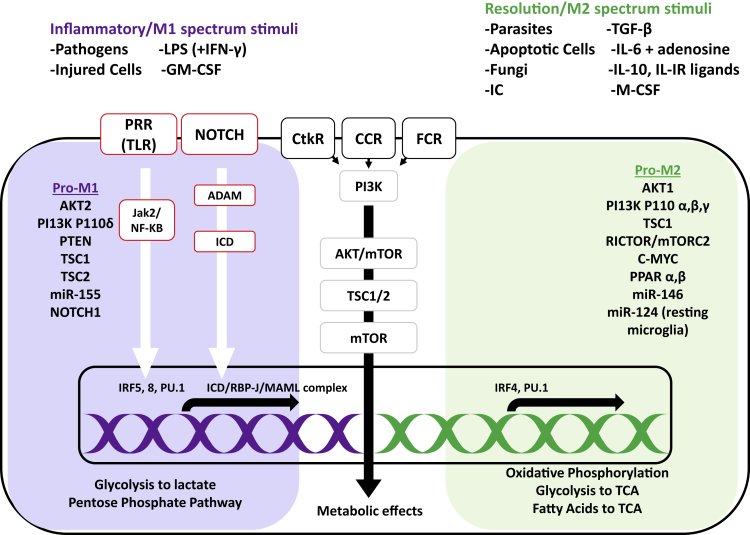
Key stimuli and molecular pathways in macrophages with the inflammatory (M1) versus healing phenotype (M2) The M1 phenotype is activated by signals from pathogens, injured cells, and in vitro stimuli, and the M2 phenotype is activated by parasites, fungi, apoptotic cells, immune complexes, and other cytokine/growth factor stimuli. Signals that are sensed via pathogen-recognition receptors (PRRs), such as Toll-like receptors (TLRs), result in Janus-activated kinase (Jak) 2 and nuclear factor κB (NF-κB) activation. Signals received via Notch receptors, cytokine receptor (CtkR), chemokine receptor (CCR), and Fc receptor (FcR) stimulation also define gene expression and downstream metabolic reprogramming. IRF5 and IRF8 induce inflammatory M1 gene expression, whereas IRF 4 promotes M2 phenotype genes that, in turn, promote changes in nutrient uptake and metabolic pathways, depending on which part of the gene is expressed. LPS, lipopolysaccharide; GM-CSF, granulocyte monocyte colony-stimulating factor; IC, immune complex; M-CSF, monocyte colony-stimulating factor; PI3K, phosphatidylinositol 3-kinase; AKT, serine threonine kinase; mTOR, mammalian target of rapamycin; PTEN, phosphatase and tensin homolog; TSC, tuberous sclerosis complex; PPAR, peroxisome proliferator-activated receptor; ADAM, a disintegrin and metalloproteinase; RBP-J, recombination signal binding protein for immunoglobulin κJ region; MAML, mastermind-like; Rictor, rapamycin-insensitive companion of mTOR; TCA, tricarboxylic acid/Krebs cycle. Adapted from Amici et al.
Figure 7
Figure 7
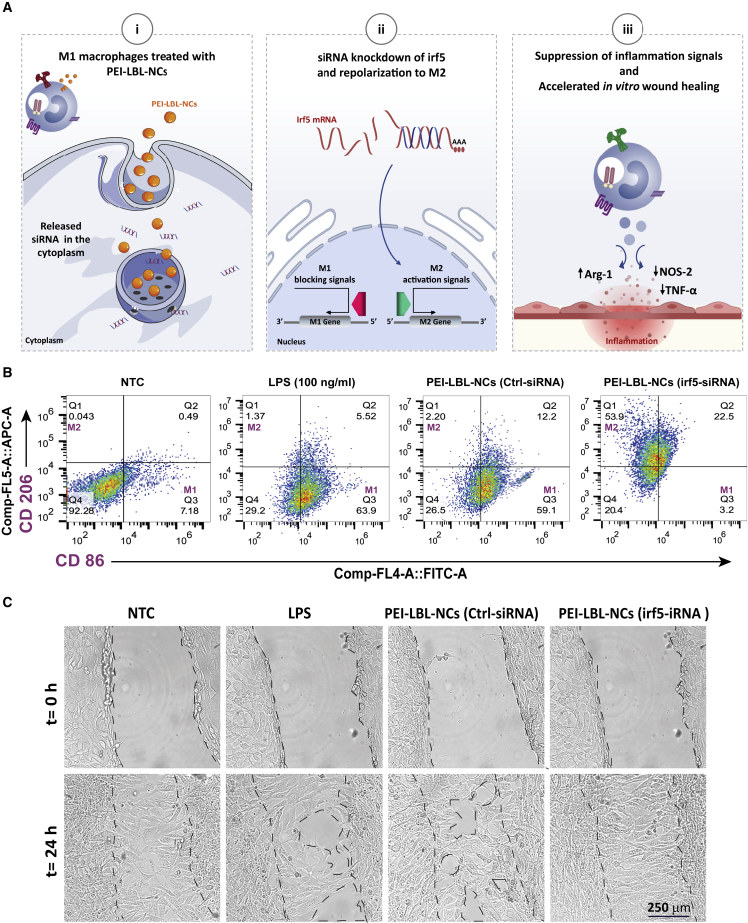
Enforced M1-to-M2 macrophage repolarization using siIRF5-loaded polyethyleneimine (PEI) layer-by-layer (LBL) nanocomplexes (NCs) (A) i: M1 macrophage treated by IRF5 siRNA loaded in PEI LBL (NCs. ii: reprogramming into a pro-healing phenotype by successful release of IRF5 siRNA in the cytoplasm. iii: macrophage phenotype change from the M1 to the M2 phenotype leads to faster wound healing in an in vitro scratch assay. (B) Representative flow cytometry results showing the CD206+ (M2 marker) and CD86+ (M1 marker) populations in LPS-activated RAW 264.7 cells after treatment with PEI LBL NCs loaded with IFR5 siRNA or Ctrl (control) siRNA. (C) For the in vitro wound healing assay, the proliferation of NIH-3T3 fibroblasts was monitored by transmission microscopy after treatment with conditioned cell culture medium (C-CCM) containing secreted factors from macrophage cells (RAW 264.7) stimulated with LPS and treated with PEI LBL NCs loaded with IRF5-siRNA or Ctrl siRNA. Transmission microscopy images show NIH 3T3cells before (0 h) and 24 h after treatment with C-CCM from LPS-stimulated RAW 264.7 cells and LPS-stimulated RAW 264.7 cells treated with PEI LBL NCs loaded with IRF5 siRNA or Ctrl siRNA, NTC, non-treated control. Adapted from Sharifiaghdam et al.‏‏

References

    1. Proksch E., Brandner J.M., Jensen J.M. The skin: an indispensable barrier. Exp. Dermatol. 2008;17:1063–1072. - PubMed
    1. Nguyen A.V., Soulika A.M. The dynamics of the skin’s immune system. Int. J. Mol. Sci. 2019;20:1811. - PMC - PubMed
    1. Rodero M.P., Khosrotehrani K. Skin wound healing modulation by macrophages. Int. J. Clin. Exp. Pathol. 2010;3:643–653. - PMC - PubMed
    1. Diegelmann R.F., Evans M.C. Wound healing: an overview of acute, fibrotic and delayed healing. Front. Biosci. 2004;9:283–289. - PubMed
    1. Gurtner G.C., Werner S., Barrandon Y., Longaker M.T. Wound repair and regeneration. Nature. 2008;453:314–321. - PubMed

Publication types

LinkOut - more resources