. 2023 Feb;19(2):578-588.
doi: 10.1002/alz.12734. Epub 2022 Aug 3.

Cumulative loneliness and subsequent memory function and rate of decline among adults aged ≥50 in the United States, 1996 to 2016

Affiliations

Cumulative loneliness and subsequent memory function and rate of decline among adults aged ≥50 in the United States, 1996 to 2016

Xuexin Yu et al. Alzheimers Dement. 2023 Feb.

Abstract

Introduction: The study objective was to investigate the association between loneliness duration and memory function over a 20-year period.

Methods: Data were from 9032 adults aged ≥50 in the Health and Retirement Study. Loneliness status (yes vs. no) was assessed biennially from 1996 to 2004 and its duration was categorized as never, 1 time point, 2 time points, and ≥3 time points. Episodic memory was assessed from 2004 to 2016 as a composite of immediate and delayed recall trials combined with proxy-reported memory. Mixed-effects linear regression models were fitted.

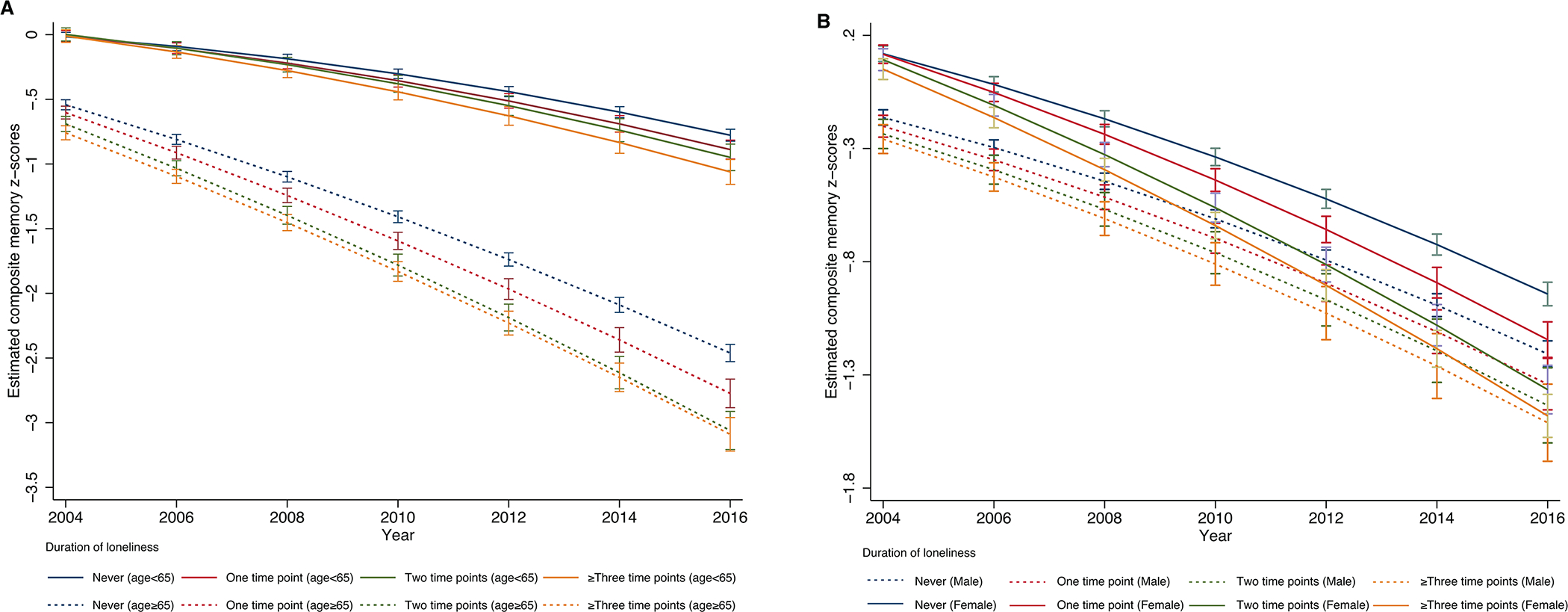
Results: A longer duration of loneliness was associated with lower memory scores (P < 0.001) and a faster rate of decline (P < 0.001). The association was stronger among adults aged ≥65 than those aged <65 (three-way interaction P = 0.013) and was stronger among women than men (three-way interaction P = 0.002).

Discussion: Cumulative loneliness may be a salient risk factor for accelerated memory aging, especially among women aged ≥65.

Highlight: A longer duration of loneliness was associated with accelerated memory aging. The association was stronger among women than men and among older adults than the younger. Reducing loneliness in mid- to late life may help maintain memory function.

Keywords: United States; loneliness trajectories; memory aging; middle aged; older adults.


Conflict of interest statement

Conflict of Interest:

None.

Figures
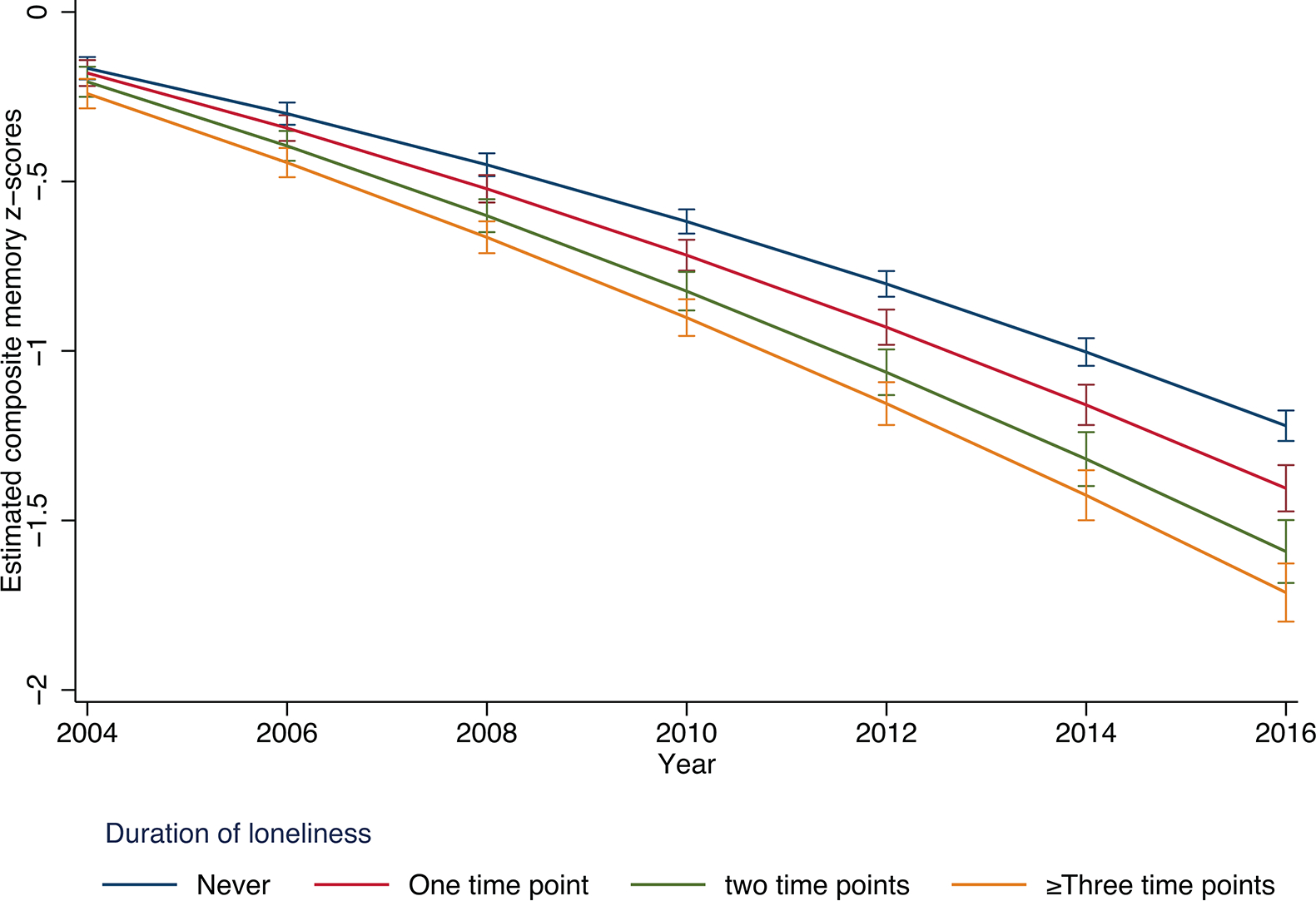
Figure 1
Figure 1. Predicted composite memory z-scores from 2004–2016 by duration of loneliness, the US Health and Retirement Study
Note: Composite memory z-scores (SD units) are predicted by estimates in Model 3 in Table 2. Covariates in Model 3 were set to the following values: age 63 years, male, partnered, white, less than high school, 2nd quintile of household wealth, objective social isolation index=1, CES-D score=1, and ADL score=1.
Figure 2
Figure 2. Predicted composite memory z-scores from 2004–2016 by duration of loneliness, sex and age, the US Health and Retirement Study
Note: Panel A: Predicted composite memory z-scores (SD units) from 2004–2016 by duration of loneliness and baseline age. Composite memory z-scores are predicted using estimates from the fully adjusted pooled model with a three-way interaction term between duration of loneliness, year, and baseline age (50–64 vs. ≥65) in Table 3. Covariates were set to the following values: baseline age (60 for the age<65 group; 70 for the age ≥65 group), male, partnered, white, less than high school, 2nd quintile household wealth, objective social isolation index=1, CES-D score=1, and ADL score=1. Panel B: Predicted composite memory z-scores (SD units) from 2004–2016 by duration of loneliness and sex. Composite memory z-scores are predicted using estimates from the fully adjusted pooled model with a three-way interaction term between duration of loneliness, year, and sex in Table 4. Covariates were set to the following values: age 63 years, partnered, white, less than high school, 2nd quintile household wealth, objective social isolation index=1, CES-D score=1, and ADL score=1.

References

    1. Evans IEM, Llewellyn DJ, Matthews FE, et al. Living alone and cognitive function in later life. Arch Gerontol Geriatr. 2019;81:222–233. doi: 10.1016/j.archger.2018.12.014 - DOI - PubMed
    1. Wilson RS, Krueger KR, Arnold SE, et al. Loneliness and risk of Alzheimer disease. Arch Gen Psychiatry. 2007;64(2):234–240. doi: 10.1001/archpsyc.64.2.234 - DOI - PubMed
    1. Rafnsson SB, Orrell M, d’Orsi E, Hogervorst E, Steptoe A. Loneliness, social integration, and incident dementia over 6 years: prospective findings from the English Longitudinal Study of Ageing. J Gerontol B Psychol Sci Sco Sci. 2017;75(1):114–124. doi: 10.1093/geronb/gbx087 - DOI - PMC - PubMed
    1. Shankar A, Hamer M, McMunn A, Steptoe A. Social isolation and loneliness: relationships with cognitive function during 4 years of follow-up in the English longitudinal study of ageing. Psychosom Med. 2013;75(2):161–170. doi: 10.1097/PSY.0b013e31827f09cd - DOI - PubMed
    1. Holwerda TJ, Deeg DJ, Beekman AT, et al. Feelings of loneliness, but not social isolation, predict dementia onset: results from the Amsterdam Study of the Elderly (AMSTEL). J Neurol Neurosurg Psychiatry. 2014;85(2):135–42. doi: 10.1136/jnnp-2012-302755 - DOI - PubMed

Publication types