


Associations between airborne crude oil chemicals and symptom-based asthma
- PMID: 35921771
- PMCID: PMC9378681
- DOI: 10.1016/j.envint.2022.107433
Associations between airborne crude oil chemicals and symptom-based asthma
Abstract
Rationale: The 2010 Deepwater Horizon (DWH) oil spill response and cleanup (OSRC) workers were exposed to airborne total hydrocarbons (THC), benzene, toluene, ethylbenzene, o-, m-, and p-xylenes and n-hexane (BTEX-H) from crude oil and PM2.5 from burning/flaring oil and natural gas. Little is known about asthma risk among oil spill cleanup workers.
Objectives: We assessed the relationship between asthma and several oil spill-related exposures including job classes, THC, individual BTEX-H chemicals, the BTEX-H mixture, and PM2.5 using data from the Gulf Long-Term Follow-up (GuLF) Study, a prospective cohort of 24,937 cleanup workers and 7,671 nonworkers following the DWH disaster.
Methods: Our analysis largely focused on the 19,018 workers without asthma before the spill who had complete exposure, outcome, and covariate information. We defined incident asthma 1-3 years following exposure using both self-reported wheeze and self-reported physician diagnosis of asthma. THC and BTEX-H were assigned to participants based on measurement data and work histories, while PM2.5 used modeled estimates. We used modified Poisson regression to estimate risk ratios (RR) and 95% confidence intervals (CIs) for associations between spill-related exposures and asthma and a quantile-based g-computation approach to explore the joint effect of the BTEX-H mixture on asthma risk.
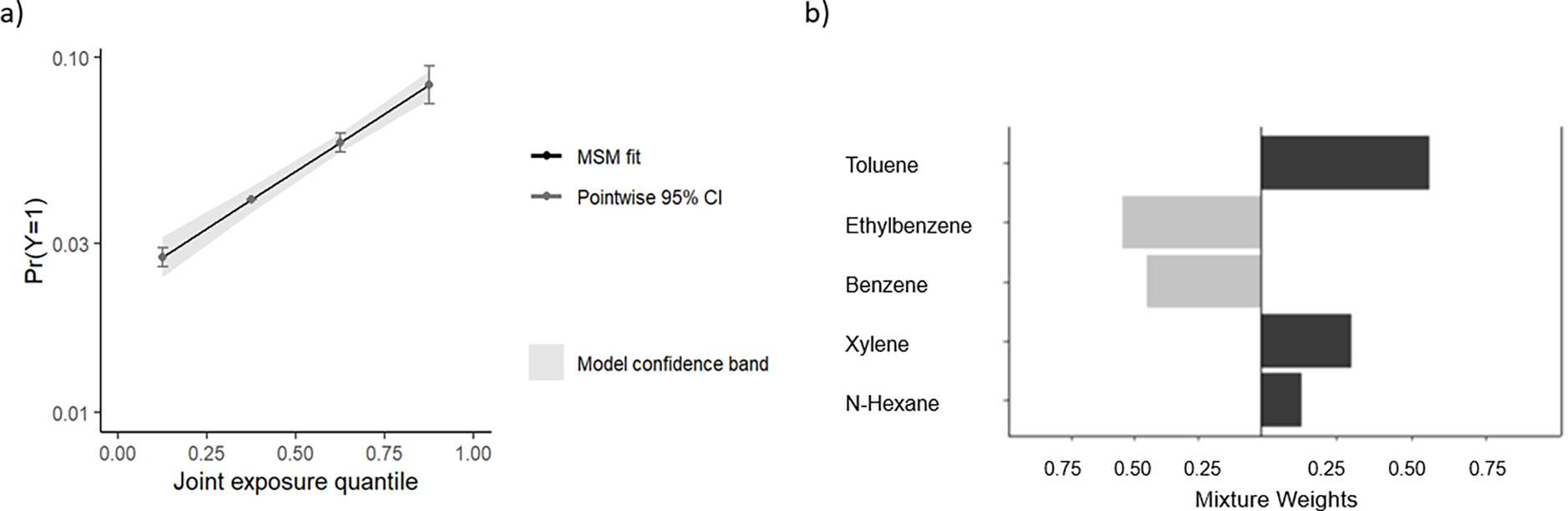
Results: OSRC workers had greater asthma risk than nonworkers (RR: 1.60, 95% CI: 1.38, 1.85). Higher estimated THC exposure levels were associated with increased risk in an exposure-dependent manner (linear trend test p < 0.0001). Asthma risk also increased with increasing exposure to individual BTEX-H chemicals and the chemical mixture: A simultaneous quartile increase in the BTEX-H mixture was associated with an increased asthma risk of 1.45 (95% CI: 1.35,1.55). With fewer cases, associations were less apparent for physician-diagnosed asthma alone.
Conclusions: THC and BTEX-H were associated with increased asthma risk defined using wheeze symptoms as well as a physician diagnosis.
Keywords: Asthma; BTEX-H; Mixtures; Oil spills; Total hydrocarbons; Volatile organic compounds.
Published by Elsevier Ltd.
Conflict of interest statement
Conflict of Interest
All authors report no conflicts of interest.
Figures
References
-
- Aguilera F, Méndez J, Pásaro E, Laffon B. Review on the effects of exposure to spilled oils on human health. Journal of Applied Toxicology. 2010;30(4):291–301. - PubMed
-
- Health) NNIfOSa. NIOSH method 1501 (hydrocarbons, aromatic) NIOSH manual of analytical methods. 4th edition. 1994. [Available from: https://www.cdc.gov/niosh/docs/2003-154/pdfs/1501.pdf.
-
- Health) NNIfOSa. NIOSH method 1500 (hydrocarbons, BP 36°– 216°C). NIOSH manual of analytical methods. 4th edition. 1994.
-
- Health) NNIfOSa. NIOSH method 1550 (naphtha’s). NIOSH manual of analytical methods. 4th edition. 1994.
-
- Wallace L, Pellizzari E, Hartwell TD, Perritt R, Ziegenfus R. Exposures to benzene and other volatile compounds from active and passive smoking. Archives of Environmental Health: An International Journal. 1987;42(5):272–9. - PubMed
