. 2022 Sep 14;30(9):1231-1241.e6.
doi: 10.1016/j.chom.2022.07.002. Epub 2022 Jul 7.

SARS-CoV-2 Omicron sublineages exhibit distinct antibody escape patterns

Affiliations

SARS-CoV-2 Omicron sublineages exhibit distinct antibody escape patterns

Henning Gruell et al. Cell Host Microbe. .

Abstract

SARS-CoV-2 neutralizing antibodies play a critical role in COVID-19 prevention and treatment but are challenged by viral evolution and the emergence of novel escape variants. Importantly, the recently identified Omicron sublineages BA.2.12.1 and BA.4/5 are rapidly becoming predominant in various countries. By determining polyclonal serum activity of 50 convalescent or vaccinated individuals against BA.1, BA.1.1, BA.2, BA.2.12.1, and BA.4/5, we reveal a further reduction in BA.4/5 susceptibility to vaccinee sera. Most notably, delineation of sensitivity to an extended 163-antibody panel demonstrates pronounced antigenic differences with distinct escape patterns among Omicron sublineages. Antigenic distance and/or higher resistance may therefore favor immune-escape-mediated BA.4/5 expansion after the first Omicron wave. Finally, while most clinical-stage monoclonal antibodies are inactive against Omicron sublineages, we identify promising antibodies with high pan-SARS-CoV-2 neutralizing potency. Our study provides a detailed understanding of Omicron-sublineage antibody escape that can inform on effective strategies against COVID-19.

Keywords: BA.2.12.1; BA.4; BA.5; COVID-19; Omicron; SARS-CoV-2; immune escape; neutralizing antibodies; resistance; sublineages.


Conflict of interest statement

Declaration of interests H.G., K.V., M.Z., C.K., and F. Klein are listed as inventors on patent applications on SARS-CoV-2 neutralizing antibodies filed by the University of Cologne that encompass aspects of this work.

Figures
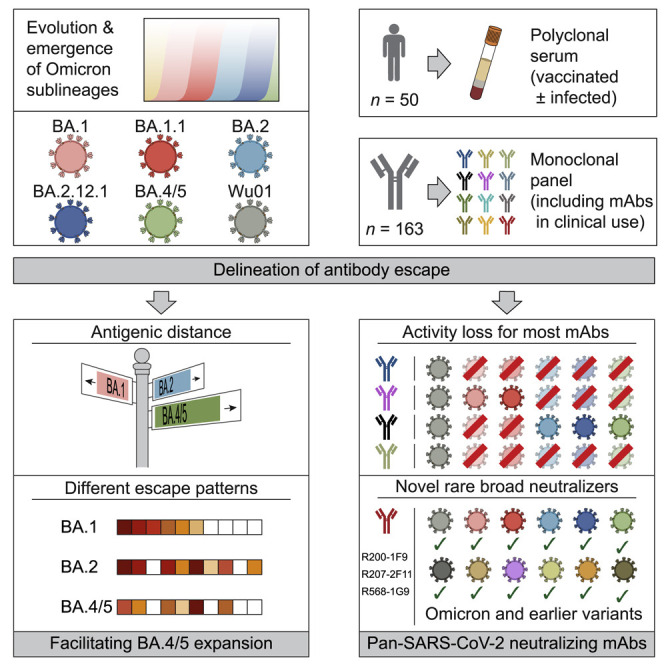
None
Graphical abstract
Figure 1
Figure 1
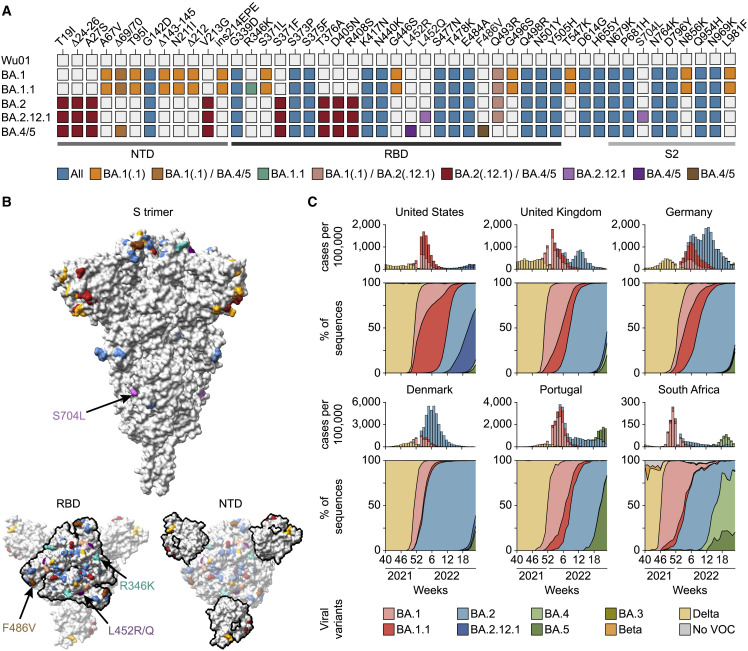
Omicron sublineage differences (A) Spike amino acid changes in Omicron sublineages relative to Wu01. (B) Locations of Omicron-sublineage amino acid changes on the SARS-CoV-2 spike (PDB: 6XR8) with colors as in (A), and RBD and NTD outlined in the bottom models. Residues with mutations exclusive to individual sublineages are indicated by arrows. (C) Top panels indicate weekly reported SARS-CoV-2 infections as aggregated by the Johns Hopkins University CSSE COVID-19 data repository and Our World in Data, with variant proportions extrapolated from weekly GISAID SARS-CoV-2 database variant sequences (accessed on June 20, 2022) shown in bottom panels. NTD, N-terminal domain; RBD, receptor-binding domain; PDB, Protein Data Bank.
Figure 2
Figure 2
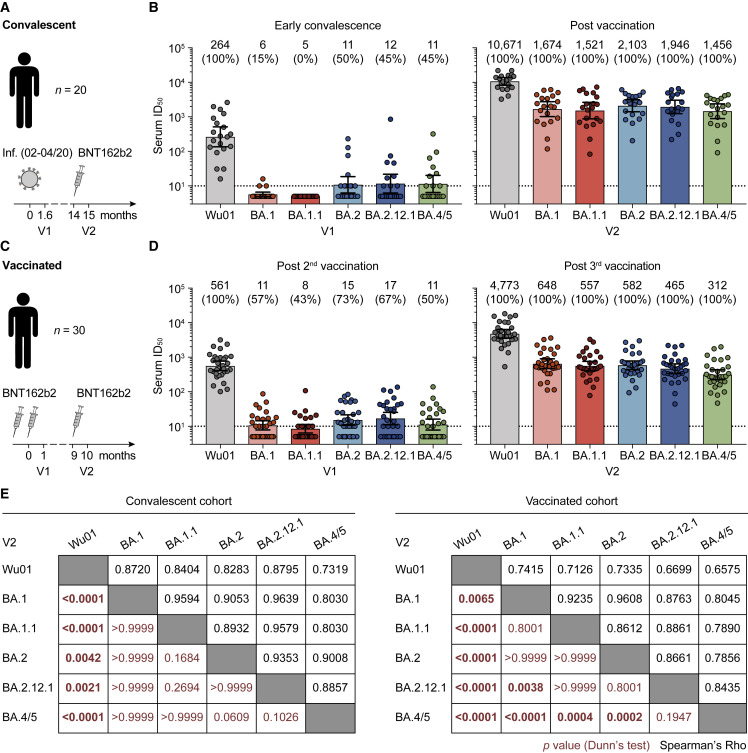
Omicron-sublineage-neutralizing serum activity in vaccinated and convalescent individuals (A) Study scheme in COVID-19-convalescent individuals infected between February and April 2020. (B) Pseudovirus neutralization assay 50% inhibitory serum dilutions (ID50s) in convalescent individuals. Bars indicate geometric mean ID50s (GeoMeanID50s) with 95% confidence intervals (CIs). Numbers indicate GeoMeanID50s and fraction of individuals with detectable neutralizing activity (ID50 > 10; in parentheses). (C) Study scheme in vaccinated individuals. (D) Pseudovirus neutralization assay serum ID50s in vaccinated individuals. Bars indicate GeoMeanID50s with 95% CIs. Numbers indicate GeoMeanID50s and fraction of individuals with detectable neutralizing activity (ID50 > 10; in parentheses). (E) Black numbers indicate Spearman’s rank correlation coefficients (rho) at V2. Red numbers indicate p values determined after the Friedman test by Dunn’s multiple comparison tests at V2 (statistically significant differences with p < 0.05 in bold). In (B) and (D), ID50s below the lower limit of quantification (LLOQ, ID50 = 10; indicated by black dotted lines) were imputed to ½ × LLOQ (ID50 = 5), and ID50s above the upper limit of quantification (21,870) were imputed to 21,871. See also Figure S1 and Table S1.
Figure 3
Figure 3
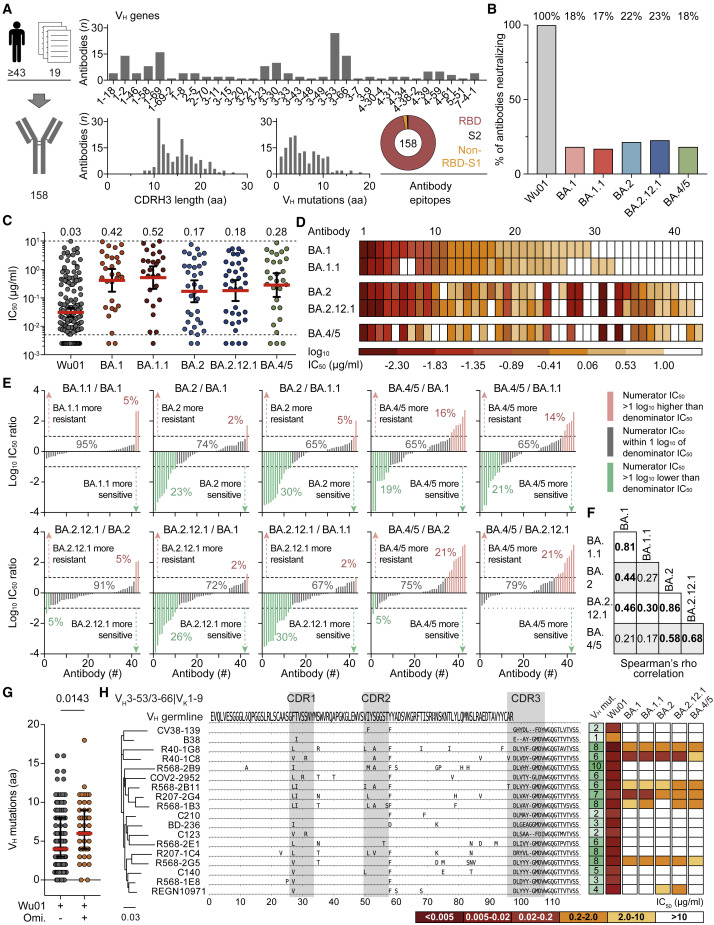
Determining Omicron-sublineage immune escape using monoclonal antibodies (A) SARS-CoV-2-neutralizing monoclonal antibodies (n = 158) were derived from 19 studies and ≥43 convalescent individuals. Bar and pie charts indicate numbers of antibodies per heavy-chain variable (VH) gene segment, amino acid (aa) length of the heavy-chain complementarity-determining region 3 (CDRH3), number of VH aa mutations relative to VH germline-encoded domain, and epitope. RBD, receptor-binding domain. (B) Fractions of antibodies neutralizing Wu01 and Omicron sublineages (IC50 < 10 μg/mL). (C) Neutralizing antibody IC50s against sublineages (Wu01, n = 158; BA.1, n = 29; BA.1.1, n = 27; BA.2, n = 34; BA.2.12.1, n = 36; BA.4/5, n = 29). Solid lines indicate geometric mean IC50s and 95% confidence intervals, and dashed lines indicate lower (LLOQ, 0.005 μg/mL) and upper limits of quantification (ULOQ, 10 μg/mL). IC50s < LLOQ were imputed to ½ × LLOQ (IC50 = 0.0025). (D) IC50 heatmap of the subset of antibodies (n = 43) with neutralizing activity (IC50 < 10 μg/mL) against ≥1 Omicron sublineage. Antibodies are sorted based on their potency against BA.1. (E) Log10 IC50 ratios of antibodies neutralizing any Omicron sublineage for indicated sublineage comparisons. Within each panel, antibodies are sorted by increasing IC50 ratios. Numbers indicate fractions of antibodies with higher, similar, or lower sublineage activity. IC50s < LLOQ were imputed to ½ × LLOQ (IC50 = 0.0025) and IC50s > ULOQ were imputed to 2 × ULOQ (IC50 = 20). (F) Spearman’s rank correlation coefficients for ≥1 Omicron-sublineage-neutralizing antibodies (n = 43) as shown in Figure S2C. Numbers in bold indicate values with p < 0.05. (G) VH aa mutations of antibodies neutralizing Wu01 only or both Wu01 and ≥1 Omicron sublineage. Lines indicate medians and interquartile ranges. Groups were compared using a two-tailed Mann-Whitney U test. (H) Phylogenetic tree and heavy-chain sequence alignment of VH3-53/3-66|VK1-9 public clonotype antibodies. Letters indicate aa mutations relative to VH germline-encoded residues. Number of aa mutations and neutralizing activity are indicated. Germline VH represents consensus of identified antibody germline alleles (VH3-5301, VH3-5304, and VH3-6601). See also Figure S2 and Table S2.
Figure 4
Figure 4
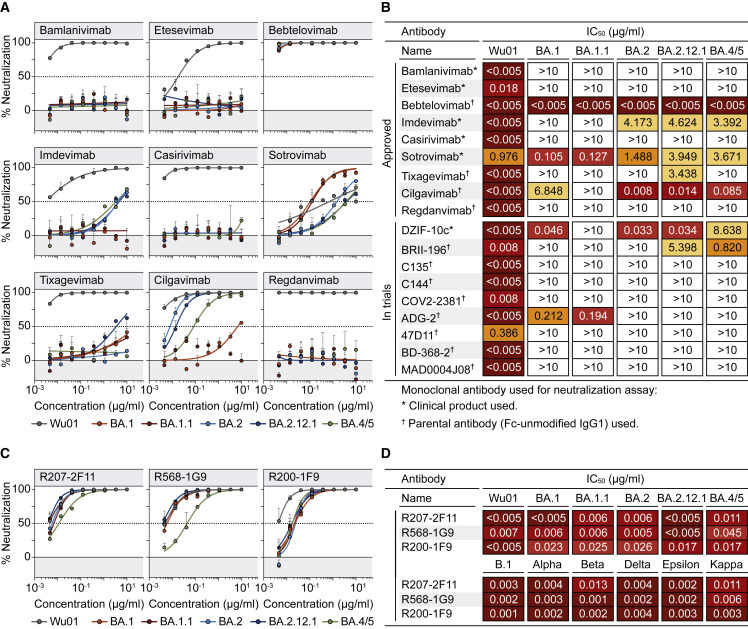
Omicron-sublineage-neutralizing activity of monoclonal antibodies in clinical use (A) Neutralization dose response curves in pseudovirus-based assay. Circles show averages and error bars indicate standard deviation. Dotted lines indicate 50% neutralization (IC50). (B) IC50s of antibodies in current or previous clinical use or development. Symbols indicate whether clinical products or parental antibodies produced as human IgG1 were used for neutralization testing. (C) Neutralization dose response curves in pseudovirus-based assay. Circles show averages and error bars indicate standard deviation. Dotted lines indicate 50% neutralization (IC50). (D) IC50s of antibodies in (C) against Wu01 and Omicron sublineages (upper rows) and previously circulating variants (lower rows, as previously determined; Vanshylla et al., 2022). See also Figure S3.

References

    1. Altarawneh H.N., Chemaitelly H., Hasan M.R., Ayoub H.H., Qassim S., AlMukdad S., Coyle P., Yassine H.M., Al-Khatib H.A., Benslimane F.M., et al. Protection against the omicron variant from previous SARS-CoV-2 infection. N. Engl. J. Med. 2022;386:1288–1290. - PMC - PubMed
    1. Andreano E., Nicastri E., Paciello I., Pileri P., Manganaro N., Piccini G., Manenti A., Pantano E., Kabanova A., Troisi M., et al. Extremely potent human monoclonal antibodies from COVID-19 convalescent patients. Cell. 2021;184:1821–1835.e16. - PMC - PubMed
    1. Andrews N., Stowe J., Kirsebom F., Toffa S., Rickeard T., Gallagher E., Gower C., Kall M., Groves N., O'Connell A.M., et al. Covid-19 vaccine effectiveness against the omicron (B.1.1.529) variant. N. Engl. J. Med. 2022;386:1532–1546. - PMC - PubMed
    1. Baum A., Fulton B.O., Wloga E., Copin R., Pascal K.E., Russo V., Giordano S., Lanza K., Negron N., Ni M., et al. Antibody cocktail to SARS-CoV-2 spike protein prevents rapid mutational escape seen with individual antibodies. Science. 2020;369:1014–1018. - PMC - PubMed
    1. Brouwer P.J.M., Caniels T.G., van der Straten K., Snitselaar J.L., Aldon Y., Bangaru S., Torres J.L., Okba N.M.A., Claireaux M., Kerster G., et al. Potent neutralizing antibodies from COVID-19 patients define multiple targets of vulnerability. Science. 2020;369:643–650. - PMC - PubMed