


Catastrophic health expenditure among Chinese adults living alone with cognitive impairment: findings from the CHARLS
- PMID: 35922775
- PMCID: PMC9351200
- DOI: 10.1186/s12877-022-03341-8
Catastrophic health expenditure among Chinese adults living alone with cognitive impairment: findings from the CHARLS
Abstract
Background: The catastrophic health expenditure of older adults results in serious consequences; however, the issue of whether cognitive status and living situations contribute to such financial burdens is uncertain. Our aim was to compare the differences in catastrophic health expenditure between adults living alone with cognitive impairment and those adults living with others and with normal cognition.
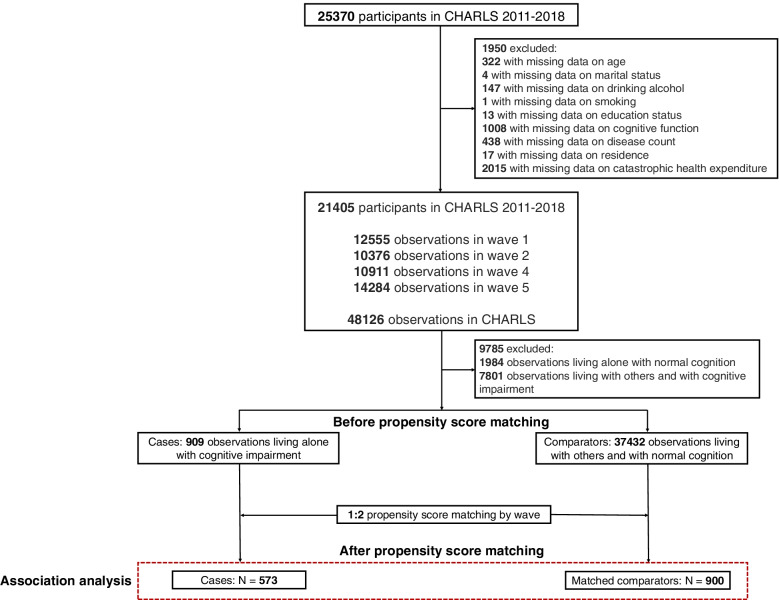
Methods: We identified 909 observations of participants living alone with cognitive impairment (cases) and 37,432 observations of participants living with others and with normal cognition (comparators) from the 2011/2012, 2013, 2015 and 2018 waves of the China Health and Retirement Longitudinal Study (CHARLS). We used propensity score matching (1:2) to create matched cases and comparators in a covariate-adjusted logistic regression analysis. Catastrophic health expenditure was defined as an out-of-pocket cost for health care ≥40% of a household's capacity to pay.
Results: In comparison with participants living with others and with normal cognition, those adults living alone with cognitive impairment reported a higher percentage of catastrophic health expenditure (19.5% vs. 11.8%, respectively, P < 0.001). When controlling for age, sex, education, marital status, residence areas, alcohol consumption, smoking status and disease counts, we found that this subpopulation had significantly higher odds of having catastrophic health expenditure (odds ratio [OR] = 1.89, 95% confidence interval [CI]: 1.40, 2.56). Additional analyses confirmed the robustness of the results.
Conclusions: This study demonstrated that adults living alone with cognitive impairment in the CHARLS experienced a high burden of catastrophic health expenditure. Health care policies on social health insurance and medical assistance should consider these vulnerable adults.
Keywords: Catastrophic health expenditure; Chinese adults; Cognitive impairment; Living alone.
© 2022. The Author(s).
Conflict of interest statement
There are no competing financial interests.
Figures
References
-
- Jia L, Du Y, Chu L, Zhang Z, Li F, Lyu D, Li Y, Li Y, Zhu M, Jiao H, et al. Prevalence, risk factors, and management of dementia and mild cognitive impairment in adults aged 60 years or older in China: a cross-sectional study. Lancet Public Health. 2020;5(12):e661–e671. doi: 10.1016/S2468-2667(20)30185-7. - DOI - PubMed
-
- Kolanowski A, Fortinsky RH, Calkins M, Devanand DP, Gould E, Heller T, Hodgson NA, Kales HC, Kaye J, Lyketsos C, et al. Advancing research on care needs and supportive approaches for persons with dementia: recommendations and rationale. J Am Med Dir Assoc. 2018;19(12):1047–1053. doi: 10.1016/j.jamda.2018.07.005. - DOI - PMC - PubMed
-
- Graham C, Johnson JK, Torres JM, Glymour MM, Keiser S, Tran T, Portacolone E. The living alone with cognitive impairment (LACI) project: bridging research and policy to expand long-term services and supports. Alzheimers Dement. 2021;17(S10):e055783. doi: 10.1002/alz.055783. - DOI
Publication types
MeSH terms
Grants and funding
LinkOut - more resources
Full Text Sources
Medical
