


Prospective network analysis of proinflammatory proteins, lipid markers, and depression components in midlife community women
- PMID: 35924730
- PMCID: PMC9898473
- DOI: 10.1017/S003329172200232X
Prospective network analysis of proinflammatory proteins, lipid markers, and depression components in midlife community women
Abstract
Background: Vulnerability theories propose that suboptimal levels of lipid markers and proinflammatory proteins predict future heightened depression. Scar models posit the reverse association. However, most studies that tested relationships between non-specific immune/endocrine markers and depression did not separate temporal inferences between people and within-person and how different immunometabolism markers related to unique depression symptoms. We thus used cross-lagged prospective network analyses (CLPN) to investigate this topic.
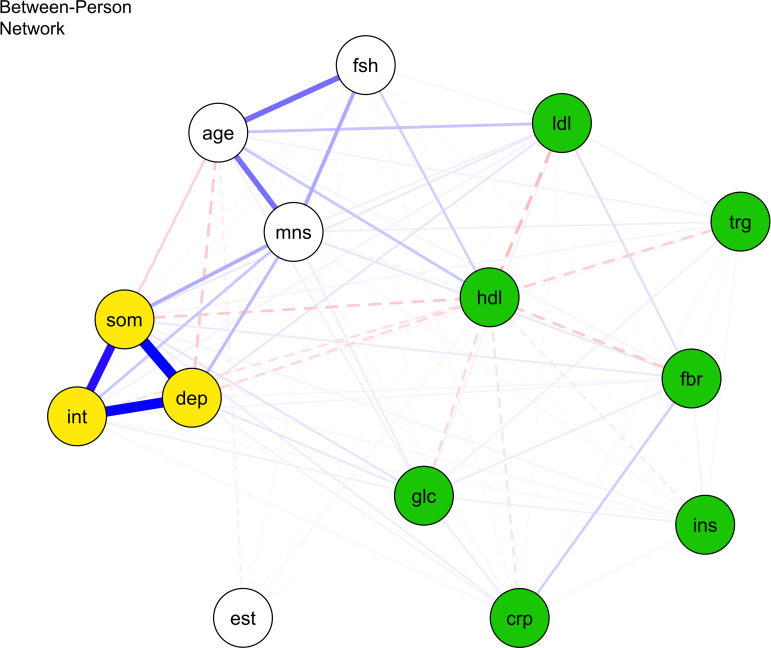
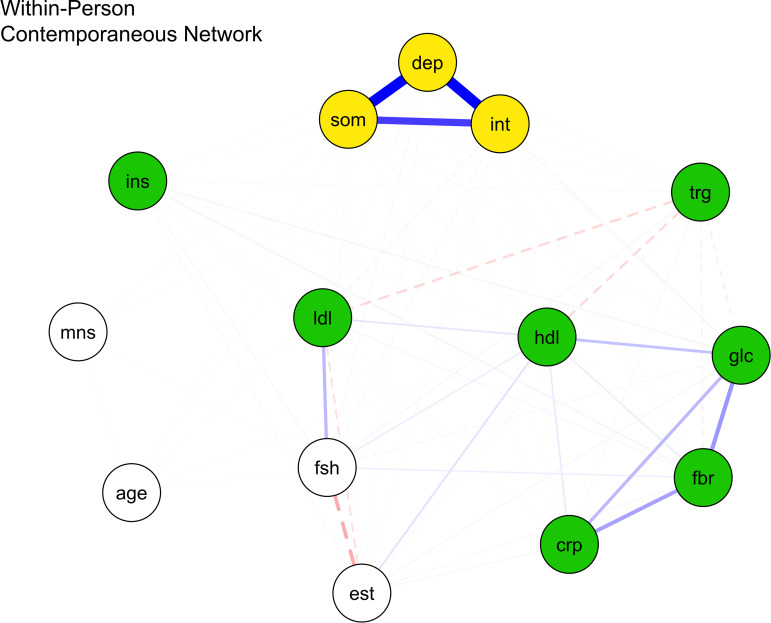
Methods: Community midlife women (n = 2224) completed the Center for Epidemiologic Studies-Depression scale and provided biomarker samples across five time-points spanning 9 years. CLPN identified significant relations (edges) among components (nodes) of depression (depressed mood, somatic symptoms, interpersonal issues), lipid markers [insulin, fasting glucose, triglycerides, low-density lipoprotein-cholesterol (LDL), high-density lipoprotein-cholesterol (HDL)], and proinflammatory proteins [C-reactive protein (CRP), fibrinogen], within and across time-points. All models adjusted for age, estradiol, follicle-stimulating hormone, and menopausal status.
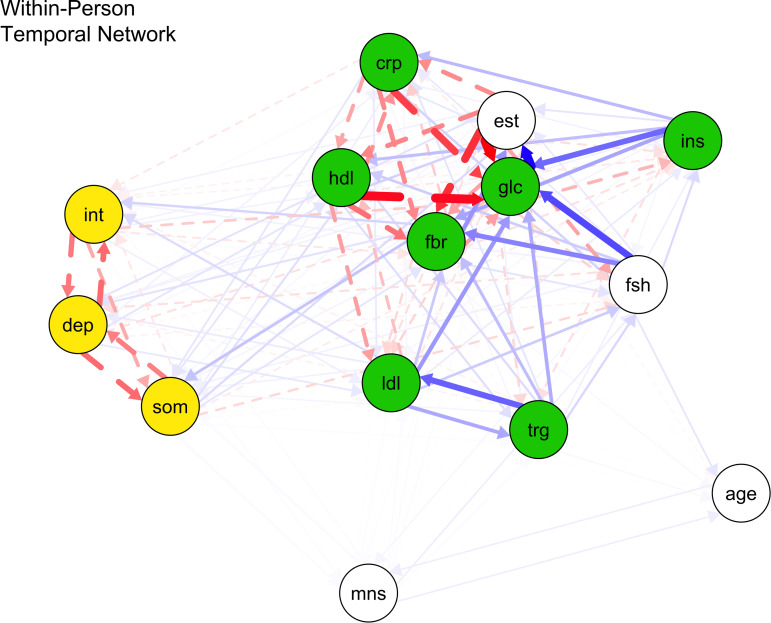
Results: In within-person temporal networks, higher CRP and HDL predicted all three depression components (d = 0.131-2.112). Increased LDL preceded higher depressed mood and interpersonal issues (v. somatic symptoms) (d = 0.251-0.327). Elevated triglycerides predicted more somatic symptoms (v. depressed mood and interpersonal problems) (d = 0.131). More interpersonal problems forecasted elevated fibrinogen and LDL levels (d = 0.129-0.331), and stronger somatic symptoms preceded higher fibrinogen levels (d = 0.188).
Conclusions: Results supported both vulnerability and scar models. Long-term dysregulated immunometabolism systems, social disengagement, and related patterns are possible mechanistic accounts. Cognitive-behavioral therapies that optimize nutrition and physical activity may effectively target depression.
Keywords: Cross-lagged; depression; endocrine; immune; inflammation; interpersonal; network analysis; scar theory; vulnerability theory.
Figures
References
-
- Beydoun, M. A., Beydoun, H. A., Dore, G. A., Fanelli-Kuczmarski, M. T., Evans, M. K., & Zonderman, A. B. (2015). Total serum cholesterol, atherogenic indices and their longitudinal association with depressive symptoms among US adults. Translational Psychiatry, 5, e518. 10.1038/tp.2015.4. - DOI - PMC - PubMed
-
- Blanchard, M. A., Contreras, A., Kalkan, R. B., & Heeren, A. (in press). Auditing the research practices and statistical analyses of the group-level temporal network approach to psychological constructs: A systematic scoping review. Behavior Research Methods, 1–21. 10.3758/s13428-022-01839-y. - DOI - PubMed
-
- Borsboom, D., Deserno, M. K., Rhemtulla, M., Epskamp, S., Fried, E. I., McNally, R. J., … Waldorp, L. J. (2021). Network analysis of multivariate data in psychological science. Nature Reviews Methods Primers, 1, 1–18. 10.1038/s43586-021-00055-w. - DOI
MeSH terms
Substances
Grants and funding
LinkOut - more resources
Full Text Sources
Medical
Research Materials
Miscellaneous
