


[Therapeutic peculiarities in diseases of the nipple skin]
- PMID: 35925215
- PMCID: PMC9592625
- DOI: 10.1007/s00105-022-05031-3
[Therapeutic peculiarities in diseases of the nipple skin]
Abstract
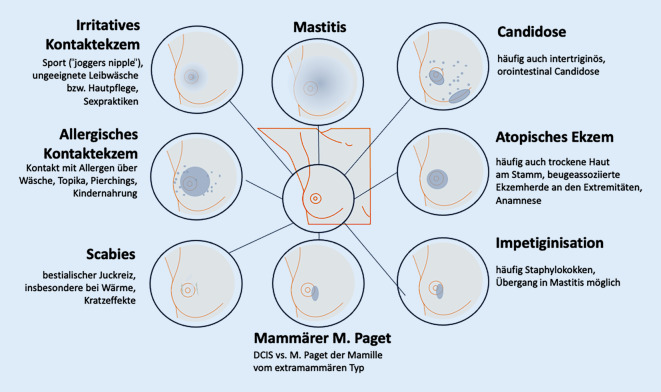
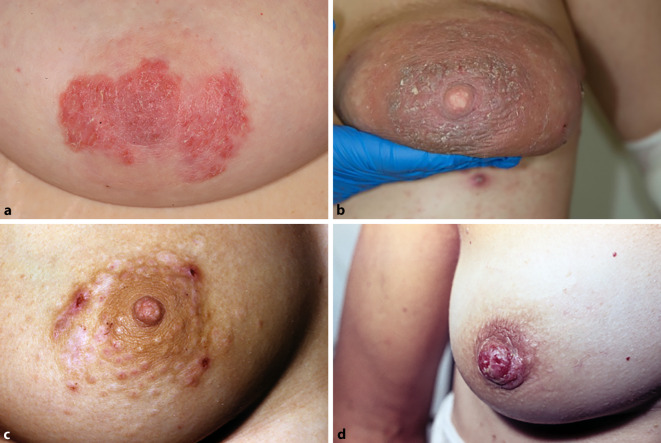
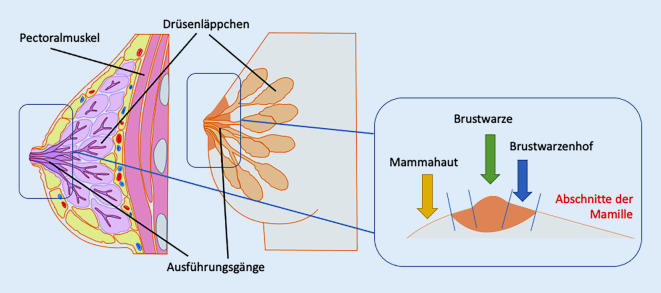
The nipple region is characterized by special anatomical conditions and from a dermatological perspective can be divided into breast skin, skin of the areola and the skin of the nipple. In a clinical context the nipples are often altered during lactation by mechanical alteration, changes in the environment with maceration by the milk flow and by microbial pathogens. In addition, there is a risk of developing puerperal mastitis. Outside of pregnancy and lactation, eczema diseases are occasionally found on the mammary skin, often with atopic disposition (atopic nipple eczema) or as irritant contact eczema ("joggers nipple"). More rarely, allergic contact eczema is observed from preservatives in topical preparations or metals (piercings). Also, in the context of a scabies infestation involvement of the nipples, especially in women, is regularly observed. Of great clinical importance are rare preinvasive lesions of breast cancer or Paget's disease of the mamilla of the extramammary type. Due to the special anatomical conditions, it is obvious that specific penetration conditions are also derived from the application of topical substances. Experimental studies on human skin ex vivo suggest that depending on the molecular weight and solubility of the drug as well as the vehicle system used, a significant increase in cutaneous bioavailability, especially on the nipple itself through the transpapillary diffusion pathway, may occur. This should be considered in particular in the topical application of drugs with known potential of dose-dependent side effects (e.g. glucocorticoids); however, there is still no clinical evidence for this.
Die Mamillenregion ist durch besondere anatomische Verhältnisse charakterisiert und lässt sich aus dermatologischer Perspektive in Brusthaut, Haut des Brustwarzenhofes (Areola) und Haut der Brustwarze (Papilla mammae) unterteilen. Im klinischen Zusammenhang sind die Brustwarzen häufig während der Stillzeit durch mechanische Beanspruchung, Milieuänderung mit Mazeration durch den Milchfluss sowie durch mikrobielle Erreger alteriert. Zudem besteht hier die Gefahr der Entwicklung einer Mastitis puerperalis. Außerhalb der Schwangerschaft und Stillzeit finden sich gelegentlich an der Mamillenhaut Ekzemerkrankungen, häufig bei atopischer Disposition (atopisches Mamillenekzem) oder als irritatives Kontaktekzem („joggers nipple“). Seltener werden allergische Kontaktekzeme auf Konservierungsstoffe von Topika oder Metallen (Piercings) beobachtet. Auch im Rahmen einer Skabiesinfestation wird eine Beteiligung der Mamillen, insbesondere bei Frauen, regelmäßig beobachtet. Von großer klinischer Bedeutung sind seltene, präinvasive Läsionen eines Mammakarzinoms oder der Morbus Paget der Mamille vom extramammären Typ. Durch die besonderen anatomischen Gegebenheiten ist es naheliegend, dass bei der Anwendung von Topika sich auch spezifische Penetrationsbedingungen ableiten. Experimentelle Untersuchungen an Humanhaut ex vivo legen nahe, dass in Abhängigkeit von der Molmasse und der Löslichkeit des Arzneistoffs sowie des eingesetzten Vehikelsystems eine deutliche Zunahme der kutanen Bioverfügbarkeit, insbesondere an der Brustwarze selbst durch den transpapillären Diffusionsweg, auftreten kann. Dies sollte insbesondere bei der topischen Anwendung von Arzneistoffen mit bekanntem dosisabhängigem Nebenwirkungspotenzial (z. B. Glukokortikoiden) beachtet werden. Allerdings fehlt dafür bisher eine klinische Evidenz.
Keywords: Breast skin; Mamilla; Mamma skin; Nipple; Topical treatment.
© 2022. The Author(s).
Similar articles
-
Correlation of nipple eczema in pregnancy with atopic dermatitis in Northern India: a study of 100 cases.An Bras Dermatol. 2019 Sep-Oct;94(5):549-552. doi: 10.1016/j.abd.2018.10.004. Epub 2019 Sep 30. An Bras Dermatol. 2019. PMID: 31777355 Free PMC article.
-
[How to explore breast skin lesion?: Guidelines].J Gynecol Obstet Biol Reprod (Paris). 2015 Dec;44(10):921-6. doi: 10.1016/j.jgyn.2015.09.040. Epub 2015 Oct 31. J Gynecol Obstet Biol Reprod (Paris). 2015. PMID: 26527029 Review. French.
-
Paget Disease of the Breast in Pregnancy and Lactation.Adv Exp Med Biol. 2020;1252:133-136. doi: 10.1007/978-3-030-41596-9_18. Adv Exp Med Biol. 2020. PMID: 32816273 Review.
-
Dermatologic diseases of the breast, areola and nipple.J Dtsch Dermatol Ges. 2025 May;23(5):621-641. doi: 10.1111/ddg.15535. J Dtsch Dermatol Ges. 2025. PMID: 40388094 Review.
-
Dermatoses of the breast in lactation.Dermatol Ther. 2013 Jul-Aug;26(4):331-6. doi: 10.1111/dth.12071. Dermatol Ther. 2013. PMID: 23914890 Review.
References
-
- Moritani S, Ichihara S, Hasegawa M, Endo T, Oiwa M, Shiraiwa M, Nishida C, Morita T, Sato Y, Hayashi T, Kato A, Aoyama H, Yoshikawa K. Topographical, morphological and immunohistochemical characteristics of carcinoma in situ of the breast involving sclerosing adenosis. Two distinct topographical patterns and histological types of carcinoma in situ. Histopathology. 2011;58:835–846. - PubMed
-
- Love SM, Barsky SH. Anatomy of the nipple and breast ducts revisited. Cancer. 2004;101:1947–1957. - PubMed
-
- Pandya S, Moore RG. Breast development and anatomy. Clin Obstet Gynecol. 2011;54:91–95. - PubMed
-
- Waldman RA, Finch J, Grant-Kels JM, Stevenson C, Whitaker-Worth D. Skin diseases of the breast and nipple: benign and malignant tumors. J Am Acad Dermatol. 2019;80:1467–1481. - PubMed
-
- Nicholson BT, Harvey JA, Cohen MA. Nipple-areolar complex: normal anatomy and benign and malignant processes. Radiographics. 2009;29:509–523. - PubMed
Publication types
MeSH terms
Substances
LinkOut - more resources
Full Text Sources
Medical