A New Approach to Simplifying and Harmonizing Cancer Clinical Trials-Standardizing Eligibility Criteria
- PMID: 35925576
- PMCID: PMC9934063
- DOI: 10.1001/jamaoncol.2022.1664
A New Approach to Simplifying and Harmonizing Cancer Clinical Trials-Standardizing Eligibility Criteria
Abstract
Importance: Clinical trial sponsors rely on eligibility criteria to control the characteristics of patients in their studies, promote the safety of participants, and optimize the interpretation of results. However, in recent years, complex and often overly restrictive inclusion and exclusion criteria have created substantial barriers to patient access to novel therapies, hindered trial recruitment and completion, and limited generalizability of trial results. A LUNGevity Foundation working group developed a framework for lung cancer clinical trial eligibility criteria. The goals of this framework are to (1) simplify eligibility criteria, (2) facilitate stakeholders' (patients, clinicians, and sponsors) search for appropriate trials, and (3) harmonize trial populations to support intertrial comparisons of treatment effects.
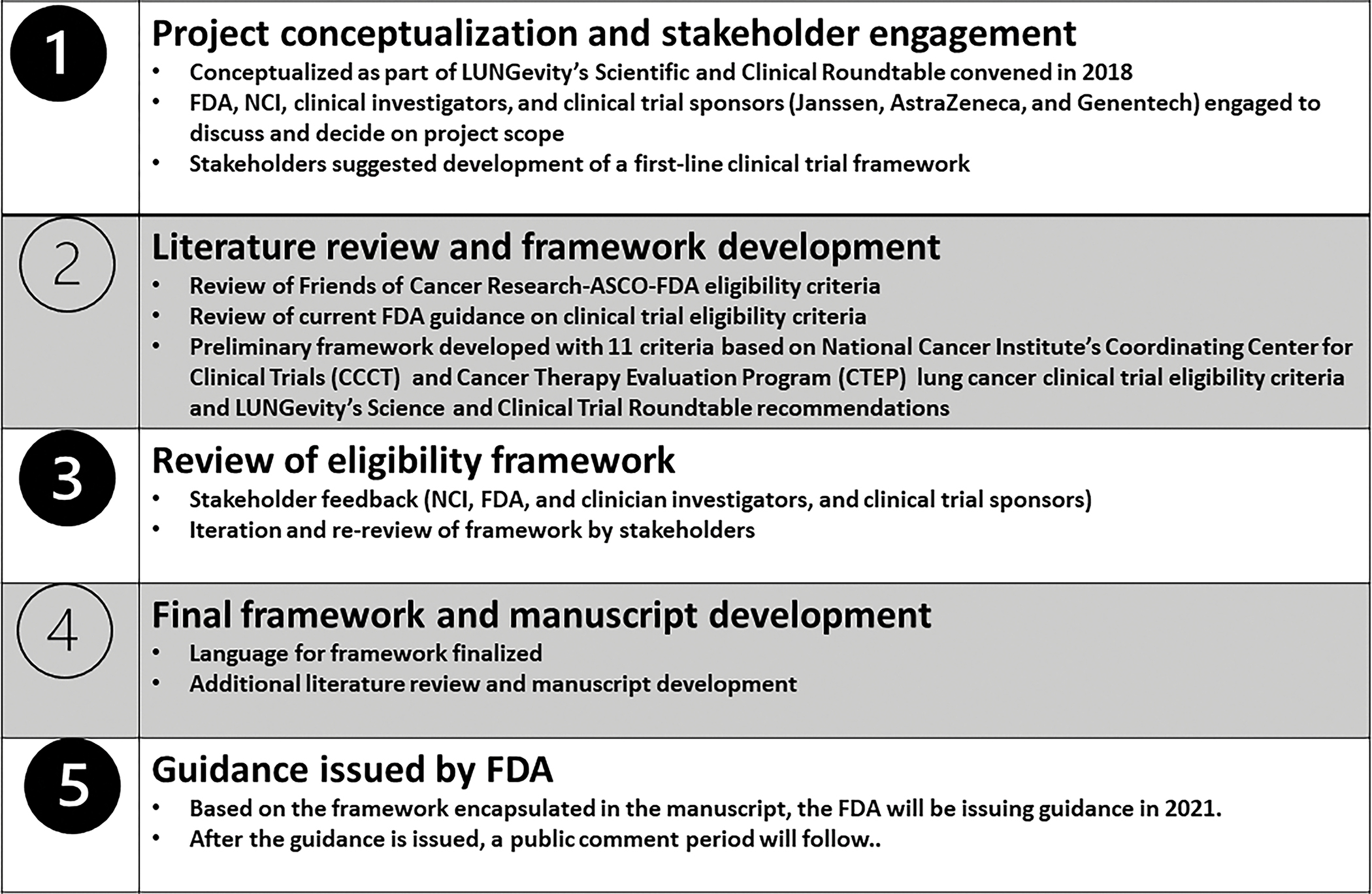
Observations: Clinicians and representatives from the pharmaceutical industry, the National Cancer Institute, the US Food and Drug Administration (FDA), the European Medicines Agency, and the LUNGevity Foundation undertook a process to identify and prioritize key items for inclusion in trial eligibility criteria. The group generated a prioritized library of terms to guide investigators and sponsors in the design of first-line, advanced non-small cell lung cancer clinical trials intended to support marketing application. These recommendations address disease stage and histologic features, enrollment biomarkers, performance status, organ function, brain metastases, and comorbidities. This effort forms the basis for a forthcoming FDA draft guidance for industry.
Conclusions and relevance: As an initial step, the recommended cross-trial standardization of eligibility criteria may harmonize trial populations. Going forward, by connecting diverse stakeholders and providing formal opportunity for public input, the emerging FDA draft guidance may also provide an opportunity to revise and simplify long-standing approaches to trial eligibility. This work serves as a prototype for similar efforts now underway for other cancers.
Figures
References
-
- FDA. US Food and Drug Administration. Guidance for Industry: Considerations for the Inclusion of Adolescent Patients in Adult Oncology Clinical Trials Guidance for Industry. In:2019.
-
- FDA. US Food and Drug Administration. Draft Guidance: Cancer Clinical Trial Eligibility Criteria: Patients with Organ Dysfunction or Prior or Concurrent Malignancies Guidance for Industry. In:2019.
MeSH terms
Grants and funding
LinkOut - more resources
Full Text Sources
Medical
Research Materials