


COVID-19 pandemic and vitamin D: rising trends in status and in daily amounts of vitamin D provided by supplements
- PMID: 35926985
- PMCID: PMC9358618
- DOI: 10.1136/bmjopen-2021-059477
COVID-19 pandemic and vitamin D: rising trends in status and in daily amounts of vitamin D provided by supplements
Abstract
Objectives: Since the onset of the COVID-19 pandemic in 2020, there have been plausible suggestions about the need to augment vitamin D intake by supplementation in order to prevent SARS-CoV2 infection and reduce mortality. Some groups have advocated supplementation for all adults, but governmental agencies have advocated targeted supplementation. We sought to explore the effect of the COVID-19 pandemic on both vitamin D status and on the dose of new-to-market vitamin D supplements.
Setting: University hospital, Dublin, Ireland.
Participants: Laboratory-based samples of circulating 25-hydroxyvitamin D (25OHD) (n=100 505).
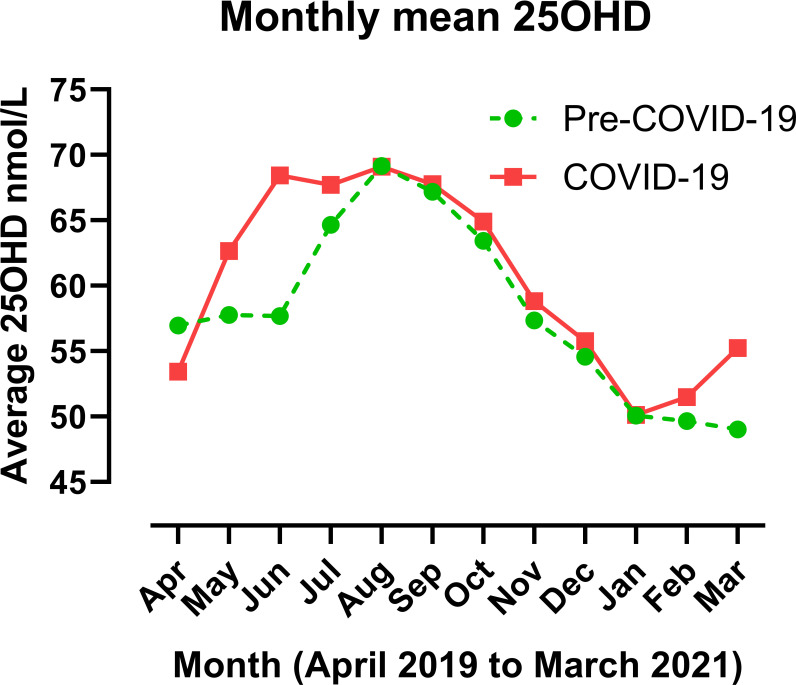
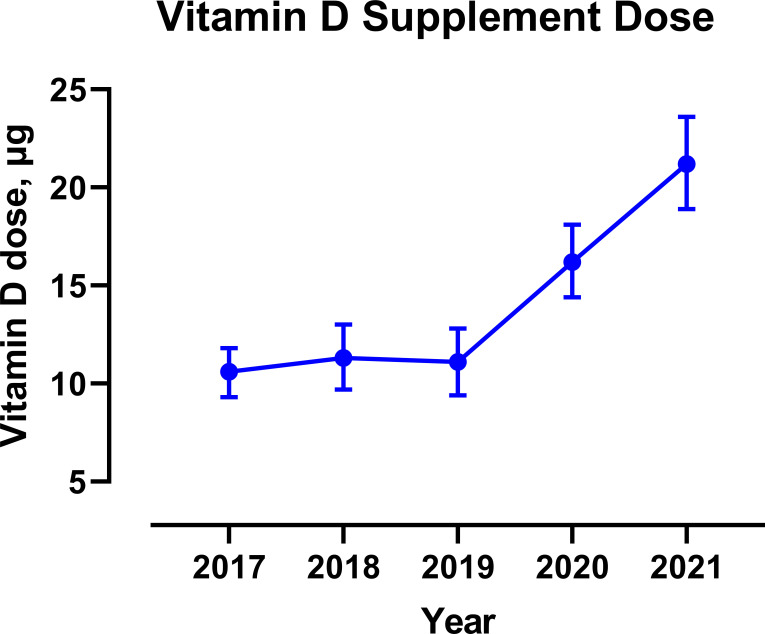
Primary and secondary outcome measures: Primary outcomes: comparing yearly average 25OHD prior to the pandemic (April 2019 to March 2020) with during the pandemic (April 2020 to March 2021) and comparing the dose of new-to-market vitamin D supplements between 2017 and 2021 (n=2689).
Secondary outcome: comparing prevalence of vitamin D deficiency and vitamin D excess during the two time periods.
Results: The average yearly serum 25OHD measurement increased by 2.8 nmol/L (61.4, 95% CI 61.5 to 61.7 vs 58.6, 95% CI 58.4 to 58.9, p<0.001), which was almost threefold higher than two similar trend analyses that we conducted between 1993 and 2016. There was a lower prevalence of low 25OHD and a higher prevalence of high 25OHD. The dose of new-to-market vitamin D supplements was higher in the years 2020-2021 compared with the years 2017-2019 (p<0.001).
Conclusions: We showed significant increases in serum 25OHD and in the dose of new-to-market vitamin D supplements. The frequency of low vitamin D status reduced indicating benefit, but the frequency of vitamin D excess increased indicating risk of harm. Rather than a blanket recommendation about vitamin D supplementation for all adults, we recommend a targeted approach of supplementation within current governmental guidelines to at-risk groups and cautioning consumers about adverse effects of high dose supplements on the market.
Keywords: COVID-19; Calcium & bone; NUTRITION & DIETETICS.
© Author(s) (or their employer(s)) 2022. Re-use permitted under CC BY-NC. No commercial re-use. See rights and permissions. Published by BMJ.
Conflict of interest statement
Competing interests: None declared.
Figures
References
-
- Committee to Review Dietary Reference Intakes for Vitamin D and Calcium, Institute of Medicine . Dietary reference intakes for calcium and vitamin D. Washington, DC: The National Academies Press, 2011.
-
- Secretary of the Nordic Council of Ministers, Nordic Council of Ministers . Integrating nutrition and physical activity, 2014.
-
- EFSA Panel on Dietetic Products NaAN . Dietary reference values for vitamin D, 2016.
-
- Scientific Advisory Committee on Nutrition . Vitamin D and health. vol. 2016. Crown, 2016.
MeSH terms
Substances
LinkOut - more resources
Full Text Sources
Medical
Miscellaneous
