


Japanese herbal Kampo medicine, Keishibukuryogan, for chronic subdural hematoma - Prospective observational study
- PMID: 35928329
- PMCID: PMC9345083
- DOI: 10.25259/SNI_455_2022
Japanese herbal Kampo medicine, Keishibukuryogan, for chronic subdural hematoma - Prospective observational study
Abstract
Background: Pharmacological treatment for chronic subdural hematoma (CSDH) recurrence prevention after surgery is under debate. CSDH may be related to suidoku (fluid disturbance) from the Japanese herbal kampo perspective. Goreisan (GRS) treats suidoku and is used to prevent a postoperative recurrence. However, not all CSDHs are liquid, and some have structures such as trabecula, hematoma, and clots, suggesting oketsu (blood stasis). Therefore, we prospectively investigated the keishibukuryogan (KBG) effectiveness, which treats oketsu, for CSDH recurrence prevention and hematoma resolution compared to GRS.
Methods: We prospectively prescribed KBG 7.5 g/day for 12 CSDH patients after burr-hole surgery. As a control cohort, we retrospectively collected 48 patients treated by GRS 7.5 g/day. The recurrence within 1 month and the hematoma thickness after 1 month were evaluated.
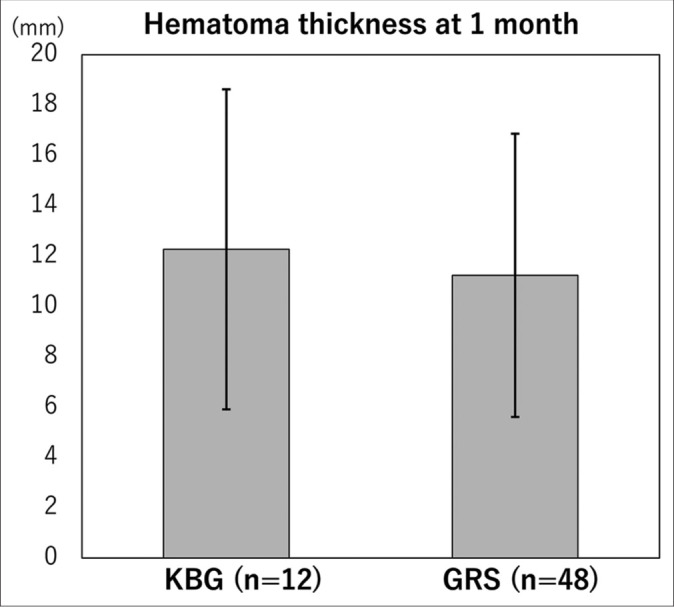
Results: The median age was 84 years old. All the patients' symptoms improved after surgery. The median preoperative midline shift and mean hematoma thicknesses were 6.0 mm and 23.75 mm. Those at 1 month were 2.0 mm and 11.43 mm. The recurrence rate was not significantly different between the KBG cohort (1 of 12) and the GRS cohort (4 of 48) (P = 0.999). The KBG's noninferiority to GRS regarding the hematoma thickness at 1 month was statistically proven; KBG (12.26 mm) and GRS (11.20 mm).
Conclusion: The recurrence rate at 1 month was not different between the KBG and GRS cohorts. The hematoma thickness at 1 month in the KBG cohort was not statistically inferior to that in the GRS cohort.
Keywords: Chronic subdural hematoma; Goreisan; Japanese herbal kampo medicine; Keishibukuryogan; Recurrence.
Copyright: © 2022 Surgical Neurology International.
Conflict of interest statement
There are no conflicts of interest.
Figures
References
-
- Di Cristofori A, Remida P, Patassini M, Piergallini L, Buonanno R, Bruno R, et al. Middle meningeal artery embolization for chronic subdural hematomas. A systematic review of the literature focused on indications, technical aspects, and future possible perspectives. Surg Neurol Int. 2022;13:94. - PMC - PubMed
-
- Fujii S, Kiyokawa J, Tamada N, Yoshimura M, Hirota S, Yamamoto S, et al. Administration of keishibukuryogan in combination with sennoside may accelerate absorption of intracerebral hematomas: Evaluation of six cases (Japanese) J Neurosurg Kampo Med. 2017;3:41–7.
-
- Karibe H, Kameyama M, Kawase M, Hirano T, Kawaguchi T, Tominaga T. Epidemiology of chronic subdural hematomas. No Shinkei Geka. 2011;39:1149–53. - PubMed
-
- Katayama K, Matsuda N, Kakuta K, Naraoka M, Takemura A, Hasegawa S, et al. The effect of Goreisan on the prevention of chronic subdural hematoma recurrence: Multi-center randomized controlled study. J Neurotrauma. 2018;35:1537–42. - PubMed
LinkOut - more resources
Full Text Sources
Research Materials