


STAT3 gain-of-function is not responsible for low total IgE levels in patients with autoimmune chronic spontaneous urticaria
- PMID: 35928809
- PMCID: PMC9345496
- DOI: 10.3389/fimmu.2022.902652
STAT3 gain-of-function is not responsible for low total IgE levels in patients with autoimmune chronic spontaneous urticaria
Abstract
Background: The pathogenesis of chronic spontaneous urticaria (CSU) has not been clarified entirely. Type IIb autoimmune chronic spontaneous urticaria (CSUaiTIIb) is a distinct subtype of CSU that is often difficult to treat and is connected to low levels of total IgE. Previous findings indicate that an enhanced signal transducer and activator of transcription 3 (STAT3) may be responsible for reduced IgE serum levels.
Objective: Our aim was to investigate a possible underlying gain-of-function mutation or activating polymorphism in STAT3 that could be responsible for the low levels of IgE in patients with CSUaiTIIb.
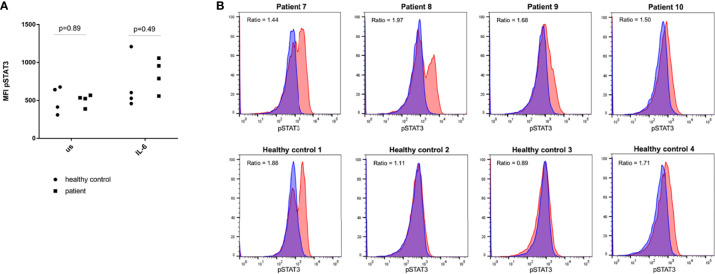
Methods: We included 10 patients with CSUaiTIIb and low levels of IgE and sequenced selected single nucleotide polymorphisms (SNP) in STAT3 associated with common autoimmune diseases. Exon sequencing was performed for the most relevant exons of STAT3. To test for a gain-of-function of STAT3, we performed a phospho-specific flow cytometry analysis of STAT3 in peripheral blood mononuclear cells before and after stimulation with interleukin-6.
Results: No differences were found in the prevalence of the tested SNPs between our patients and a control population. Moreover, we could not find any mutations or variants on the tested exons of STAT3. The function of STAT3 was also not altered in our patients.
Conclusion: In total, we could not find any evidence for our hypothesis that low IgE in patients with CSUaiTIIb is linked to mutations in STAT3 or altered activity of STAT3. Thus, it remains to be discovered what causes the low serum levels of IgE in patients with CSUaiTIIb.
Keywords: autoimmune disease; autoreactivity; basophil activation test; chronic spontaneous urticaria; gain-of-function mutation; immunoglobulin E; mast cell; signal transducer and activator of transcription 3.
Copyright © 2022 Sauer, Scheffel, Frischbutter, Mahnke, Maurer, Burmeister, Krause and Metz.
Conflict of interest statement
The authors declare that the research was conducted in the absence of any commercial or financial relationships that could be construed as a potential conflict of interest.
Figures
References
MeSH terms
Substances
LinkOut - more resources
Full Text Sources
Miscellaneous
