


Causal Association of Cardiovascular Risk Factors and Lifestyle Behaviors With Peripheral Artery Disease: A Mendelian Randomization Approach
- PMID: 35929454
- PMCID: PMC9496309
- DOI: 10.1161/JAHA.122.025644
Causal Association of Cardiovascular Risk Factors and Lifestyle Behaviors With Peripheral Artery Disease: A Mendelian Randomization Approach
Abstract
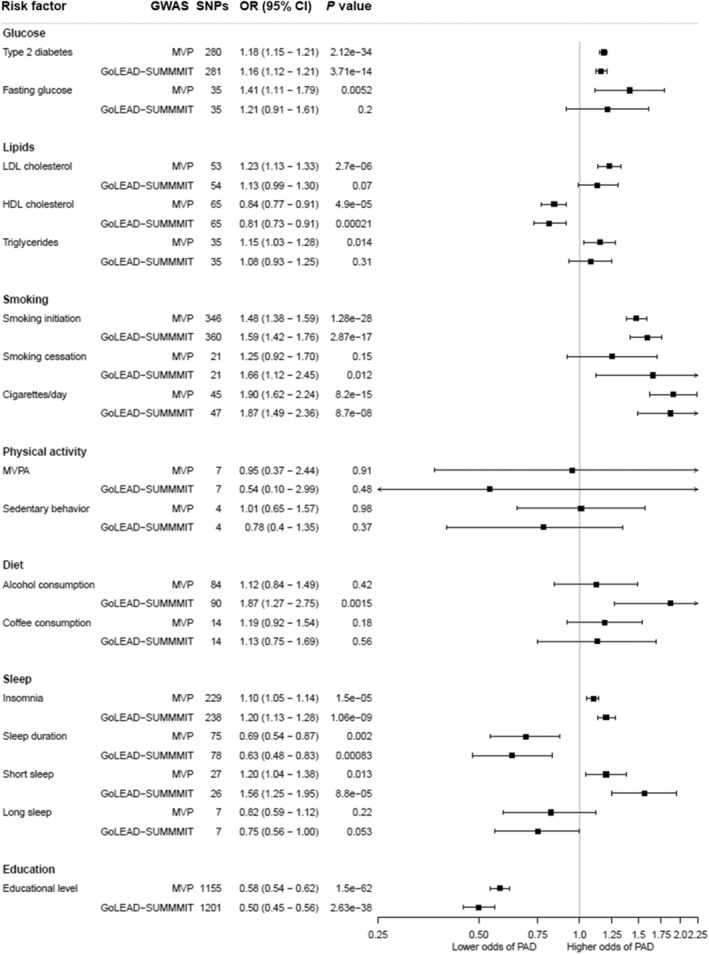
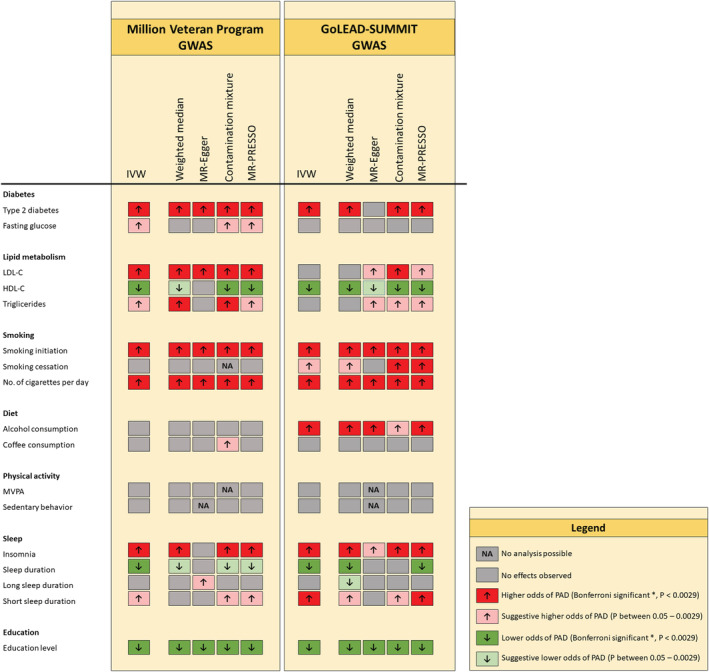
Background We investigated the causal associations between the genetic liability to cardiovascular and lifestyle risk factors and peripheral artery disease (PAD), using a Mendelian randomization approach. Methods and Results We performed a 2-sample inverse-variance weighted Mendelian randomization analysis, multiple sensitivity analyses to assess pleiotropy and multivariate Mendelian randomization analyses to assess mediating/confounding factors. European-ancestry genomic summary data (P<5×10⁻⁸) for type 2 diabetes, lipid-fractions, smoking, alcohol and coffee consumption, physical activity, sleep, and education level were selected. Genetic associations with PAD were extracted from the Million-Veteran-Program genome-wide association studies (cases=31 307, controls=211 753, 72% European-ancestry) and the GoLEAD-SUMMIT genome-wide association studies (11 independent genome-wide association studies, European-ancestry, cases=12 086, controls=449 548). Associations were categorized as robust (Bonferroni-significant (P<0.00294), consistent over PAD-cohorts/sensitivity analyses), suggestive (P value: 0.00294-0.05, associations in 1 PAD-cohort/inconsistent sensitivity analyses) or not present. Robust evidence for genetic liability to type 2 diabetes, smoking, insomnia, and inverse associations for higher education level with PAD were found. Suggestive evidence for the genetic liability to higher low-density lipoprotein cholesterol, triglyceride-levels, alcohol consumption, and inverse associations for high-density lipoprotein cholesterol, and increased sleep duration were found. No associations were found for physical activity and coffee consumption. However, effects fully attenuated for low-density lipoprotein cholesterol and triglycerides after correcting for apoB, and for insomnia after correcting for body mass index and lipid-fractions. Nonsignificant attenuation by potential mediators was observed for education level and type 2 diabetes. Conclusions Detrimental effects of smoking and type 2 diabetes, but not of low-density lipoprotein cholesterol and triglycerides, on PAD were confirmed. Lower education level and insomnia were identified as novel risk factors for PAD; however, complete mediation for insomnia and incomplete mediation for education level by downstream risk factors was observed.
Keywords: cardiometabolic risk factors; cigarette smoking; education; health risk behaviors; hypercholesterolemia; mendelian randomization analysis; peripheral artery disease.
Figures
References
-
- Ankle Brachial Index C, Fowkes FG, Murray GD, Butcher I, Heald CL, Lee RJ, Chambless LE, Folsom AR, Hirsch AT, Dramaix M, et al. Ankle brachial index combined with Framingham risk score to predict cardiovascular events and mortality: a meta‐analysis. JAMA. 2008;300:197–208. doi: 10.1001/jama.300.2.197 - DOI - PMC - PubMed
-
- Gerhard‐Herman MD, Gornik HL, Barrett C, Barshes NR, Corriere MA, Drachman DE, Fleisher LA, Fowkes FG, Hamburg NM, Kinlay S, et al. 2016 AHA/ACC guideline on the management of patients with lower extremity peripheral artery disease: a report of the American College of Cardiology/American Heart Association task force on clinical practice guidelines. Circulation. 2017;135:e726–e779. doi: 10.1161/CIR.0000000000000471 - DOI - PMC - PubMed
-
- Bonaca MP, Nault P, Giugliano RP, Keech AC, Pineda AL, Kanevsky E, Kuder J, Murphy SA, Jukema JW, Lewis BS, et al. Low‐density lipoprotein cholesterol lowering with evolocumab and outcomes in patients with peripheral artery disease: insights from the fourier trial (further cardiovascular outcomes research with PCSK9 inhibition in subjects with elevated risk). Circulation. 2018;137:338–350. doi: 10.1161/CIRCULATIONAHA.117.032235 - DOI - PubMed
Publication types
MeSH terms
Substances
LinkOut - more resources
Full Text Sources
Medical
Miscellaneous
