


Patient-reported factors associated with avoidance of in-person care during the COVID-19 pandemic: Results from a national survey
- PMID: 35930581
- PMCID: PMC9355185
- DOI: 10.1371/journal.pone.0272609
Patient-reported factors associated with avoidance of in-person care during the COVID-19 pandemic: Results from a national survey
Abstract
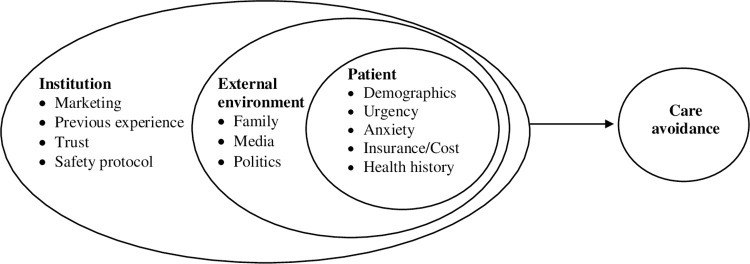
Background: There has been a substantial decline in in-person care in inpatient and outpatient settings during the ongoing COVID-19 pandemic. Avoidance of needed in-person care may contribute to an avoidable decline in patient health and an increase in mortality. While several systems and behavioral theories have been put forward to explain the decline, there is a lack of studies informed by patients' own experiences. The current study applied a socio-ecological model encompassing patient, environmental, and institutional-related variables to examine patient-reported factors associated with avoidance of in-person care.
Methods: Between October and December 2020, a total of 3840 persons responded to a nationwide online questionnaire that was administered using ResearchMatch and Facebook. Self-reported avoidance of in-person care among those who needed it was the main outcome. Multivariable logistic regression analysis was used to identify factors associated with avoidance of needed care.
Findings: Out of a total of 3372 respondents who reported that they needed in-person care during the early phase of the pandemic, 257 (7.6%) avoided it. Patient-related variables associated with avoiding needed care included younger age (odds ratio (OR), 1.46, 95% CI 1.11 to 1.94, p<0.01; <45 y/o vs 45+), inability to afford care (OR = 1.65, 95% CI 1.17 to 2.34, p<0.01), and greater COVID-related stress (OR = 1.36, CI 1.01 to 1.83, p<0.05). More frequent discussions about COVID with family and friends was the only significant environment-related avoidance of care variable (OR = 1.39, 95% CI 1.01-1.91, p < .05). Institution-related care avoidance variables included a negative patient healthcare experience rating (OR 1.83, 95% CI 1.38 to 2.42, p<0.001), poor awareness of the institution's safety protocol (OR = 1.79, 95% CI 1.28 to 2.51, p<0.01), and low ratings of the institution's effectiveness in communicating their safety protocol (OR = 3.45, 95% CI 1.94 to 6.12, p<0.001). The final model predicted 11.9% of the variance in care avoidance.
Conclusions: These results suggest that care avoidance of in-person care during the initial phase of the pandemic was influenced by a patient's demographics as well as environmental and healthcare institutional factors. Patients' previous experiences and their awareness of healthcare systems' safety protocols are important factors in care avoidance.
Conflict of interest statement
The authors have declared that no competing interests exist.
References
-
- Weber T, Januszewicz A, Agabiti Rosei E, Tsioufis K, Okorie M, Stergiou GS,et al.. The corona-virus disease 2019 pandemic compromised routine care for hypertension: a survey conducted among excellence centers of the European Society of Hypertension. J Hypertens, 2021; 39(1), 190–195. doi: 10.1097/HJH.0000000000002703 - DOI - PubMed
Publication types
MeSH terms
Associated data
LinkOut - more resources
Full Text Sources
Medical
