


Health insurance and financial hardship in cancer survivors during the COVID-19 pandemic
- PMID: 35930603
- PMCID: PMC9355233
- DOI: 10.1371/journal.pone.0272740
Health insurance and financial hardship in cancer survivors during the COVID-19 pandemic
Abstract
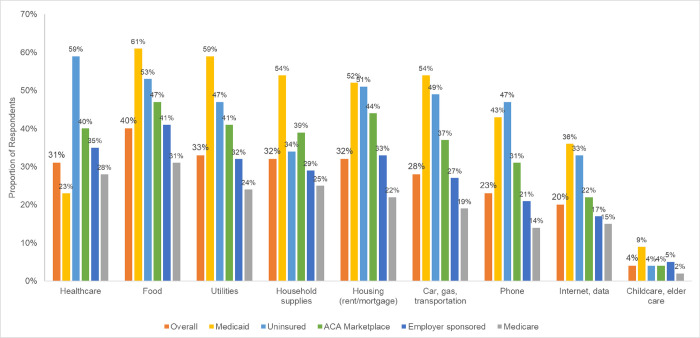
Uninsured or underinsured individuals with cancer are likely to experience financial hardship, including forgoing healthcare or non-healthcare needs such as food, housing, or utilities. This study evaluates the association between health insurance coverage and financial hardship among cancer survivors during the COVID-19 pandemic. This cross-sectional analysis used Patient Advocate Foundation (PAF) survey data from May to July 2020. Cancer survivors who previously received case management or financial aid from PAF self-reported challenges paying for healthcare and non-healthcare needs during the COVID-19 pandemic. Associations between insurance coverage and payment challenges were estimated using Poisson regression with robust standard errors, which allowed for estimation of adjusted relative risks (aRR). Of 1,437 respondents, 74% had annual household incomes <$48,000. Most respondents were enrolled in Medicare (48%), 22% in employer-sponsored insurance, 13% in Medicaid, 6% in an Affordable Care Act (ACA) plan, and 3% were uninsured. Approximately 31% of respondents reported trouble paying for healthcare during the COVID-19 pandemic. Respondents who were uninsured (aRR 2.58, 95% confidence interval [CI] 1.83-3.64), enrolled in an ACA plan (aRR 1.86, 95% CI 1.28-2.72), employer-sponsored insurance (aRR 1.70, 95% CI 1.23-2.34), or Medicare (aRR 1.49, 95% CI 1.09-2.03) had higher risk of trouble paying for healthcare compared to Medicaid enrollees. Challenges paying for non-healthcare needs were reported by 57% of respondents, with 40% reporting trouble paying for food, 31% housing, 28% transportation, and 20% internet. In adjusted models, Medicare and employer-sponsored insurance enrollees were less likely to have difficulties paying for non-healthcare needs compared to Medicaid beneficiaries. Despite 97% of our cancer survivor sample being insured, 31% and 57% reported trouble paying for healthcare and non-healthcare needs during the COVID-19 pandemic, respectively. Greater attention to both medical and non-medical financial burden is needed given the economic pressures of the COVID-19 pandemic.
Conflict of interest statement
I have read the journal’s policy and the authors of this manuscript have the following competing interests: Dr. Rocque is supported by an American Cancer Society Mentored Research Scholar Grant (MRSG-17-051-01-PCSM) and has received research funding from Genentech, Pfizer, and Carevive and consulting fees for Genentech and Pfizer for work unrelated to the current study. This does not alter our adherence to PLOS ONE policies on sharing data and materials.
Figures
References
-
- Nipp RD, Shui AM, Perez GK, Kirchhoff AC, Peppercorn JM, Moy B, et al. Patterns in Health Care Access and Affordability Among Cancer Survivors During Implementation of the Affordable Care Act. JAMA Oncol. 2018;4(6):791–7. Epub 2018/03/30. doi: 10.1001/jamaoncol.2018.0097 ; PubMed Central PMCID: PMC5885177. - DOI - PMC - PubMed
-
- Collins SR, Rasmussen PW, Beutel S, Doty MM. The problem of underinsurance and how rising deductibles will make it worse. Findings from the Commonwealth Fund Biennial Health Insurance Survey, 2014. Issue Brief (Commonw Fund). 2015;13:1–20. Epub 2015/06/03. . - PubMed
-
- Garfield R CG, Damico A, Levitt L. Eligibility for ACA Health Coverage Following Job Loss 2020 [cited 2021 March 9].
MeSH terms
LinkOut - more resources
Full Text Sources
Medical
