Review
. 2022 Aug 5;12(1):35.
doi: 10.1038/s41387-022-00213-3.

Role of branched-chain amino acid metabolism in the pathogenesis of obesity and type 2 diabetes-related metabolic disturbances BCAA metabolism in type 2 diabetes

Affiliations
Review

Role of branched-chain amino acid metabolism in the pathogenesis of obesity and type 2 diabetes-related metabolic disturbances BCAA metabolism in type 2 diabetes

Froukje Vanweert et al. Nutr Diabetes. .

Abstract

Branched-chain amino acid (BCAA) catabolism has been considered to have an emerging role in the pathogenesis of metabolic disturbances in obesity and type 2 diabetes (T2D). Several studies showed elevated plasma BCAA levels in humans with insulin resistance and patients with T2D, although the underlying reason is unknown. Dysfunctional BCAA catabolism could theoretically be an underlying factor. In vitro and animal work collectively show that modulation of the BCAA catabolic pathway alters key metabolic processes affecting glucose homeostasis, although an integrated understanding of tissue-specific BCAA catabolism remains largely unknown, especially in humans. Proof-of-concept studies in rodents -and to a lesser extent in humans - strongly suggest that enhancing BCAA catabolism improves glucose homeostasis in metabolic disorders, such as obesity and T2D. In this review, we discuss several hypothesized mechanistic links between BCAA catabolism and insulin resistance and overview current available tools to modulate BCAA catabolism in vivo. Furthermore, this review considers whether enhancing BCAA catabolism forms a potential future treatment strategy to promote metabolic health in insulin resistance and T2D.


Conflict of interest statement

The authors declare no competing interests.

Figures
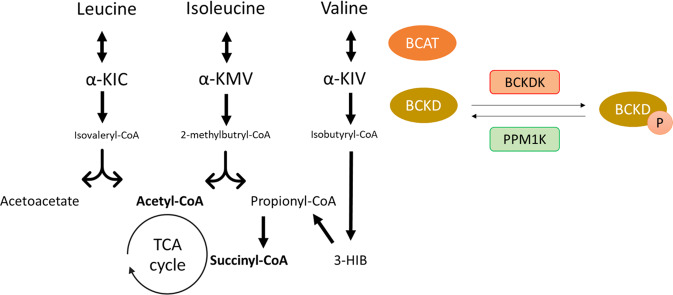
Fig. 1
Fig. 1. Schematic overview of BCAA catabolism.
BCAT branched-chain amino acid transaminase, BCKD branched-chain keto acid dehydrogenase, α-KIC α-ketoisocaproate, α-KMV α-keto-methylvalerate, α-KIV α-ketoisovalerate, 3-HIB 3-hydroxyisobutyrate, BCKDK BCKDK kinase, PPM1K BCKDK phosphatase. Adapted from Neinast et al. [73].
Fig. 2
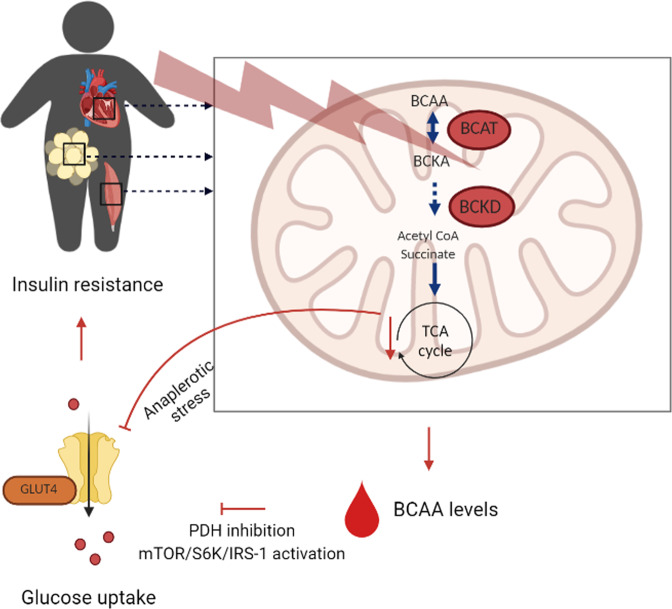
Fig. 2. Schematic overview of mechanisms linking BCAA catabolism with insulin resistance.
BCAA branched-chain amino acids, mTOR mammalian target of rapamycin complex, S6K ribosomal S6 kinase, IRS-1 insulin receptor substrate-1, PDH pyruvate dehydrogenase complex, GLUT4 glucose transporter type 4.
Fig. 3
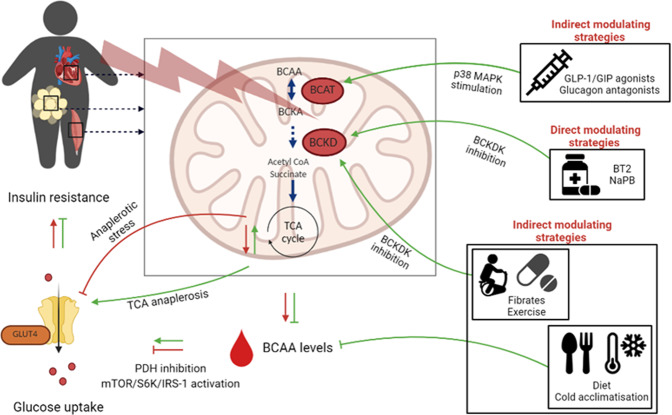
Fig. 3. Schematic overview of pharmaceutical and alternative strategies and their hypothesized way of action to boost BCAA oxidation and lower BCAA levels.
BCAA branched-chain amino acids, mTOR mammalian target of rapamycin complex, S6K ribosomal S6 kinase, IRS-1 insulin receptor substrate-1, PDH pyruvate dehydrogenase complex, GLUT4 glucose transporter type 4, BT2 3,6-dichlorobenzo(b)thiopene-2-carboxylic acid, NaPB sodium phenylbutyrate, GLP-1 GCR-like peptide-1, GIP glucose-dependent insulinotropic polypeptide.

References

    1. Organization WH Global Report on Diabetes. France: WHO; 2016.
    1. Abdul-Ghani MA, DeFronzo RA. Pathogenesis of insulin resistance in skeletal muscle. J Biomed Biotechnol. 2010;2010:476279. doi: 10.1155/2010/476279. - DOI - PMC - PubMed
    1. Newgard CB, An J, Bain JR, Muehlbauer MJ, Stevens RD, Lien LF, et al. A branched-chain amino acid-related metabolic signature that differentiates obese and lean humans and contributes to insulin resistance. Cell Metab. 2009;9:311–26.. doi: 10.1016/j.cmet.2009.02.002. - DOI - PMC - PubMed
    1. Tai ES, Tan ML, Stevens RD, Low YL, Muehlbauer MJ, Goh DL, et al. Insulin resistance is associated with a metabolic profile of altered protein metabolism in Chinese and Asian-Indian men. Diabetologia. 2010;53:757–67. doi: 10.1007/s00125-009-1637-8. - DOI - PMC - PubMed
    1. Krebs M, Krssak M, Bernroider E, Anderwald C, Brehm A, Meyerspeer M, et al. Mechanism of amino acid-induced skeletal muscle insulin resistance in humans. Diabetes. 2002;51:599–605. doi: 10.2337/diabetes.51.3.599. - DOI - PubMed

Publication types