Review
. 2023 Feb;20(2):109-125.
doi: 10.1038/s41569-022-00741-6. Epub 2022 Aug 5.

Sulfide regulation of cardiovascular function in health and disease

Affiliations
Review

Sulfide regulation of cardiovascular function in health and disease

Gopi K Kolluru et al. Nat Rev Cardiol. 2023 Feb.

Abstract

Hydrogen sulfide (H2S) has emerged as a gaseous signalling molecule with crucial implications for cardiovascular health. H2S is involved in many biological functions, including interactions with nitric oxide, activation of molecular signalling cascades, post-translational modifications and redox regulation. Various preclinical and clinical studies have shown that H2S and its synthesizing enzymes - cystathionine γ-lyase, cystathionine β-synthase and 3-mercaptosulfotransferase - can protect against cardiovascular pathologies, including arrhythmias, atherosclerosis, heart failure, myocardial infarction and ischaemia-reperfusion injury. The bioavailability of H2S and its metabolites, such as hydropersulfides and polysulfides, is substantially reduced in cardiovascular disease and has been associated with single-nucleotide polymorphisms in H2S synthesis enzymes. In this Review, we highlight the role of H2S, its synthesizing enzymes and metabolites, their roles in the cardiovascular system, and their involvement in cardiovascular disease and associated pathologies. We also discuss the latest clinical findings from the field and outline areas for future study.


Conflict of interest statement

The authors declare no competing interests.

Figures
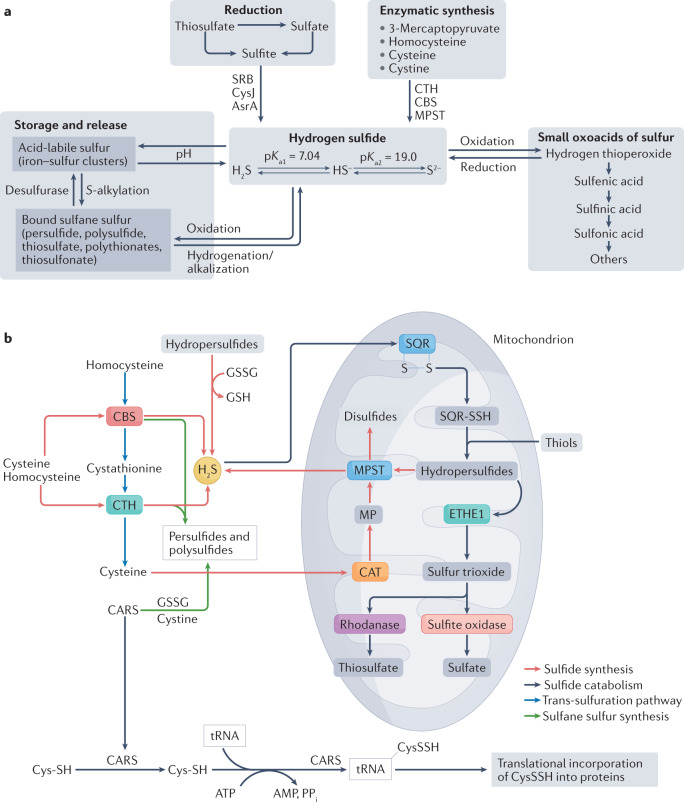
Fig. 1
Fig. 1. Sulfide metabolite formation and fate.
a | Various chemical metabolite fate pathways for sulfide and its related species are shown. The basal level of production of hydrogen sulfide (H2S) is determined by the activity of three main enzymes: cystathionine γ-lyase (CTH), cystathionine β-synthase (CBS) and 3-mercaptopyruvate sulfurtransferase (MPST). In addition, bacterial enzymes (such as sulfate-reducing bacteria (SRB), sulfite reductase [NADPH] flavoprotein α-component (CysJ) and anaerobic sulfite reductase subunit A (AsrA)) can reduce terminal sulfide oxidation end products (such as thiosulfate, sulfate and sulfite) back to H2S. H2S can undergo a myriad of reactions leading to the formation of small oxoacids of sulfur, sulfane sulfur species and acid-labile sulfur species. b | Various enzymatic and non-enzymatic biochemical pathways are involved in sulfide metabolite formation. Sulfide catabolism through the mitochondrial H2S oxidation pathway leads to the metabolic end products of sulfate and thiosulfate. CARS, cysteinyl–tRNA synthetase (also known as cytoplasmic cysteine–tRNA ligase); CAT, cysteine aminotransferase; CysSH, cysteine; CysSSH, cysteine hydropersulfide; ETHE1, persulfide dioxygenase; GSH, glutathione; GSSG, glutathione disulfide; MP, mercaptopyruvate; PPi, inorganic pyrophosphate; SQR, sulfide–quinone oxidoreductase; SQR-SSH, sulfide–quinone oxidoreductase hydropersulfide.
Fig. 2
Fig. 2. Sulfide signalling and chemical reaction pathways.
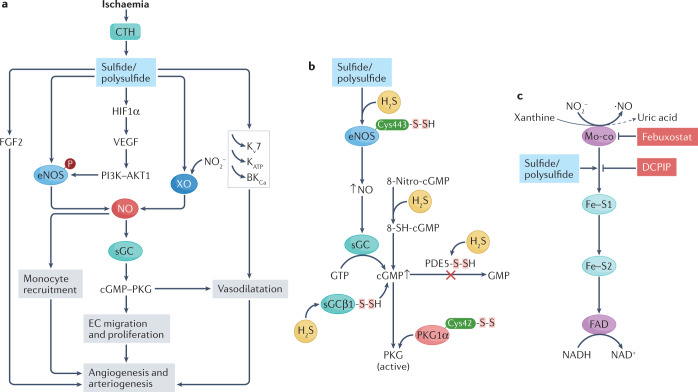
a | An ischaemia-driven increase in the expression and function of cystathionine γ-lyase (CTH) leads to sulfide metabolite production, which affects both endothelial nitric oxide synthase (eNOS) phosphorylation and hypoxia-inducible factor 1α (HIF1α) activation. This cascade leads to vascular endothelial growth factor (VEGF) and nitric oxide (NO) production, stimulating the monocyte recruitment and endothelial cell (EC) proliferation necessary for angiogenesis and arteriogenesis. b | Sulfide post-translational modifications of eNOS and cGMP-dependent protein kinase 1α (PKG1α), together with electrophilic sulfhydration of 8-nitro-cGMP to 8-SH-cGMP, the soluble guanylate cyclase-β1 subunit (sGCβ1) to sGCβ1 persulfide (sGC-SSH) and phosphodiesterase type 5 (PDE5) to PDE5 persulfide (PDE5-SSH), contribute to increased cGMP levels and subsequent protein kinase G (PKG) activity. c | The effect of sulfide and polysulfide on xanthine oxidase (XO)-dependent nitrite (NO2) reduction via interaction with either Fe–S clusters or a molybdenum cofactor (Mo-co) domain, which is inhibited by 2,6-dichlorophenolindophenol (DCPIP) or febuxostat, respectively. AKT1, RACα serine–threonine protein kinase; BKCa, large-conductance calcium-activated potassium channel; FGF2, fibroblast growth factor 2; H2S, hydrogen sulfide; KATP, ATP-sensitive potassium channel; Kv7, voltage-gated potassium channels; PI3K, phosphatidylinositol 3-kinase.
Fig. 3
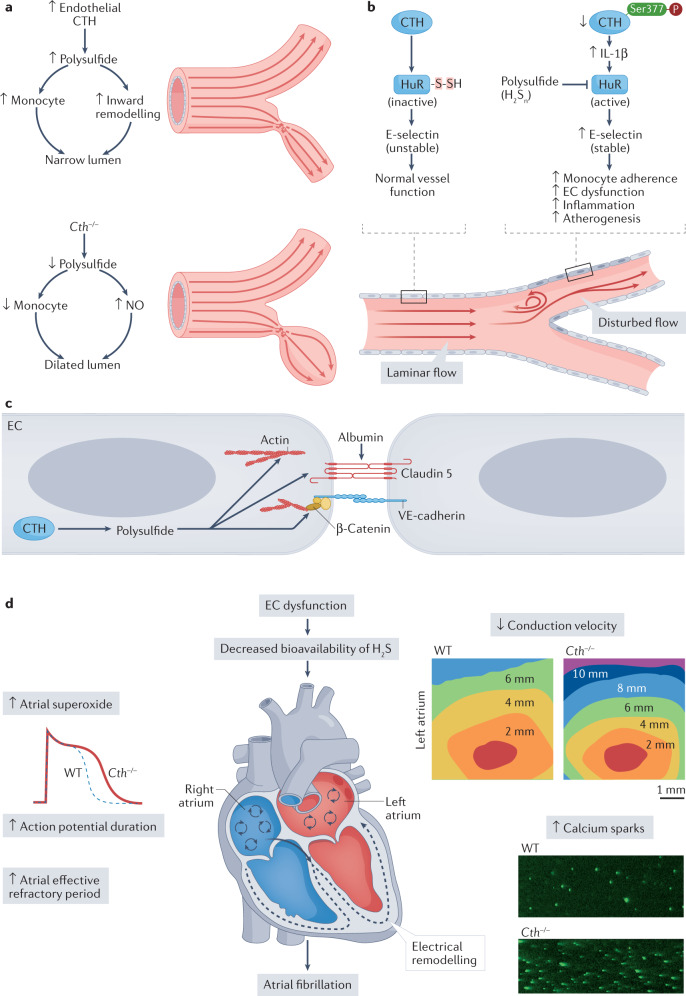
Fig. 3. Sulfide regulation of cardiovascular responses involving CTH expression and function.
a | Cystathionine γ-lyase (CTH) expression and sulfane sulfur production are increased by disturbed blood flow in conduit vessels, causing increased macrophage recruitment to these areas, leading to flow-induced vascular remodelling. In Cth−/− mice, sulfane sulfur levels in response to partial carotid artery ligation are reduced, leading to defective inward remodelling and a dilated vascular phenotype, which results from elevated nitric oxide (NO) bioavailability. b | In regions of laminar blood flow, CTH-derived polysulfide inactivates human antigen R (HuR) via S-sulfhydration (HuR-S-SH), thereby attenuating E-selectin expression, which regulates vascular inflammation and atherogenesis. In regions of disturbed blood flow, defective CTH or polysulfide leads to HuR activation and subsequent E-selectin stability, which induces endothelial cell (EC) dysfunction and atherogenesis. c | Regulation of endothelial permeability by CTH-derived sulfur species increases endothelial solute permeability and leads to disruption of the endothelial junction proteins claudin 5 and vascular endothelial (VE)-cadherin, together with increased actin stress fibre formation. d | Hydrogen sulfide (H2S) modulates cardiac ion channels both directly and indirectly, leading to electrical remodelling. Reduced CTH-derived sulfide bioavailability (for example, owing to EC dysfunction or in Cth−/− mice) increases atrial superoxide levels and the frequency of atrial cell calcium sparks, slows atrial conduction velocity and prolongs both the action potential duration and atrial effective refractory period, all of which contribute to the development of atrial fibrillation. WT, wild-type.

References

    1. Industrial Safety and Hygiene News. Many oil & gas workers risk hydrogen sulfide overexposure. https://www.ishn.com/articles/109717-many-oil-gas-workers-risk-hydrogen-... (2018).
    1. Neubeck A, Freund F. Sulfur chemistry may have paved the way for evolution of antioxidants. Astrobiology. 2020;20:670–675. doi: 10.1089/ast.2019.2156. - DOI - PMC - PubMed
    1. Olson KR, Straub KD. The role of hydrogen sulfide in evolution and the evolution of hydrogen sulfide in metabolism and signaling. Physiology. 2016;31:60–72. doi: 10.1152/physiol.00024.2015. - DOI - PubMed
    1. Kolluru GK, Shen X, Bir SC, Kevil CG. Hydrogen sulfide chemical biology: pathophysiological roles and detection. Nitric Oxide. 2013;35:5–20. doi: 10.1016/j.niox.2013.07.002. - DOI - PMC - PubMed
    1. Kolluru GK, Shen X, Kevil CG. A tale of two gases: NO and H2S, foes or friends for life? Redox Biol. 2013;1:313–318. doi: 10.1016/j.redox.2013.05.001. - DOI - PMC - PubMed

Publication types