


Percutaneous autologous bone marrow concentrate for knee osteoarthritis: patient-reported outcomes and progenitor cell content
- PMID: 35932306
- PMCID: PMC9492580
- DOI: 10.1007/s00264-022-05524-9
Percutaneous autologous bone marrow concentrate for knee osteoarthritis: patient-reported outcomes and progenitor cell content
Abstract
Purpose: Knee osteoarthritis (OA) is a common, progressively debilitating joint disease, and the intra-articular injection of autologous bone marrow concentrate (BMC) may offer a minimally invasive method of harnessing the body's own connective tissue progenitor cells to counteract accompanying degenerative effects of the disease. However, the extent to which the progenitor cell content of BMC influences treatment outcomes is unclear. We sought to determine whether patient-reported outcome measures associated with BMC treatment for knee OA are related to the concentration of progenitor cells provided.
Methods: In the present study, 65 patients (72 knees) underwent treatment for knee OA with autologous BMC and self-reported their outcomes for up to one year using follow-up questionnaires tracking function, pain, and percent improvement. A small fraction of each patient's BMC sample was reserved for quantification with a haematological analyzer and cryopreserved for subsequent analysis of potential connective tissue progenitor cells using a colony-forming unit fibroblast (CFU-F) assay.
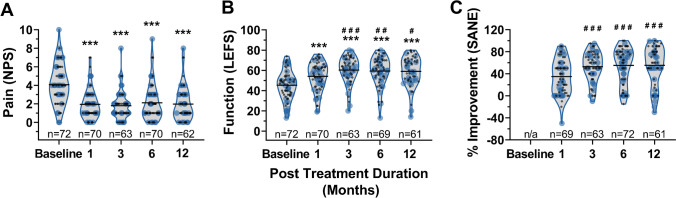
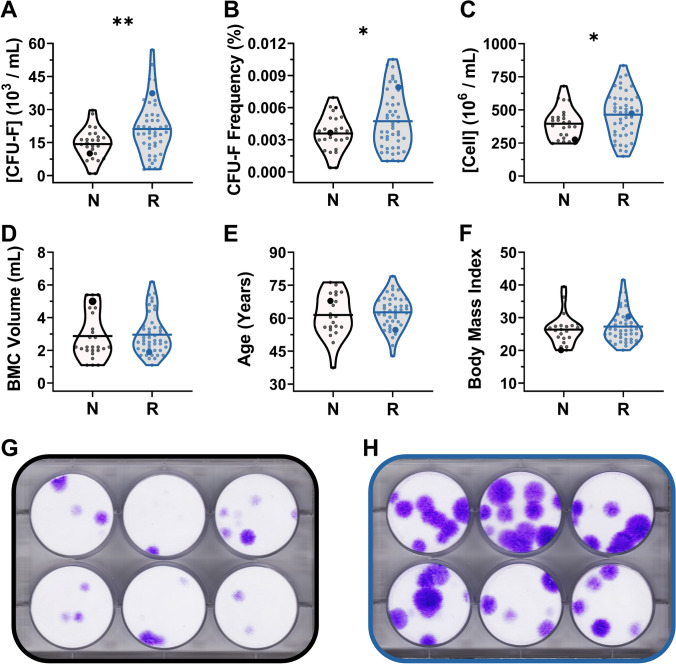
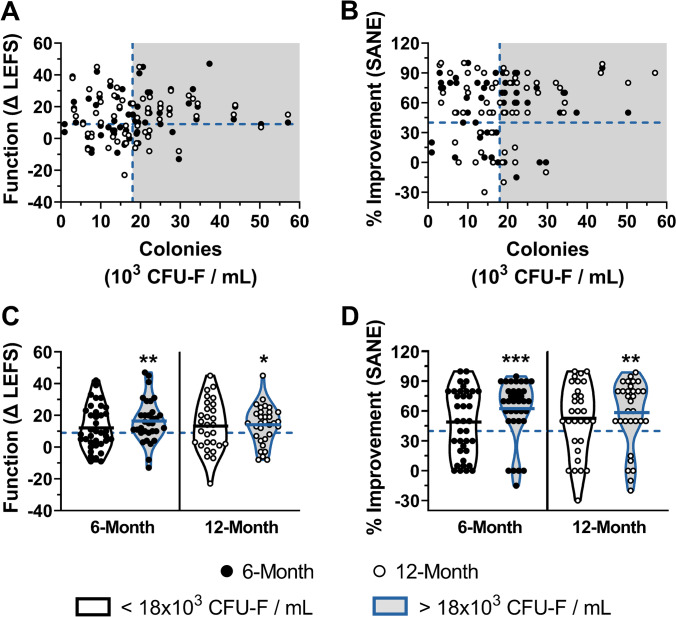
Results: Patients reported significant increases in function and overall percent improvement in addition to decreases in pain relative to baseline levels following treatment with autologous BMC that persisted through 12 months. Patients reporting improved outcomes (46 of 72 knees) received BMC injections having higher CFU-F concentrations than non-responding patients (21.1×10³ ± 12.4×10³ vs 14.3×10³ ± 7.0 x10³ CFU-F per mL). A progenitor cell concentration of 18×103 CFU-F per mL of BMC was found to best differentiate responders from non-responders.
Conclusion: This study provides supportive evidence for using autologous BMC in the minimally invasive treatment of knee OA and suggests that increased progenitor cell content leads to improved treatment outcomes.
Trial registration: ClinicalTrials.gov Identifier: NCT03011398, 1/7/17.
Keywords: Bone marrow concentrate (BMC); Colony-forming unit fibroblast (CFU-F); Connective tissue progenitor cells; Knee osteoarthritis (OA).
© 2022. The Author(s).
Conflict of interest statement
One or more of the authors has declared a potential conflict of interest. DRB, ED, and NJS are employed by Regenexx, LLC. CJC is a shareholder, patent holder, and chief medical officer of Regenexx, LLC, and an owner of the Centeno-Schultz Clinic. BTM and CWU are employed by the Centeno-Schultz Clinic.
Figures

Comment in
-
Letter to the editor: "Percutaneous autologous bone marrow concentrate for knee osteoarthritis: patient‑reported outcomes and progenitor cell content".Int Orthop. 2023 Jan;47(1):283. doi: 10.1007/s00264-022-05600-0. Epub 2022 Oct 7. Int Orthop. 2023. PMID: 36205742 No abstract available.
References
-
- Centeno CJ, Al-Sayegh H, Freeman MD, Smith J, Murrell WD, Bubnov R. A multi-center analysis of adverse events among two thousand, three hundred and seventy two adult patients undergoing adult autologous stem cell therapy for orthopaedic conditions. Int Orthop. 2016;40(8):1755–1765. doi: 10.1007/s00264-016-3162-y. - DOI - PubMed
Publication types
MeSH terms
Associated data
LinkOut - more resources
Full Text Sources
Medical
