. 2022 Aug 6;13(1):4598.
doi: 10.1038/s41467-022-32372-3.

A non-Hermitian optical atomic mirror

Affiliations

A non-Hermitian optical atomic mirror

Yi-Cheng Wang et al. Nat Commun. .

Abstract

Explorations of symmetry and topology have led to important breakthroughs in quantum optics, but much richer behaviors arise from the non-Hermitian nature of light-matter interactions. A high-reflectivity, non-Hermitian optical mirror can be realized by a two-dimensional subwavelength array of neutral atoms near the cooperative resonance associated with the collective dipole modes. Here we show that exceptional points develop from a nondefective degeneracy by lowering the crystal symmetry of a square atomic lattice, and dispersive bulk Fermi arcs that originate from exceptional points are truncated by the light cone. From its nontrivial energy spectra topology, we demonstrate that the geometry-dependent non-Hermitian skin effect emerges in a ribbon geometry. Furthermore, skin modes localized at a boundary show a scale-free behavior that stems from the long-range interaction and whose mechanism goes beyond the framework of non-Bloch band theory. Our work opens the door to the study of the interplay among non-Hermiticity, topology, and long-range interaction.


Conflict of interest statement

The authors declare no competing interests.

Figures
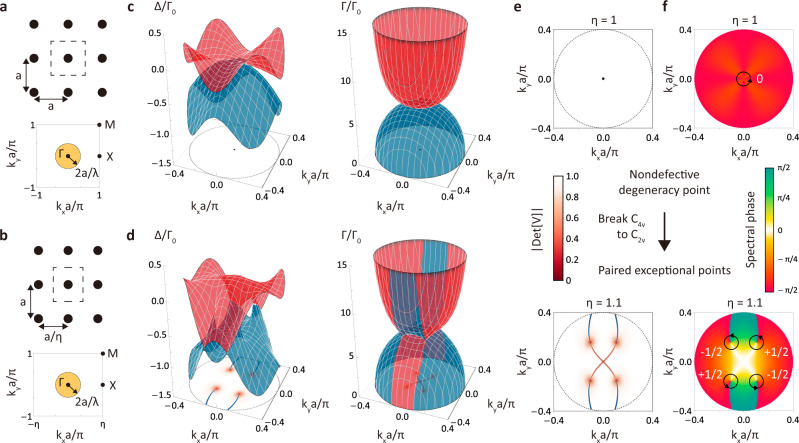
Fig. 1
Fig. 1. Paired exceptional points split from a nondefective degeneracy point.
Schematics of square (a) and rectangular (b) atomic lattices and their irreducible Brillouin zones in the subwavelength regime. The yellow circular region represents the light cone, wherein the system is non-Hermitian. Collective frequency shift Δk and overall decay rate Γk of infinite square (c) and rectangular (d) lattices within the light cone (black dashed circle). Two energy bands E1,2(k)=(ω0+Δk)i2Γk are colored in red and blue, respectively. e A non-Hermitian degeneracy point can be identified as NDP or EP by calculating det[V(k)]. The η = 1 case shows that the non-Hermitian degeneracy point at the high symmetry point Γ in c is an NDP, and the η = 1.1 case shows that four non-Hermitian degeneracy points in (d) corresponding to the coalescence of two eigenstates are EPs. These EPs are joined by the degeneracy of the real and imaginary parts of E1,2 (k) in (d), known as real (blue) and imaginary (red) Fermi arcs in the kx-ky plane. f The spectral phase that reflects the winding of bulk energy bands. The vorticity of NDP at η = 1 is zero, while that of each EP at η = 1.1 is a half-integer. The plots are obtained with a subwavelength lattice constant a = 0.2λ and η = 1.1 for rectangular lattice.
Fig. 2
Fig. 2. Geometry-dependent non-Hermitian skin effect in a ribbon geometry.
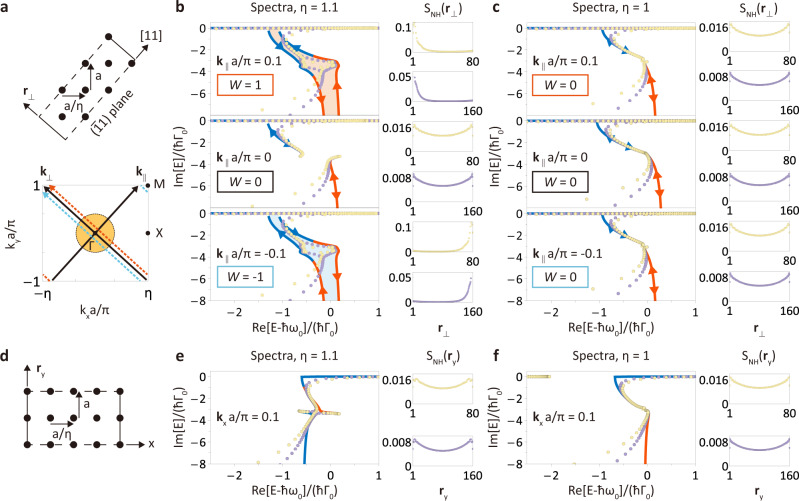
a Illustration of the ribbon geometry for a rectangular atomic lattice. The boundaries are open on the (1¯1) plane (dashed line) and extend infinitely in the [11] direction (solid line). Open boundary eigenenergy spectra σ[HL(k,r)] of rectangular (b, η = 1.1) and square (c, η = 1) lattices in ribbon geometries with a width of 80 and 160 unit cells (light yellow dots and purple dots, respectively) and the corresponding bulk spectra σ[Heff(k,k)]={E1,2(k,k)} (curves in red and blue) at fixed k = 0.1π/a (orange dashed line in a) and k = 0 (k axis in a) and k = − 0.1π/a (cyan dashed line in (a)). The non-Hermitian parts of σ[Heff(k,k)] result in the nontrivial winding (in (b) at finite k), and the corresponding spatial distributions demonstrate that there are extensive skin modes localized at the edge normal to r axis in a ribbon geometry. Otherwise, inversion and mirror symmetries lead to doubly degenerate spectral arcs with zero winding numbers, which suppress the NHSE. d Illustration of the ribbon geometry for a rectangular atomic lattice with open boundaries in the y direction. Open boundary eigenenergy spectra σ[HL(kx,ry)] of rectangular (e, η = 1.1) and square (f, η = 1) lattices in ribbon geometries. The mirror symmetries here lead to doubly degenerate spectral arcs and suppress the NHSE. The plots are obtained with the same parameters in Fig. 1.
Fig. 3
Fig. 3. Size dependence of non-Hermitian skin effect in a ribbon geometry.
a The OBC spectra at L = 40, 80, 160, 240, and 320 unit cells (light blue, light yellow, purple, dark green, and black, respectively) gradually approach bulk spectrum as L increases. b Rescaled probability distributions of normalized right eigenstates at 80 and 160 unit cells in the ascending order of the imaginary part of eigenenergy. N represents the number of localized modes in spatial distributions in Fig. 2b, c. c Rescaled probability distributions of the n = 0.2L eigenstates. The inset shows a crossover from a constant to scale-free characteristic length as system size increases, and a is the lattice constant for this ribbon geometry in the r direction. The plots are obtained with the same parameters in Fig. 2b at k = 0.1π/a.
Fig. 4
Fig. 4. Geometry-dependent non-Hermitian skin effect in rectangle and parallelogram-shaped boundaries.
Spectra and spatial distribution of non-Hermitian right eigenstates of 2D square (a, c) and rectangular (b, d) atomic lattices (a = 0.2λ) with rectangle (a, b) and parallelogram (c, d) shaped boundaries. At a fixed system size Lx × Ly = 60 × 30, only the geometry in (d) exhibits extensive skin modes localized at left and right boundaries since mirror symmetries of the other geometries suppress NHSE. Each mode is colored according to its population within the given boundaries (out of white dashed lines, leftmost and rightmost 6 sites), and those extensive skin modes in (d) are located around the exceptional points in the corresponding bulk spectra. In all the spectra, the nondefective degeneracy points and exceptional points are denoted by the red circles and red rectangles, respectively.

References

    1. Shahmoon E, Wild DS, Lukin MD, Yelin SF. Cooperative resonances in light scattering from two-dimensional atomic arrays. Phys. Rev. Lett. 2017;118:113601. doi: 10.1103/PhysRevLett.118.113601. - DOI - PubMed
    1. Rui J, et al. A subradiant optical mirror formed by a single structured atomic layer. Nature. 2020;583:369–374. doi: 10.1038/s41586-020-2463-x. - DOI - PubMed
    1. Asenjo-Garcia A, Moreno-Cardoner M, Albrecht A, Kimble HJ, Chang DE. Exponential improvement in photon storage fidelities using subradiance and "selective radiance” in atomic arrays. Phys. Rev. X. 2017;7:031024.
    1. Perczel J, et al. Topological quantum optics in two-dimensional atomic arrays. Phys. Rev. Lett. 2017;119:023603. doi: 10.1103/PhysRevLett.119.023603. - DOI - PubMed
    1. Bettles RJ, Minář J, Adams CS, Lesanovsky I, Olmos B. Topological properties of a dense atomic lattice gas. Phys. Rev. A. 2017;96:041603. doi: 10.1103/PhysRevA.96.041603. - DOI