


5,6-Dihydroxyindole eumelanin content in human skin with varying degrees of constitutive pigmentation
- PMID: 35933709
- PMCID: PMC9804219
- DOI: 10.1111/pcmr.13062
5,6-Dihydroxyindole eumelanin content in human skin with varying degrees of constitutive pigmentation
Abstract
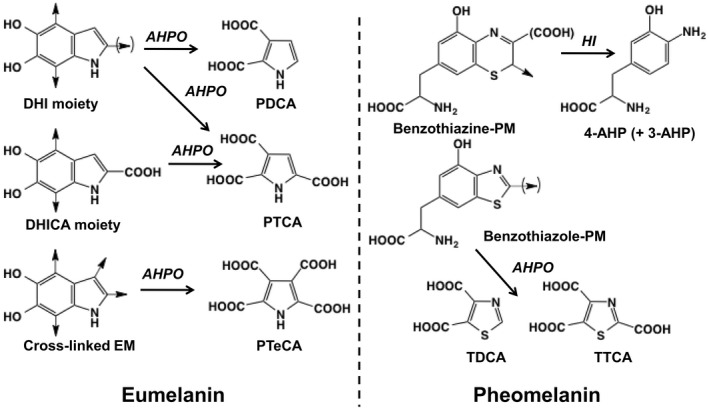
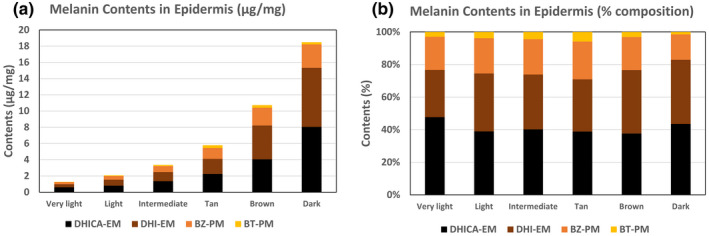
Human skin contains two distinct components: brown to black, insoluble eumelanin and light colored, alkaline-soluble pheomelanin. Eumelanin consists of 5,6-dihydroxyindole (DHI) and 5,6-dihydroxyindole-2-carboxylic acid (DHICA) moieties, while pheomelanin consists of benzothiazine (BT) and benzothiazole (BZ) moieties. These melanin monomer units can be quantitatively analyzed through specific degradation products by high-performance liquid chromatography (HPLC). Alkaline hydrogen peroxide oxidation (AHPO) of eumelanin gives rise to pyrrole-2,3,5-tricarboxylic acid (PTCA) and pyrrole-2,3-dicarboxylic acid (PDCA) as specific degradation products of the DHICA and DHI moieties, respectively. BZ moiety in pheomelanin can be analyzed as thiazole-2,4,5-tricarboxylic acid (TTCA). By reductive hydrolysis with hydroiodic acid, BT moieties in pheomelanin can be analyzed as 4-amino-3-hydroxyphenylalanine (4-AHP). As a recently improved AHPO-HPLC method enabled a better characterization of PDCA, this prompted us to address the question of DHI to DHICA ratio in human skin samples with varying degrees of constitutive pigmentation ranging from very light to dark. Results showed for the first time the ratio of 4 moieties: DHI 35%, DHICA 41%, BZ 20%, and BT 4%. The ratio is constant regardless of the degree of pigmentation. The high content of DHICA moiety may impart an antioxidant property to the epidermis melanin.
Keywords: 5,6-dihydroxyindole; 5,6-dihydroxyindole-2-carboxylic acid; eumelanin; pheomelanin; skin.
© 2022 The Authors. Pigment Cell & Melanoma Research published by John Wiley & Sons Ltd.
Conflict of interest statement
SDB and JS are full time employees of L'Oreal, Research and Innovation, Aulnay, France. SI has a consulting contract with L'Oreal, Research and Innovation. KW declares no conflict of interest.
Figures
References
-
- Corani, A. , Huijser, A. , Gustavsson, T. , Markovitsi, D. , Malmqvist, P. A. , Pezzella, A. , d'Ischia, M. , & Sundstrom, V. (2014). Superior photoprotective motifs and mechanisms in eumelanins uncovered. Journal of the American Chemical Society, 136(33), 11626–11635. 10.1021/ja501499q - DOI - PubMed
MeSH terms
Substances
LinkOut - more resources
Full Text Sources
Research Materials
