Review
. 2022 Oct:141:104814.
doi: 10.1016/j.neubiorev.2022.104814. Epub 2022 Aug 4.

The gut microbiome and Alzheimer's disease: Complex and bidirectional interactions

Affiliations
Review

The gut microbiome and Alzheimer's disease: Complex and bidirectional interactions

Rawan Tarawneh et al. Neurosci Biobehav Rev. 2022 Oct.

Abstract

Structural and functional alterations to the gut microbiome, referred to as gut dysbiosis, have emerged as potential key mediators of neurodegeneration and Alzheimer disease (AD) pathogenesis through the "gut -brain" axis. Emerging data from animal and clinical studies support an important role for gut dysbiosis in mediating neuroinflammation, central and peripheral immune dysregulation, abnormal brain protein aggregation, and impaired intestinal and brain barrier permeability, leading to neuronal loss and cognitive impairment. Gut dysbiosis has also been shown to directly influence various mechanisms involved in neuronal growth and repair, synaptic plasticity, and memory and learning functions. Aging and lifestyle factors including diet, exercise, sleep, and stress influence AD risk through gut dysbiosis. Furthermore, AD is associated with characteristic gut microbial signatures which offer value as potential markers of disease severity and progression. Together, these findings suggest the presence of a complex bidirectional relationship between AD and the gut microbiome and highlight the utility of gut modulation strategies as potential preventative or therapeutic strategies in AD. We here review the current literature regarding the role of the gut-brain axis in AD pathogenesis and its potential role as a future therapeutic target in AD treatment and/or prevention.

Keywords: Age; Alzheimer disease; Gut microbiome; Lifestyle; Prevention.


Figures

Fig. 1.
Fig. 1.
The Gut-Brain Axis. A schematic diagram demonstrating interactions between the brain and the gut via the gut-brain axis, including interactions mediated by gut secretion of toxins and metabolites, and gut modulation of the immune system leading to migration of immune cells and inflammatory markers across the blood-brain barrier. The central nervous system modulates gut motility and secretion via the enteric nervous system and the hypothalamic-pituitary axis. LPS, lipopoly-saccharide. Created with BioRender.com.
Fig. 2.
Fig. 2.
Potential mechanisms by which the gut microbiome contributes to AD pathogenesis. Animal and clinical studies suggest several mechanisms by which the gut microbiome contributes to the onset and progression of AD pathology, including modulation of innate and adaptive immunity, neuroinflammation and the release of cytokines and other inflammatory mediators, increased blood-brain barrier permeability, reduced integrity of the intestinal barrier leading to “leaky gut” which facilities the translocation of toxins into the circulation, increased protein aggregation including amyloid, tau, and synuclein, and direct effects on synaptic plasticity, memory, and learning processes. LPS, lipopolysaccharide; PSA, polysaccharide A; p-gp, p-glycoprotein. Created with BioRender.com.
Fig. 3.
Fig. 3.
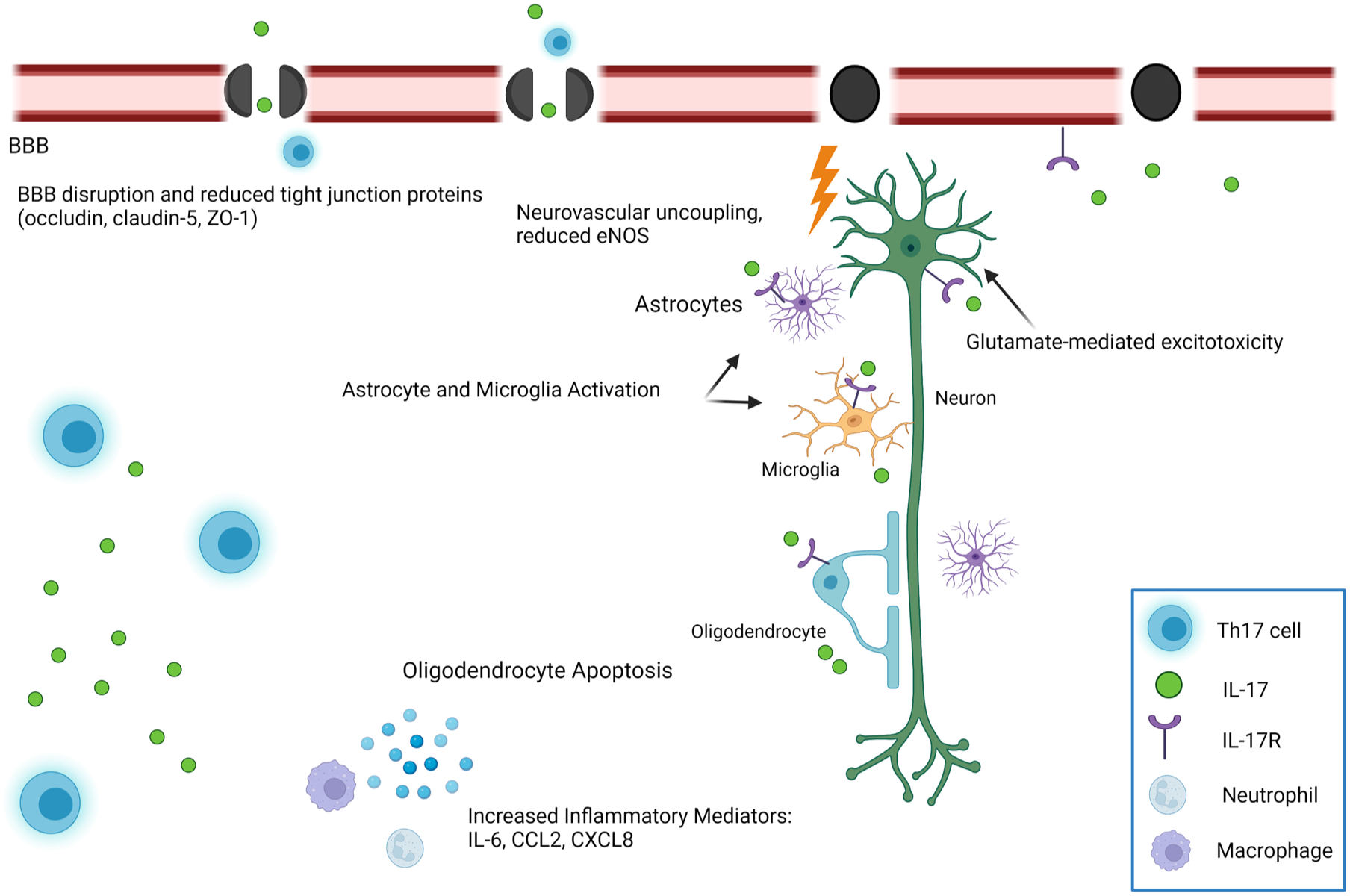
The Role of Interleukin-17 (IL-17) in AD Pathogenesis. One of the important inflammatory mediators by which gut dysbiosis contributes to AD pathogenesis is IL-17, produced by Th17 cells. IL-17 promotes neuronal and oligodendrocyte apoptosis, neuroinflammation through activation of astrocytes and microglia, neurovascular uncoupling, and increased calcium-mediated excitotoxicity, eventually leading to neuronal loss. Created with BioRender.com.
Fig. 4.
Fig. 4.
Proposed Modalities of Gut Modulation with Potential Benefits in AD Prevention or Treatment. Gut modulation through dietary modification, exercise, supplementation with probiotics, prebiotics, or the short chain fatty acid butyrate, and use of antibiotics have been investigated as potential strategies for AD prevention or treatment. This matrix summarizes the mechanisms by which each of these modalities influences AD pathogenesis. Further research is warranted to determine the safety and efficacy of other modalities, such as fecal microbiota transplantation (FMT). BBB, blood-brain barrier. Created with BioRender.com.

References

    1. Abduljaleel Z, Al-Allaf FA, Khan W, et al., 2014. Evidence of trem2 variant associated with triple risk of Alzheimer’s disease. PLoS One 9 (3), e92648. - PMC - PubMed
    1. Abraham D, Feher J, Scuderi GL, et al., 2019. Exercise and probiotics attenuate the development of Alzheimer’s disease in transgenic mice: role of microbiome. Exp. Gerontol 115, 122–131. - PubMed
    1. Akbari E, Asemi Z, Daneshvar Kakhaki R, et al., 2016. Effect of probiotic supplementation on cognitive function and metabolic status in Alzheimer’s disease: a randomized, double-blind and controlled trial. Front. Aging Neurosci 8, 256. - PMC - PubMed
    1. Alvarez CA, Jones MB, Hambor J, Cobb BA, 2020. Characterization of polysaccharide a response reveals interferon responsive gene signature and immunomodulatory marker expression. Front. Immunol 11. - PMC - PubMed
    1. Anderson JR, Carroll I, Azcarate-Peril MA, et al., 2017. A preliminary examination of gut microbiota, sleep, and cognitive flexibility in healthy older adults. Sleep. Med 38, 104–107. - PMC - PubMed

Publication types

Substances