


Interactional quality in middle schools: Latent profiles and their associations with teacher, classroom, and school compositional factors
- PMID: 35934452
- PMCID: PMC9360606
- DOI: 10.1016/j.jsp.2022.06.001
Interactional quality in middle schools: Latent profiles and their associations with teacher, classroom, and school compositional factors
Abstract
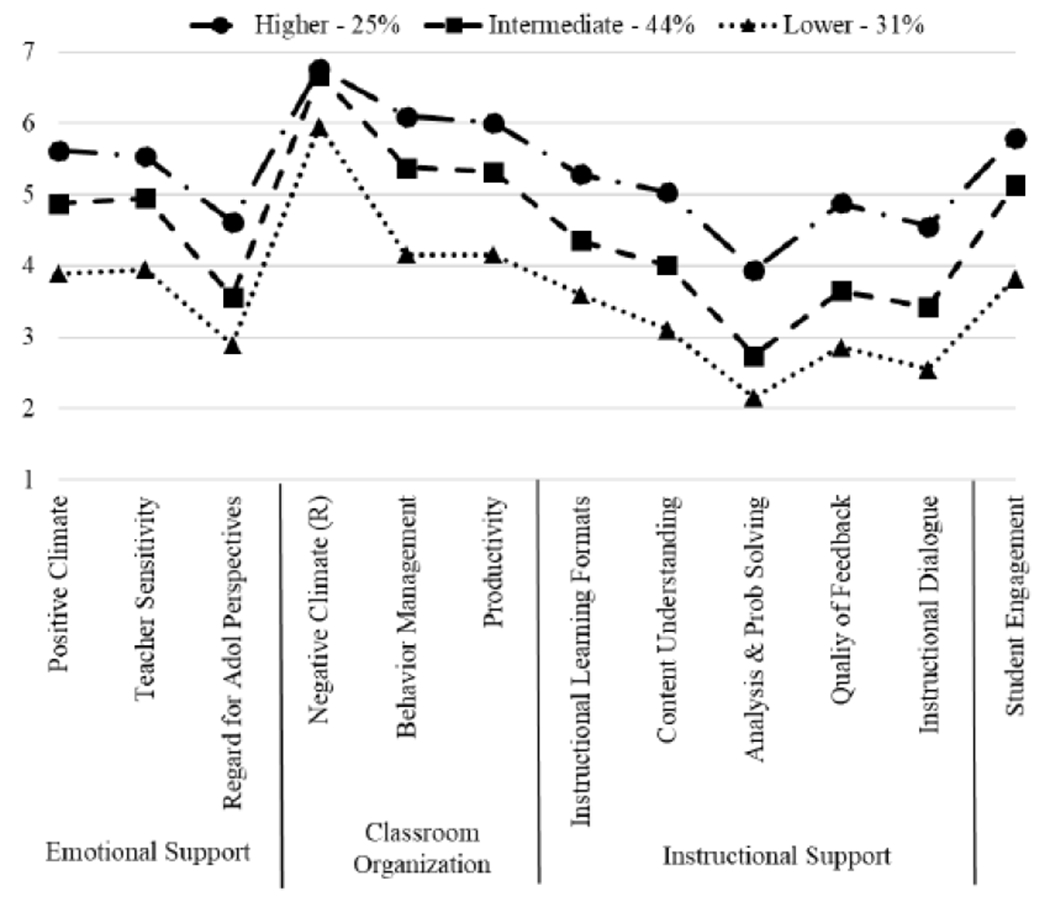
High quality teacher-student interactions are critical for the healthy social-emotional, behavioral, and academic development of middle school students. However, few studies have explored patterns of teacher-student interactions in middle school classrooms or the relation between teacher-, classroom-, and school-level factors and patterns of interaction. The current study employed latent profile analyses (LPA) to identify patterns of teacher-student interactional quality in a sample of 334 teachers from 41 schools serving middle school students within the Mid-Atlantic region of the U.S. Three distinct profiles of teacher-student interactional quality were identified that were characteristic of higher, lower, and intermediate quality and were differentially related to teacher, classroom, and school characteristics. Compared to classrooms with lower interactional quality, classrooms with "higher" or "intermediate" profiles were more likely to be taught by early career teachers, to have higher rates of observed student cooperation, and to be in schools in rural fringe areas. Classrooms with lower interactional quality were more likely to have larger student-to-teacher ratios and higher rates of student disruptive behaviors than classrooms with intermediate interactional quality and to be in schools with a higher percentage of out-of-school suspensions than classrooms with higher interactional quality. These findings suggest that interventions at the teacher, classroom, and school levels may promote positive teacher-student interactions, such as consultation to support teachers' effective classroom management, alternatives to out-of-school suspensions, and smaller student-to-teacher ratios.
Keywords: Contextual factors; Latent profiles; Teacher-student interactional quality.
Copyright © 2022 Society for the Study of School Psychology. Published by Elsevier Ltd. All rights reserved.
Conflict of interest statement
We have no known conflict of interest to disclose.
Figures
References
-
- Allen J, Gregory A, Mikami A, Lun J, Hamre B, & Pianta R (2013). Observations of effective teacher-student interactions in secondary school classrooms: Predicting student achievement with the classroom assessment scoring system-secondary. School Psychology Review, 42(1), 76–98. 10.1080/02796015.2013.12087492 - DOI - PMC - PubMed
-
- Aronson B, & Laughter J (2016). The theory and practice of culturally relevant education: A synthesis of research across content areas. Review of Educational Research, 86( 1), 163–206. 10.3102/0034654315582066 - DOI
-
- Asparouhov T, & Muthén B (2014). Auxiliary variables in mixture modeling: Three-step approaches using M plus. Structural Equation Modeling, 21(3), 329–341. 10.1080/10705511.2014.915181 - DOI
-
- Banfield JD, & Raftery AE (1993). Model-based Gaussian and non-Gaussian clustering. Biometrics, 49, 803–821. 10.2307/2532201 - DOI
-
- Barnett WS, Hustedt JT, Robin KB, & Schulman KL (2003). The state of preschool: 2003 preschool yearbook. The National Association for Early Education Research.
Publication types
MeSH terms
Grants and funding
LinkOut - more resources
Full Text Sources
Medical
Miscellaneous
