Review
. 2022 Dec;38(12):1271-1283.
doi: 10.1016/j.tig.2022.07.002. Epub 2022 Aug 4.

Phenotype-aware prioritisation of rare Mendelian disease variants

Affiliations
Review

Phenotype-aware prioritisation of rare Mendelian disease variants

Catherine Kelly et al. Trends Genet. 2022 Dec.

Abstract

A molecular diagnosis from the analysis of sequencing data in rare Mendelian diseases has a huge impact on the management of patients and their families. Numerous patient phenotype-aware variant prioritisation (VP) tools have been developed to help automate this process, and shorten the diagnostic odyssey, but performance statistics on real patient data are limited. Here we identify, assess, and compare the performance of all up-to-date, freely available, and programmatically accessible tools using a whole-exome, retinal disease dataset from 134 individuals with a molecular diagnosis. All tools were able to identify around two-thirds of the genetic diagnoses as the top-ranked candidate, with LIRICAL performing best overall. Finally, we discuss the challenges to overcome most cases remaining undiagnosed after current, state-of-the-art practices.

Keywords: molecular diagnosis; phenotype; rare disease; variant prioritisation; variant prioritization.


Conflict of interest statement

Declaration of interests The authors declare no conflict of interest.

Figures
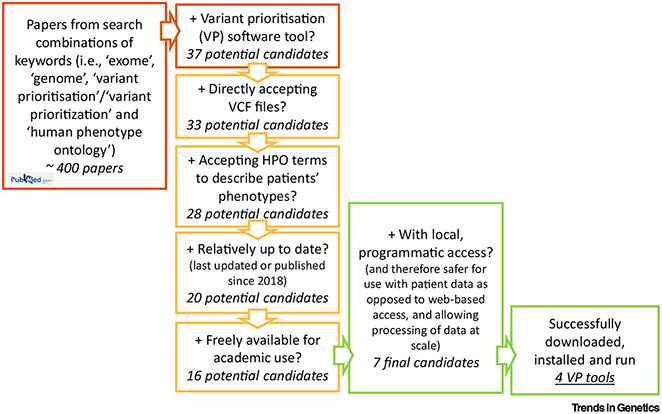
Figure 1.
Figure 1.. Flow chart of the literature search and filtering criteria used to select the final phenotype-aware variant prioritisation (VP) software tool candidates for benchmarking on real patient data.
Searches of combinations of keywords (red box) were conducted in PubMed. Phenotype-aware VP software tool candidates found in the resulting papers (37) were then narrowed down to seven final candidates based on five criteria: accepting variant call format (VCF) files; accepting Human Phenotype Ontology (HPO) terms; last updated or published since 2018; freely available; with local, programmatic access. Finally, four VP tools were successfully downloaded, installed, and run on real patient data for testing and comparison.
Figure 2.
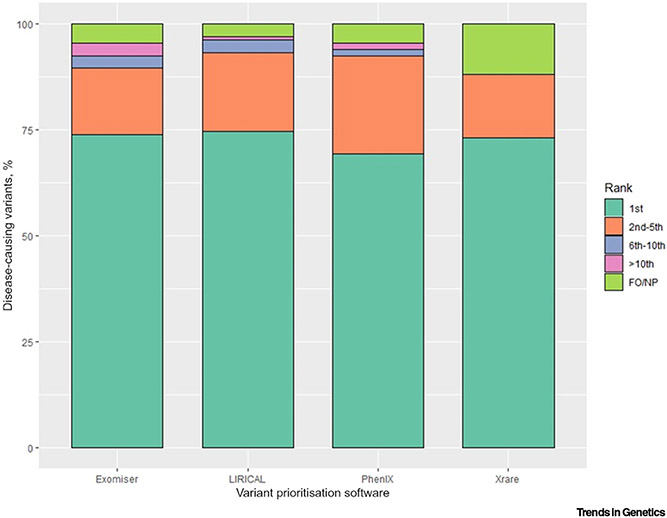
Figure 2.. Bar plot of the percentage categorical distribution of the disease-causing variant ranking in the inherited retinal disease (IRD) patient whole-exome sequencing (WES) dataset for the four successfully tested phenotype-aware variant prioritisation (VP) software tools.
The ranking results were categorised into five mutually exclusive bins: ‘Top’ (including top ties), ‘(2–5)’, ‘(6–10)’, ‘>10’, and ‘Filtered out/Not prioritised’ (FO/NP) (the latter being any disease-causing variant(s) failed to be kept in during the filtering/prioritisation step).
Figure 3.
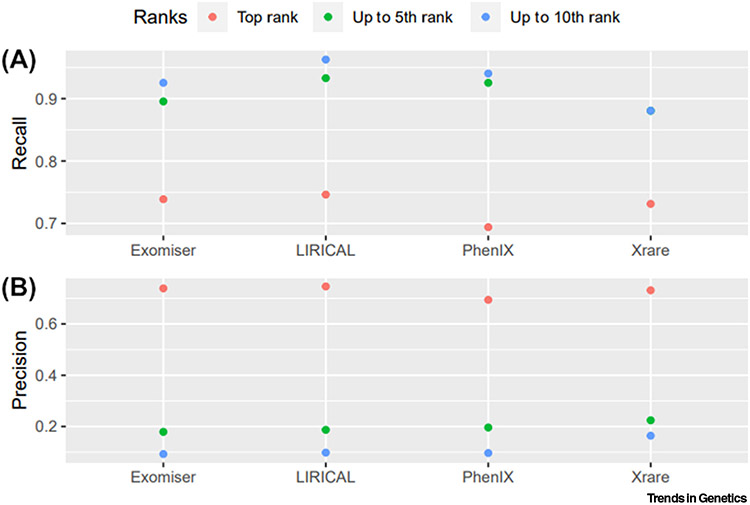
Figure 3.. Scatter plots of diagnostic measurements for the software performance of the four successfully tested phenotype-aware variant prioritisation (VP) software tools.
(A) Recall (true positive rate) and (B) precision were calculated from confusion matrices for the correctly diagnosed variants matched in the first rank, up to the fifth rank, and up to the tenth rank by each of the tested VP software tools. Recall (true positive rate) = true positives (TP)/actual positives; precision = TP/predicted positives. For Xrare, the recall estimate for the ‘up to the fifth rank’ analysis is equal to the recall estimate for the ‘up to the tenth rank’ analysis (i.e., 0.88).

References

    1. Smedley D et al. (2021) 100,000 Genomes pilot on rare-disease diagnosis in health care - preliminary report. N. Engl. J. Med 385, 1868–1880 - PMC - PubMed
    1. Caspar SM et al. (2018) Clinical sequencing: from raw data to diagnosis with lifetime value. Clin. Genet 93, 508–519 - PubMed
    1. De La Vega FM et al. (2021) Artificial intelligence enables comprehensive genome interpretation and nomination of candidate diagnoses for rare genetic diseases. Genome Med. 13, 153. - PMC - PubMed
    1. Wright CF et al. (2018) Paediatric genomics: diagnosing rare disease in children. Nat. Rev. Genet 19, 253–268 - PubMed
    1. Li J et al. (2018) Performance evaluation of pathogenicity-computation methods for missense variants. Nucleic Acids Res. 46, 7793–7804 - PMC - PubMed

Publication types