Relationship between gastroesophageal reflux disease and objective sleep quality
- PMID: 35934919
- PMCID: PMC9713921
- DOI: 10.5664/jcsm.10198
Relationship between gastroesophageal reflux disease and objective sleep quality
Abstract
Study objectives: To objectively characterize (1) the relationship between gastroesophageal reflux disease (GERD) and sleep quality, and (2) the influence of sleep position on this relationship, using in-laboratory polysomnography.
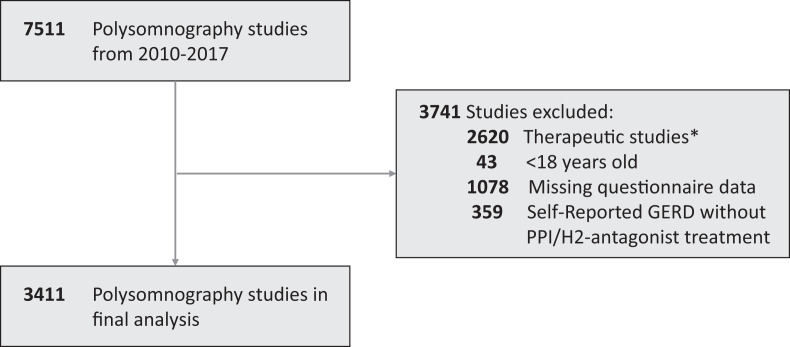
Methods: We retrospectively analyzed first-night diagnostic in-laboratory polysomnography data for 3411 patients (median age 55 years; 48% male). Medication use and medical condition data were obtained through self-reported questionnaires. Associations between sleep quality and the presence of GERD, and the influence of sleep position on these associations, were analyzed using multivariable linear regression models.
Results: After adjusting for age, sex, body mass index, and relevant comorbidities, GERD was associated with a 3.0% decrease in sleep efficiency, 8.8-minute increase in wake after sleep onset, 24.4-minute increase in rapid eye movement (REM) latency, 13.4-minute decrease in total sleep time, 1.4% decrease in %REM sleep, and 1.5% increase in %N3 sleep. Having both GERD and the majority of sleep on the right side was associated with an 8.6% decrease in sleep efficiency, 27.5-minute increase in wake after sleep onset, 35.6-minute decrease in total sleep time, 2.1% decrease in %REM sleep, and 3.5% increase in %N3 sleep. Having both GERD and the majority of sleep on the left side was associated with an 8.7-minute increase in sleep onset latency.
Conclusions: GERD is associated with an impairment in objective sleep quality. These associations were more pronounced in right-sided sleep and mostly ameliorated in left-sided sleep. Physicians should recognize the potential for poor sleep quality in patients with GERD and the effect of body position on this relationship.
Citation: Gurges P, Murray BJ, Boulos MI. Relationship between gastroesophageal reflux disease and objective sleep quality. J Clin Sleep Med. 2022;18(12):2731-2738.
Keywords: GERD; body position; polysomnography; sleep; sleep quality.
© 2022 American Academy of Sleep Medicine.
Conflict of interest statement
All authors have read and approved the final manuscript. Dr. Mark Boulos’ research program received support from the Mahaffy Family Research Fund. Patrick Gurges was supported by funding from a Branch Out Neurological Foundation summer student award. The authors report no conflicts of interest.
Figures
References
-
- Vakil N , van Zanten SV , Kahrilas P , Dent J , Jones R ; Global Consensus Group . The Montreal definition and classification of gastroesophageal reflux disease: a global evidence-based consensus . Am J Gastroenterol. 2006. ; 101 ( 8 ): 1900 – 1920, quiz 1943 . - PubMed
-
- Mittal R , Vaezi MF . Esophageal motility disorders and gastroesophageal reflux disease . N Engl J Med. 2020. ; 383 ( 20 ): 1961 – 1972 . - PubMed
-
- Klauser AG , Schindlbeck NE , Müller-Lissner SA . Symptoms in gastro-oesophageal reflux disease . Lancet. 1990. ; 335 ( 8683 ): 205 – 208 . - PubMed
-
- Dodds WJ , Dent J , Hogan WJ , et al. . Mechanisms of gastroesophageal reflux in patients with reflux esophagitis . N Engl J Med. 1982. ; 307 ( 25 ): 1547 – 1552 . - PubMed
Publication types
MeSH terms
LinkOut - more resources
Full Text Sources
Medical