Effectiveness of physical activity on immunity markers and quality of life in cancer patient: a systematic review
- PMID: 35935260
- PMCID: PMC9354736
- DOI: 10.7717/peerj.13664
Effectiveness of physical activity on immunity markers and quality of life in cancer patient: a systematic review
Abstract
Background: Cancer is a huge group of diseases that can affect various body parts of humans but also has a psychological, societal, and economic impact. Physical activity can improve the quality of life (QOL) and immunity, while moderate intensity exercise can reduce the probability of this lethal disease. The current study aimed to determine the effect of physical activity on immune markers and QOL in cancer patients as well as to evaluate cancer-related fatigue (CRF) and its association with physical activity.
Methodology: Before starting the study, the study protocol was registered in PROSPERO (registration number CRD42021273292). An electronic literature search was performed by combining MeSH terminology and keywords used with the Boolean operators "OR" and "AND" to find relevant published studies on PubMed, Scopus, Cochrane, and ScienceDirect databases. The Joanna Briggs Institute (JBI) critical evaluation checklist was used to assess the quality of selected studies, while the GRADE approach was used to see the quality of evidence.
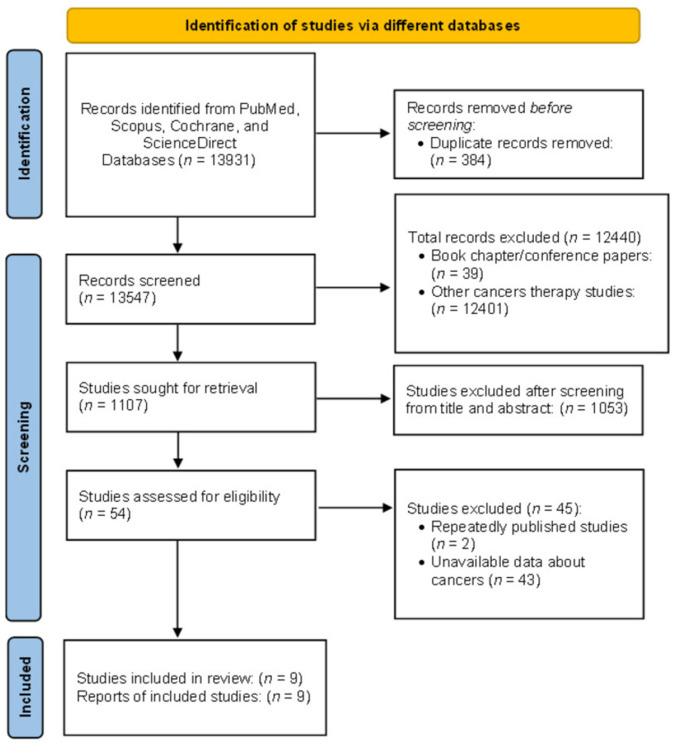
Results: A total of 13,931 studies were retrieved after the search on databases. After the scrutiny of studies by reading the title of articles and the inclusion/exclusion criteria, a total of 54 studies were selected for further screening by reading the full texts. In the final, a total of nine studies were selected for the current systematic review and proceeded for data extraction. The patients who were doing different exercises showed improvements in immunity, QOL, and reduction in CRF. A significant reduction in tumour necrosis factor-α (TNF-α), C reactive protein (CRP), interleukin-8 (IL-8), IL-6, and an increase in natural killer (NK) cells levels was also observed.
Conclusions: The exercise program is safe and beneficial to improve the quality of life and immunity markers before, during, and after cancer treatment. Physical exercise may also help patients to overcome the adverse effects of the treatment and to reduce the chance of developing new tumours in the future.
Keywords: Interprofessional; Palliative care; Patient care; Physiotherapy; Rehabilitation.
©2022 AL-Mhanna et al.
Conflict of interest statement
The authors declare there are no competing interests.
Figures
References
-
- Al-Hatamleh MA, Alshaer W, Ma’mon MH, Lambuk L, Ahmed N, Mustafa MZ, Low SC, Jaafar J, Ferji K, Six J-L. Applications of alginate-based nanomaterials in enhancing the therapeutic effects of bee products. Frontiers in Molecular Biosciences. 2022;9:865833. doi: 10.3389/fmolb.2022.865833. - DOI - PMC - PubMed
-
- Ashcroft GS, Jeong MJ, Ashworth JJ, Hardman M, Jin W, Moutsopoulos N, Wild T, McCartney-Francis N, Sim D, McGrady G. Tumor necrosis factor-alpha (TNF-α) is a therapeutic target for impaired cutaneous wound healing. Wound Repair and Regeneration. 2012;20(1):38–49. doi: 10.1111/j.1524-475X.2011.00748.x. - DOI - PMC - PubMed
-
- Basen-Engquist K, Taylor CLC, Rosenblum C, Smith MA, Shinn EH, Greisinger A, Gregg X, Massey P, Valero V, Rivera E. Randomized pilot test of a lifestyle physical activity intervention for breast cancer survivors. Patient Education and Counseling. 2006;64(1–3):225–234. doi: 10.1016/j.pec.2006.02.006. - DOI - PubMed
Publication types
MeSH terms
Substances
LinkOut - more resources
Full Text Sources
Medical
Research Materials
Miscellaneous