


MLCA2F: Multi-Level Context Attentional Feature Fusion for COVID-19 lesion segmentation from CT scans
- PMID: 35935538
- PMCID: PMC9346062
- DOI: 10.1007/s11760-022-02325-w
MLCA2F: Multi-Level Context Attentional Feature Fusion for COVID-19 lesion segmentation from CT scans
Abstract
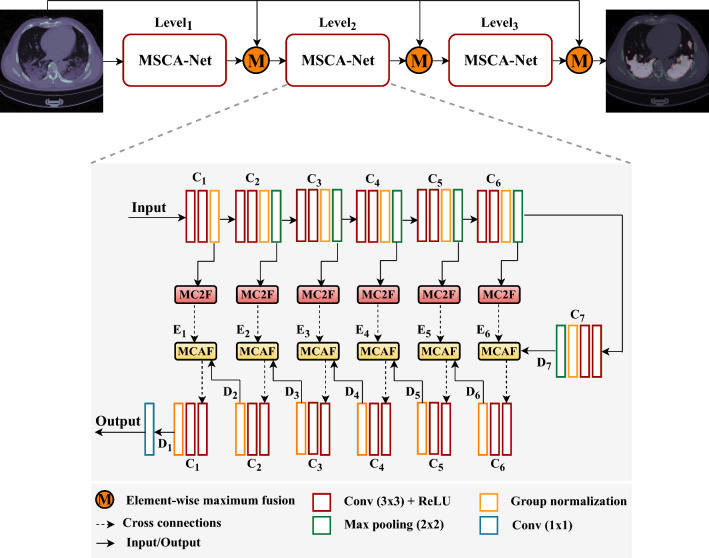
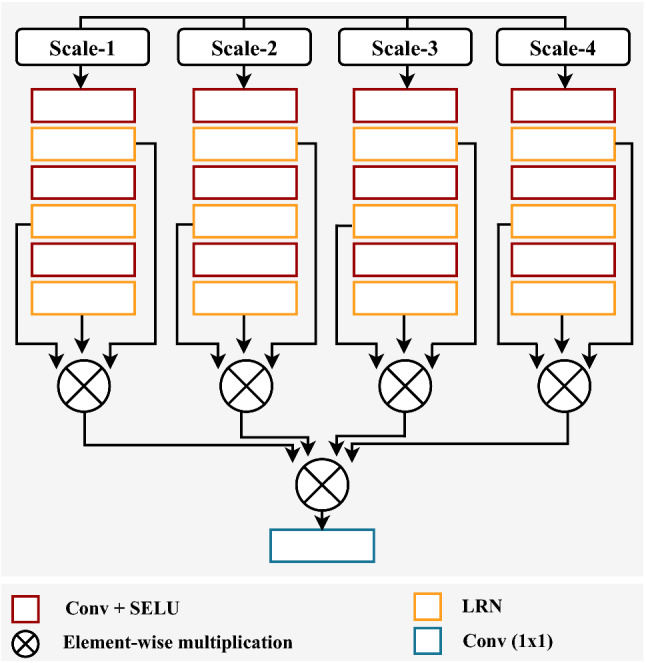
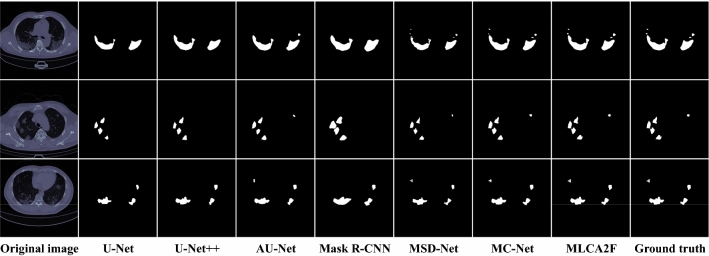
In the field of diagnosis and treatment planning of Coronavirus disease 2019 (COVID-19), accurate infected area segmentation is challenging due to the significant variations in the COVID-19 lesion size, shape, and position, boundary ambiguity, as well as complex structure. To bridge these gaps, this study presents a robust deep learning model based on a novel multi-scale contextual information fusion strategy, called Multi-Level Context Attentional Feature Fusion (MLCA2F), which consists of the Multi-Scale Context-Attention Network (MSCA-Net) blocks for segmenting COVID-19 lesions from Computed Tomography (CT) images. Unlike the previous classical deep learning models, the MSCA-Net integrates Multi-Scale Contextual Feature Fusion (MC2F) and Multi-Context Attentional Feature (MCAF) to learn more lesion details and guide the model to estimate the position of the boundary of infected regions, respectively. Practically, extensive experiments are performed on the Kaggle CT dataset to explore the optimal structure of MLCA2F. In comparison with the current state-of-the-art methods, the experiments show that the proposed methodology provides efficient results. Therefore, we can conclude that the MLCA2F framework has the potential to dramatically improve the conventional segmentation methods for assisting clinical decision-making.
Keywords: COVID-19 pneumonia; Context attentional features; Contextual information; Multi-level fusion; Multi-scale features; Segmentation.
© The Author(s), under exclusive licence to Springer-Verlag London Ltd., part of Springer Nature 2022, Springer Nature or its licensor holds exclusive rights to this article under a publishing agreement with the author(s) or other rightsholder(s); author self-archiving of the accepted manuscript version of this article is solely governed by the terms of such publishing agreement and applicable law.
Figures

References
-
- Murakami M, Miura F, Kitajima M, Fujii K, Yasutaka T, Iwasaki Y, Ono K, Shimazu Y, Sorano S, Okuda T, Ozaki A, Katayama K, Nishikawa Y, Kobashi Y, Sawano T, Abe T, Saito M, Tsubokura M, Naito W, Imoto S. COVID-19 risk assessment at the opening ceremony of the Tokyo 2020 Olympic Games. Microb. Risk Anal. 2021;19:00162. - PMC - PubMed
-
- Chen J, Wu L, Zhang J, Zhang L, Gong D, Zhao Y, Chen Q, Huang S, Yang M, Yang X, Hu S, Wang Y, Hu X, Zheng B, Zhang K, Wu H, Dong Z, Xu Y, Zhu Y, Chen X, Zhang M, Yu L, Cheng F, Yu H. Deep learning-based model for detecting 2019 novel coronavirus pneumonia on high-resolution computed tomography. Sci. Rep. 2020;10:1–11. - PMC - PubMed
LinkOut - more resources
Full Text Sources