


Oral anticoagulant decreases stroke recurrence in patients with atrial fibrillation detected after stroke
- PMID: 35935644
- PMCID: PMC9354040
- DOI: 10.3389/fcvm.2022.929304
Oral anticoagulant decreases stroke recurrence in patients with atrial fibrillation detected after stroke
Abstract
Background: Atrial fibrillation detected after stroke (AFDAS) has a lower risk of ischemic stroke recurrence than known atrial fibrillation (KAF). While the benefit of oral anticoagulants (OAC) for preventing ischemic stroke recurrence in KAF is well established, their role in patients with AFDAS is more controversial. This study aimed to evaluate the association between OAC use and the risk of recurrent ischemic stroke in patients with AFDAS in a real-world setting.
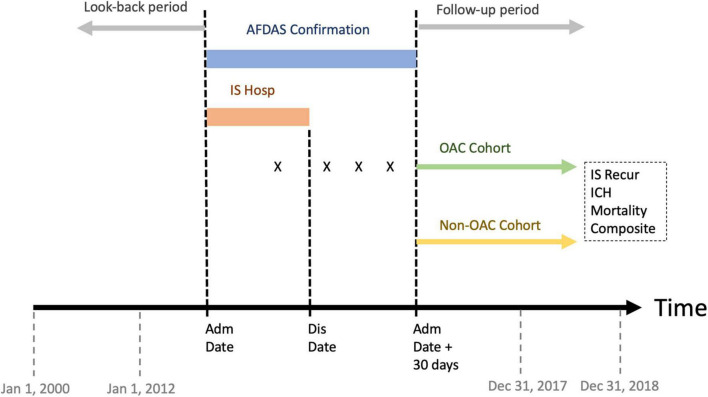
Methods: This nationwide retrospective cohort study was conducted using the Taiwan National Health Insurance Research Database. Patients hospitalized with a first-ever ischemic stroke and AFDAS confirmed within 30 days after hospitalization were assigned to OAC and non-OAC cohorts. Inverse probability of treatment weighting was applied to balance the baseline characteristics of the cohorts. The primary outcome was ischemic stroke recurrence. Secondary outcomes were intracranial hemorrhage (ICH), death, and the composite outcome of "ischemic stroke recurrence, ICH, or death." Multivariate Cox proportional hazard models were used to estimate adjusted hazard ratios (aHR) and 95% confidence intervals (CI).
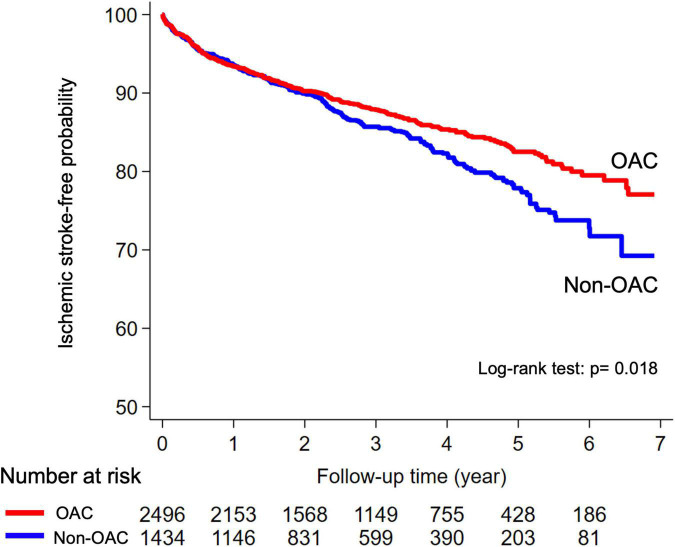
Results: A total of 4,508 hospitalized patients with stroke and AFDAS were identified. Based on OAC use, 2,856 and 1,652 patients were assigned to the OAC and non-OAC groups, respectively. During the follow-up period (median duration, 2.76 years), the OAC cohort exhibited a lower risk of ischemic stroke recurrence (aHR, 0.84; 95% CI, 0.70-0.99), death (aHR, 0.65; 95% CI, 0.58-0.73), and composite outcome (aHR, 0.70; 95% CI, 0.63-0.78) than did the non-OAC cohort. The risk of ICH (aHR, 0.96; 95% CI, 0.62-1.50) was not significantly different between the two cohorts.
Conclusion: OAC use in patients with AFDAS was associated with reduced risk of ischemic stroke recurrence, without an increased risk of ICH. This supports current guidelines recommending OACs for secondary stroke prevention in patients with AF, regardless of the time of diagnosis.
Keywords: anticoagulant; atrial fibrillation; atrial fibrillation detected after stroke; intracranial hemorrhage; ischemic stroke.
Copyright © 2022 Hsu, Liu, Sposato, Huang, Liu, Lai, Lin, Hsieh and Loh.
Conflict of interest statement
The authors declare that the research was conducted in the absence of any commercial or financial relationships that could be construed as a potential conflict of interest.
Figures
Similar articles
-
Atrial fibrillation diagnosed after stroke and dementia risk: cohort study of first-ever ischaemic stroke patients aged 65 or older.Europace. 2019 Dec 1;21(12):1793-1801. doi: 10.1093/europace/euz237. Europace. 2019. PMID: 31531673
-
Acute care and secondary prevention of stroke with newly detected versus known atrial fibrillation.Eur J Neurol. 2022 Jul;29(7):1963-1971. doi: 10.1111/ene.15338. Epub 2022 Apr 12. Eur J Neurol. 2022. PMID: 35344638
-
Characteristics and outcomes of ischemic stroke in patients with known atrial fibrillation or atrial fibrillation diagnosed after stroke.Int J Cardiol. 2018 Jun 15;261:68-72. doi: 10.1016/j.ijcard.2017.11.047. Int J Cardiol. 2018. PMID: 29657060
-
Risk of Recurrent Stroke, Mortality, and Intracerebral Hemorrhage in Patients With Atrial Fibrillation Detected Before or After a Stroke.Neurology. 2025 Mar 25;104(6):e213426. doi: 10.1212/WNL.0000000000213426. Epub 2025 Feb 25. Neurology. 2025. PMID: 39999395
-
Differences between Atrial Fibrillation Detected before and after Stroke and TIA: A Systematic Review and Meta-Analysis.Cerebrovasc Dis. 2022;51(2):152-157. doi: 10.1159/000520101. Epub 2021 Nov 29. Cerebrovasc Dis. 2022. PMID: 34844239
Cited by
-
Management of Patients Receiving Anticoagulation Therapy in Dental Practice: A Systematic Review.Healthcare (Basel). 2024 Aug 2;12(15):1537. doi: 10.3390/healthcare12151537. Healthcare (Basel). 2024. PMID: 39120240 Free PMC article. Review.
-
Differences between atrial fibrillation diagnosed before and after stroke: A large real-world cohort study.PLoS One. 2024 Aug 14;19(8):e0308507. doi: 10.1371/journal.pone.0308507. eCollection 2024. PLoS One. 2024. PMID: 39141631 Free PMC article.
-
Prevalence of atrial fibrillation in ischemic stroke and associated risk factors: A hospital-based study in Indonesia.Brain Circ. 2024 Dec 28;10(4):316-323. doi: 10.4103/bc.bc_36_24. eCollection 2024 Oct-Dec. Brain Circ. 2024. PMID: 40012599 Free PMC article.
-
Assessing Preparedness for Self-Management of Oral Anticoagulation in Adults With the PERSONAE Scale: Protocol for a Development and Validation Study.JMIR Res Protoc. 2025 Feb 26;14:e51502. doi: 10.2196/51502. JMIR Res Protoc. 2025. PMID: 40009845 Free PMC article.
-
Developing and Validating a Self-Care Self-Efficacy Scale for Oral Anticoagulation Therapy in Patients With Nonvalvular Atrial Fibrillation: Protocol for a Mixed Methods Study.JMIR Res Protoc. 2024 Sep 13;13:e51489. doi: 10.2196/51489. JMIR Res Protoc. 2024. PMID: 39269742 Free PMC article.
References
LinkOut - more resources
Full Text Sources
Medical
