


A Longitudinal Process Model Evaluating the Effects of Cooperative Learning on Victimization, Stress, Mental Health, and Academic Engagement in Middle School
- PMID: 35935738
- PMCID: PMC9345003
- DOI: 10.1007/s42380-022-00140-y
A Longitudinal Process Model Evaluating the Effects of Cooperative Learning on Victimization, Stress, Mental Health, and Academic Engagement in Middle School
Abstract
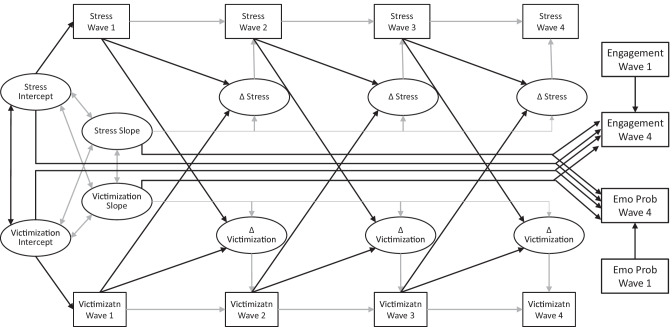
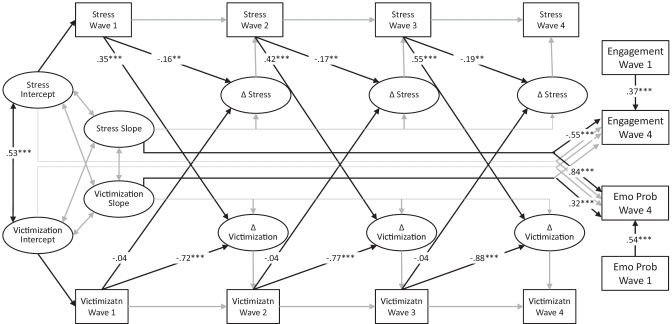
Mental health is a significant concern among young people, particularly during the COVID-19 pandemic. Notably, mental health problems can significantly reduce student performance in school, including both engagement and achievement. Both mental health problems and reduced student performance often arise due to peer victimization, which can include teasing, racial- or gender-based discrimination, and/or physical assault. Stress has been proposed as one mechanism through which victimization influences mental health, and stress can also interfere with academic performance at school, including engagement and achievement. To date, however, no research has evaluated longitudinal associations between victimization and stress, and how these longitudinal patterns may impact adolescent behavior and mental health. In this study, we used data from a 2-year cluster randomized trial of cooperative learning to evaluate an etiological process model that includes (1) longitudinal reciprocal effects between victimization and stress, and (2) the effects of both victimization and stress on student mental health and academic engagement. We hypothesized that victimization and stress would have significant reciprocal effects, and that both would predict greater mental health problems and lower academic engagement. We further hypothesized that cooperative learning would have significant effects on all constructs. We found partial support for this model, whereby stress predicted greater victimization, but victimization did not predict increased stress. While both factors were linked to student outcomes, stress was a more powerful predictor. We also found significant salutary effects of cooperative learning on all constructs. The implications of these results for student behavioral and mental health are discussed.
Keywords: Cooperative learning; Engagement; Mental health; Middle school; Stress; Victimization.
© The Author(s), under exclusive licence to Springer Nature Switzerland AG 2022, Springer Nature or its licensor holds exclusive rights to this article under a publishing agreement with the author(s) or other rightsholder(s); author self-archiving of the accepted manuscript version of this article is solely governed by the terms of such publishing agreement and applicable law.
Conflict of interest statement
Competing InterestsThe authors declare no competing interests.
Figures
References
-
- Aldridge JM, McChesney K. The relationships between school climate and adolescent mental health and wellbeing: A systematic literature review. International Journal of Educational Research. 2018;88:121–145. doi: 10.1016/j.ijer.2018.01.012. - DOI
-
- Aronen ET, Teerikangas OM, Kurkela SA. The continuity of psychiatric symptoms from adolescence into young adulthood. Nordic Journal of Psychiatry. 1999;53(5):333–338. doi: 10.1080/080394899427791. - DOI
Grants and funding
LinkOut - more resources
Full Text Sources