


Immune Evasion and Drug Resistance Mediated by USP22 in Cancer: Novel Targets and Mechanisms
- PMID: 35935969
- PMCID: PMC9347222
- DOI: 10.3389/fimmu.2022.918314
Immune Evasion and Drug Resistance Mediated by USP22 in Cancer: Novel Targets and Mechanisms
Abstract
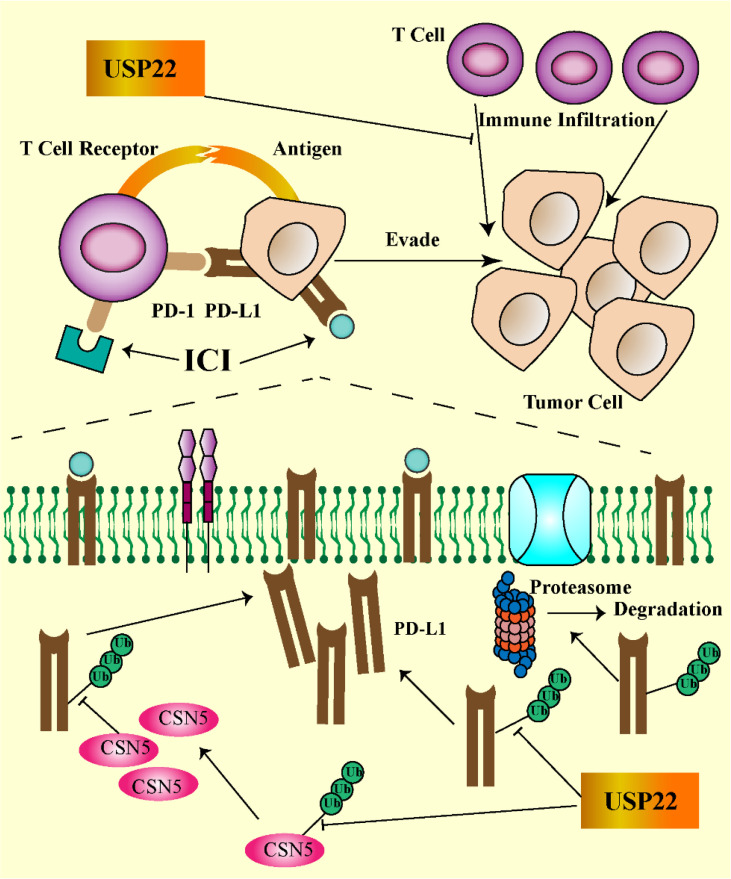
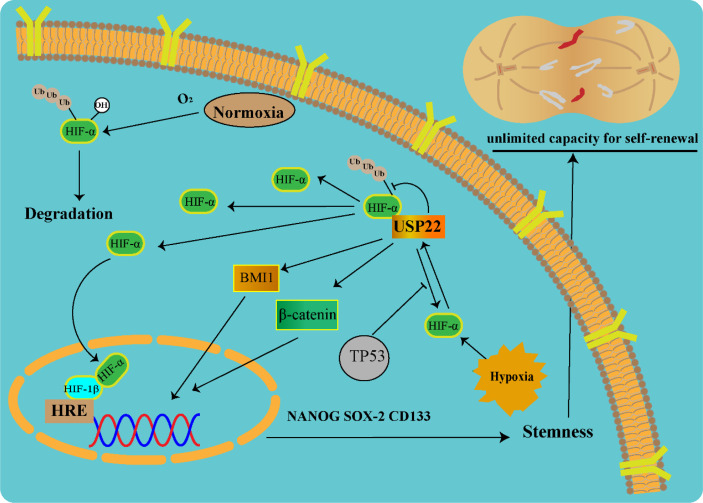
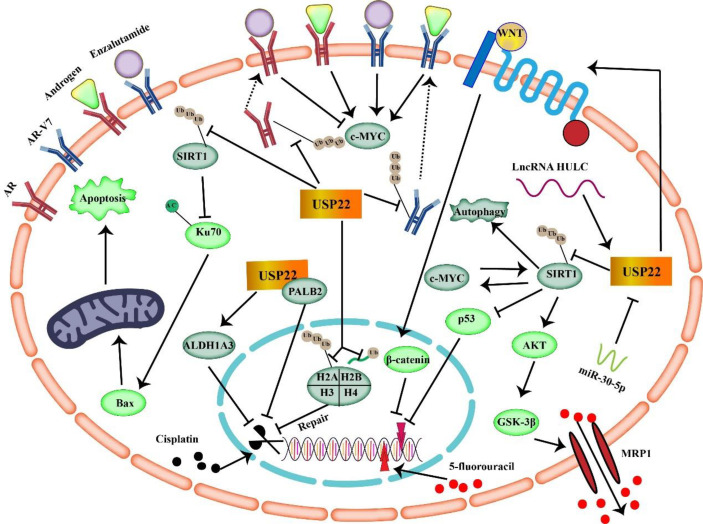
Regulation of ubiquitination is involved in various processes in cancer occurrence and development, including cell cycle arrest, cell proliferation, apoptosis, invasion, metastasis, and immunity. Ubiquitination plays an important role not only at the transcriptional and post-translational levels but also at the protein level. When ubiquitination is in a pathological state, abnormally activated biological processes will not only induce cancer progression but also induce immune evasion. The main function of deubiquitinases (DUBs) is to remove ubiquitin chains from substrates, changing the biological activity of the substrates. It has great potential to improve the prognosis of cancer by targeting DUB to regulate proteome. Ubiquitin-specific peptidase 22 (USP22) belongs to the ubiquitin-specific protease (USP) family of DUBs and has been reported to be related to various physiological and pathological processes. USP22 is abnormally expressed in various malignant tumors such as prostate cancer, lung cancer, liver cancer, and colorectal cancer, which suggests that USP22 may play an important role in tumors. USP22 may stabilize programmed death ligand 1 (PD-L1) by deubiquitination while also regulating T-cell infiltration into tumors. Regulatory T cells (Tregs) are a unique class of immunosuppressive CD4+ T cells that primarily suppress the immune system by expressing the master transcription factor forkhead box protein 3 (FOXP3). USP22 was found to be a positive regulator of stable FOXP3 expression. Treg-specific ablation of USP22 leads to reduced tumor volume in multiple cancer models. This suggests that USP22 may regulate tumor resistance to immunotherapy. In this article, we review and summarize the biological functions of USP22 in multiple signal transduction pathways during tumorigenesis, immune evasion, and drug resistance. Furthermore, we propose a new possibility of combining USP22 with chemotherapeutic, targeted, and immunosuppressive drugs in the treatment of cancer.
Keywords: DUBs; USP22; cancer; deubiquitination; immune evasion; ubiquitylation.
Copyright © 2022 Guo, Zhao, Fu, Xu and Huang.
Conflict of interest statement
The authors declare that the research was conducted in the absence of any commercial or financial relationships that could be construed as a potential conflict of interest.
Figures

Similar articles
-
The deubiquitinase USP22 regulates PD-L1 degradation in human cancer cells.Cell Commun Signal. 2020 Jul 14;18(1):112. doi: 10.1186/s12964-020-00612-y. Cell Commun Signal. 2020. PMID: 32665011 Free PMC article.
-
The secoiridoid glycoside Gentiopicroside is a USP22 inhibitor with potent antitumor immunotherapeutic activity.Biomed Pharmacother. 2024 Aug;177:116974. doi: 10.1016/j.biopha.2024.116974. Epub 2024 Jul 4. Biomed Pharmacother. 2024. PMID: 38968798
-
CRISPR screen in regulatory T cells reveals modulators of Foxp3.Nature. 2020 Jun;582(7812):416-420. doi: 10.1038/s41586-020-2246-4. Epub 2020 Apr 29. Nature. 2020. PMID: 32499641 Free PMC article.
-
Dissenting degradation: Deubiquitinases in cell cycle and cancer.Semin Cancer Biol. 2020 Dec;67(Pt 2):145-158. doi: 10.1016/j.semcancer.2020.03.008. Epub 2020 Mar 20. Semin Cancer Biol. 2020. PMID: 32201366 Free PMC article. Review.
-
Ubiquitin-specific peptidase 22 functions and its involvement in disease.Oncotarget. 2016 Jul 12;7(28):44848-44856. doi: 10.18632/oncotarget.8602. Oncotarget. 2016. PMID: 27057639 Free PMC article. Review.
Cited by
-
The Deubiquitinase USP22-Stabilized COL17A1 Promotes Lung Adenocarcinoma Progression.Clin Respir J. 2024 Aug;18(8):e13824. doi: 10.1111/crj.13824. Clin Respir J. 2024. PMID: 39143031 Free PMC article.
-
Comprehensive analysis of the role of ubiquitin-specific peptidases in colorectal cancer: A systematic review.World J Gastrointest Oncol. 2024 Jan 15;16(1):197-213. doi: 10.4251/wjgo.v16.i1.197. World J Gastrointest Oncol. 2024. PMID: 38292842 Free PMC article.
-
PTMs of PD-1/PD-L1 and PROTACs application for improving cancer immunotherapy.Front Immunol. 2024 Apr 4;15:1392546. doi: 10.3389/fimmu.2024.1392546. eCollection 2024. Front Immunol. 2024. PMID: 38638430 Free PMC article. Review.
-
USP22 as a key regulator of glycolysis pathway in osteosarcoma: insights from bioinformatics and experimental approaches.PeerJ. 2024 May 20;12:e17397. doi: 10.7717/peerj.17397. eCollection 2024. PeerJ. 2024. PMID: 38784391 Free PMC article.
-
Demethylzeylasteral induces PD-L1 ubiquitin-proteasome degradation and promotes antitumor immunity via targeting USP22.Acta Pharm Sin B. 2024 Oct;14(10):4312-4328. doi: 10.1016/j.apsb.2024.08.004. Epub 2024 Aug 8. Acta Pharm Sin B. 2024. PMID: 39525573 Free PMC article.
References
Publication types
MeSH terms
Substances
LinkOut - more resources
Full Text Sources
Medical
Research Materials
