Novel Zinc(II) and Copper(II) Complexes of 2-((2-Hydroxyethyl)amino)quinoline-3-carbaldehyde for Antibacterial and Antioxidant Activities: A Combined Experimental, DFT, and Docking Studies
- PMID: 35936450
- PMCID: PMC9352163
- DOI: 10.1021/acsomega.2c02205
Novel Zinc(II) and Copper(II) Complexes of 2-((2-Hydroxyethyl)amino)quinoline-3-carbaldehyde for Antibacterial and Antioxidant Activities: A Combined Experimental, DFT, and Docking Studies
Abstract
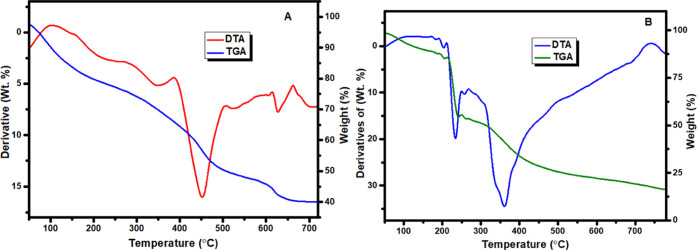
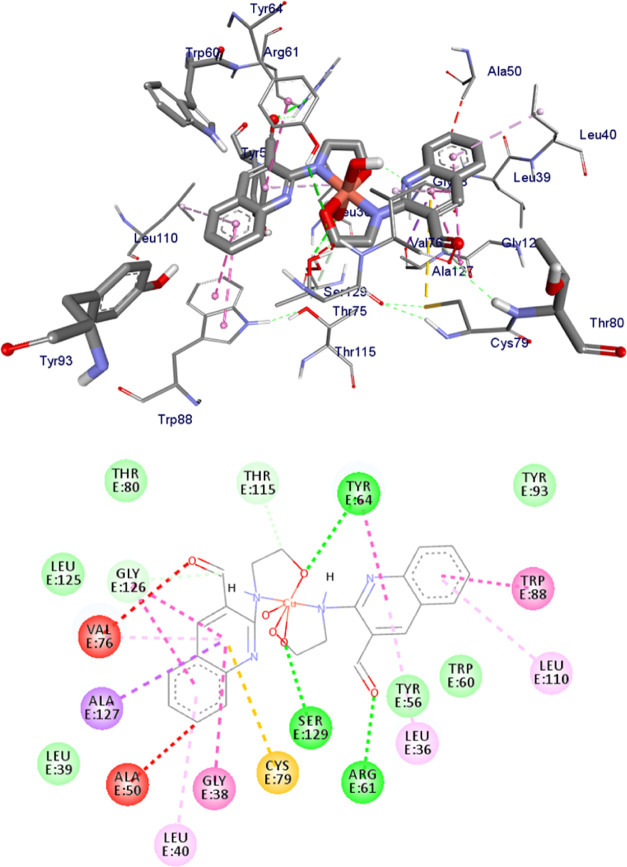
In the present work, two novel complexes of zinc(II) and copper(II) were synthesized from the ligand 2-((2-hydroxyethyl)amino)quinoline-3-carbaldehyde (H 2 L) in a 1:2 metal-to-ligand ratio in methanol. The complexes were characterized by UV-visible spectroscopy, fluorescence spectroscopy, Fourier transform infrared (FT-IR) spectroscopy, powder X-ray diffraction (XRD), scanning electron microscopy-energy-dispersive X-ray spectroscopy (SEM-EDX), mass spectrometry (MS), nuclear magnetic resonance (NMR) spectroscopy, and thermogravimetric analysis (TGA) experimental techniques and density functional theory (DFT) calculations. The spectral data revealed that the mono-deprotonated (HL) ligand acted as a bidentate ligand, which bound to both Zn(II) and Cu(II) ions via the nitrogen atom of the amine (N-H) and the hydroxyl (O-H) groups through the deprotonated oxygen atom. Formation constants and thermal analysis indicated that both metal complexes are stable up to 100 °C with thermodynamically favored chemical reactions. The Cu(II) complex showed antibacterial activities with the zones of inhibition of 20.90 ± 2.00 mm against Pseudomonas aeruginosa, 19.69 ± 0.71 mm against Staphylococcus aureus, and 18.58 ± 1.04 mm against Streptococcus pyogenes. These results are relatively higher compared with the Zn(II) complex at the same concentration. The minimum inhibitory concentration (MIC) results for the complexes also showed similar trends against the three bacteria. On the other hand, radical scavenging activities of both Cu(II) and Zn(II) complexes showed half-maximal inhibitory concentrations (IC50) of 4.72 and 8.2 μg/mL, respectively, while ascorbic acid (a positive control) has a value of 4.28 μg/mL. The Cu(II) complex exhibited better communication with the positive control, indicating its potential use for biological activities. The calculated and in silico molecular docking results also strongly support the experimental results.
© 2022 The Authors. Published by American Chemical Society.
Conflict of interest statement
The authors declare no competing financial interest.
Figures




References
-
- Vicente D.; Basterretxea M.; de la Caba I.; Sancho R.; López-Olaizola M.; Cilla G. Low Antimicrobial Resistance Rates of Mycobacterium Tuberculosis Complex between 2000 and 2015 in Gipuzkoa, Northern Spain. Enferm. Infecc. Microbiol. Clin. 2019, 37, 574–579. 10.1016/j.eimc.2019.01.016. - DOI - PubMed
-
- Kargar H.; Ardakani A. A.; Tahir M. N.; Ashfaq M.; Munawar K. S. Synthesis, Spectral Characterization, Crystal Structure and Antibacterial Activity of Nickel(II), Copper(II) and Zinc(II) Complexes Containing ONNO Donor Schiff Base Ligands. J. Mol. Struct. 2021, 1233, 1–12. 10.1016/j.molstruc.2021.130112. - DOI
-
- Kargar H.; Behjatmanesh-Ardakani R.; Torabi V.; Kashani M.; Chavoshpour-Natanzi Z.; Kazemi Z.; Mirkhani V.; Sahraei A.; Tahir M. N.; Ashfaq M.; Munawar K. S. Synthesis, Characterization, Crystal Structures, DFT, TD-DFT, Molecular Docking and DNA Binding Studies of Novel Copper(II) and Zinc(II) Complexes Bearing Halogenated Bidentate N,O-Donor Schiff Base Ligands. Polyhedron 2021, 195, 114988 10.1016/j.poly.2020.114988. - DOI
-
- Digafie Z.; Melaku Y.; Belay Z.; Eswaramoorthy R. Synthesis, Antibacterial, Antioxidant, and Molecular Modeling Studies of Novel [2,3′-Biquinoline]-4-Carboxylic Acid and Quinoline-3-Carbaldehyde Analogs. J. Chem. 2021, 2021, 1–17. 10.1155/2021/9939506. - DOI
LinkOut - more resources
Full Text Sources