Impact of Antecedent Infections on the Antibodies against Gangliosides and Ganglioside Complexes in Guillain-Barré Syndrome: A Correlative Study
- PMID: 35936588
- PMCID: PMC9350806
- DOI: 10.4103/aian.aian_121_22
Impact of Antecedent Infections on the Antibodies against Gangliosides and Ganglioside Complexes in Guillain-Barré Syndrome: A Correlative Study
Abstract
Background and aims: Guillain-Barré Syndrome (GBS), an immune-mediated neuropathy, is characterized by antibodies against gangliosides/ganglioside complexes (GSCs) of peripheral nerves. Antecedent infections have been reported to induce antibodies that cross-react with the host gangliosides and thereby have a pivotal role in conferring an increased risk for developing GBS. Data pertaining to the impact of various antecedent infections, particularly those prevalent in tropical countries like India on the ganglioside/GSC antibodies is sparse. We aimed at exploring the association between six antecedent infections and the profile of ganglioside/GSC antibodies in GBS.
Methods: Patients with GBS (n = 150) and healthy controls (n = 50) were examined for the serum profile of antibodies against GM1, GM2, GD1a, GD1b, GT1b, and GQ1b and their GSCs by ELISA. These antibodies were correlated with immunoreactivities against Campylobacter jejuni, Japanese encephalitis (JE), dengue, influenza, zika, and chikungunya infections.
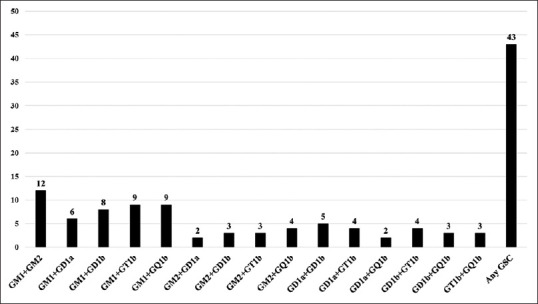
Results: The frequencies of antibodies against six single gangliosides (P < 0.001) and their GSCs (P = 0.039) were significantly higher in patients as compared to controls. Except for GT1b-antibody which was more frequent in axonal GBS, none of the other ganglioside/GSC antibodies correlated with the electrophysiological subtypes of GBS. Antecedent JE infection was significantly associated with increased frequency of antibodies against GD1a, GD1b, GT1b, and GQ1b. Antibodies against GSCs were not influenced by the antecedent infections.
Interpretation: This study for the first time shows an association between antecedent JE infection and ganglioside antibodies in GBS. This finding reinforces the determining role of antecedent infections on ganglioside antibody responses and the subsequent immunological processes in GBS.
Keywords: Antecedent infections; Guillain-Barré syndrome; Japanese encephalitis virus; autoantibodies; ganglioside complex; gangliosides.
Copyright: © 2022 Annals of Indian Academy of Neurology.
Conflict of interest statement
There are no conflicts of interest.
Figures
References
-
- Toscano G, Palmerini F, Ravaglia S, Ruiz L, Invernizzi P, Cuzzoni MG, et al. Guillain-Barré syndrome associated with SARS-CoV-2. N Engl J Med. 2020;382:2574–6. https://doi.org/10.1056/NEJMc2009191. - PMC - PubMed
-
- Jacobs BC, Rothbarth PH, van der Meché FG, Herbrink P, Schmitz PI, de Klerk MA, et al. The spectrum of antecedent infections in Guillain-Barré syndrome: A case-control study. Neurology. 1998;51:1110–5. - PubMed
-
- Sinha S, Prasad KN, Jain D, Pandey CM, Jha S, Pradhan S. Preceding infections and anti-ganglioside antibodies in patients with Guillain-Barré syndrome: A single centre prospective case-control study. Clin Microbiol Infect. 2007;13:334–7. - PubMed
LinkOut - more resources
Full Text Sources
Research Materials