


A Network-Guided Approach to Discover Phytochemical-Based Anticancer Therapy: Targeting MARK4 for Hepatocellular Carcinoma
- PMID: 35936719
- PMCID: PMC9355243
- DOI: 10.3389/fonc.2022.914032
A Network-Guided Approach to Discover Phytochemical-Based Anticancer Therapy: Targeting MARK4 for Hepatocellular Carcinoma
Abstract
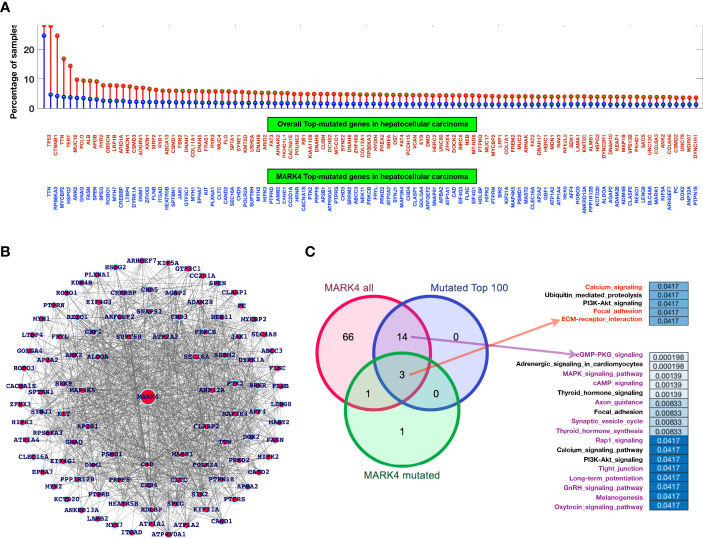
MAP/microtubule affinity-regulating kinase 4 (MARK4) is associated with various biological functions, including neuronal migration, cell polarity, microtubule dynamics, apoptosis, and cell cycle regulation, specifically in the G1/S checkpoint, cell signaling, and differentiation. It plays a critical role in different types of cancers. Hepatocellular carcinoma (HCC) is the one of the most common forms of liver cancer caused due to mutations, epigenetic aberrations, and altered gene expression patterns. Here, we have applied an integrated network biology approach to see the potential links of MARK4 in HCC, and subsequently identified potential herbal drugs. This work focuses on the naturally-derived compounds from medicinal plants and their properties, making them targets for potential anti-hepatocellular treatments. We further analyzed the HCC mutated genes from the TCGA database by using cBioPortal and mapped out the MARK4 targets among the mutated list. MARK4 and Mimosin, Quercetin, and Resveratrol could potentially interact with critical cancer-associated proteins. A set of the hepatocellular carcinoma altered genes is directly the part of infection, inflammation, immune systems, and cancer pathways. Finally, we conclude that among all these drugs, Gingerol and Fisetin appear to be the highly promising drugs against MARK4-based targets, followed by Quercetin, Resveratrol, and Apigenin.
Keywords: HCC; MARK4; biological networks; clinical relevance; herbal drugs; potential genes; signaling pathways.
Copyright © 2022 Ahmed, Mobashir, Al-Keridis, Alshammari, Adnan, Abid and Hassan.
Conflict of interest statement
The authors declare that the research was conducted in the absence of any commercial or financial relationships that could be construed as a potential conflict of interest.
Figures




References
-
- Consortium, T. I. C. G. committee, E. committee, E. A. P. group, T. A. C. A. W. group, T. W. group, B. A. W et al. PERSPECTIVES. Nature (2010) 464:993–8. doi: 10.1038/nature08987 - DOI
LinkOut - more resources
Full Text Sources
