


Is endoscopic combined intrarenal surgery ready for primetime in endourology? Outcomes from a systematic review and meta-analysis
- PMID: 35937663
- PMCID: PMC9326699
- DOI: 10.5173/ceju.2022.0049
Is endoscopic combined intrarenal surgery ready for primetime in endourology? Outcomes from a systematic review and meta-analysis
Abstract
Introduction: We aimed to review the outcomes of endoscopic combined intrarenal surgery (ECIRS) as compared to conventional percutaneous nephrolithotomy (PCNL) for kidney stones.
Material and methods: We performed a systematic literature review using MEDLINE, EMBASE, and Cochrane Central Controlled Register of Trials. We included all studies comparing ECIRS and conventional PCNL. Surgical time, hemoglobin drop, and postoperative stay were pooled using the inverse variance of the mean difference (MD) with a random effect, 95% confidence intervals (CI), and p-values. Complications, stone-free rate, and retreatment were assessed using Cochran-Mantel-Haenszel method with random effect model and expressed as odds ratio (OR), 95% CI, and p-values.
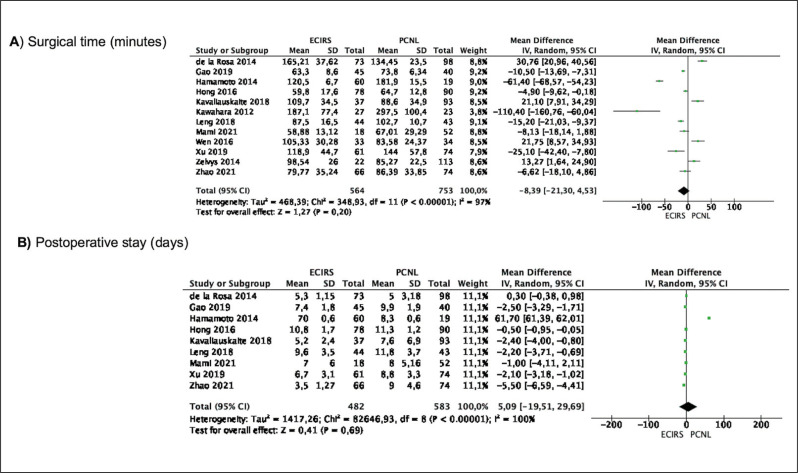
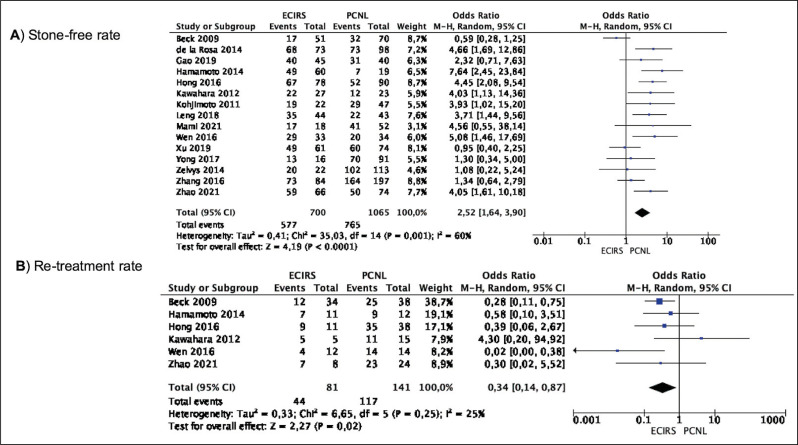
Results: A total of 17 studies were included. Surgical time and mean postoperative length did not significantly differ between the groups (MD -8.39 minutes 95%CI -21.30, 4.53, p = 0.20; 5.09 days 95%CI -19.51, 29.69, p = 0.69). Mean hemoglobin drop was significantly lower in the ECIRS group (MD -0.56 g/dl 95%CI -1.08, -0.05, p = 0.03), while blood transfusion rate did not differ between the two groups (OR 0.88 95%CI 0.64, 1.23, p = 0.15). While the incidence of postoperative sepsis did not differ between the two groups (OR 0.52 95% CI 0.17, 1.59, p = 0.25), the incidence of postoperative fever was lower in the ECIRS group but the difference was not significant (OR 0.61 95%CI 0.35, 1.06, p = 0.08). The stone-free rate was significantly higher in the PCNL group (OR 2.52 95%CI 1.64, 3.90, p <0.0001) and the retreatment rate was lower in the ECIRS group (OR 0.34 95%CI 0.14, 0.87, p = 0.002).
Conclusions: ECIRS showed shorter operative time, lower complication rate, and retreatment compared to PCNL. Conventional PCNL showed a higher stone-free rate.
Keywords: endoscopic combined intrarenal surgery; kidney stone; percutaneous nephrolithotomy; retrograde intrarenal surgery.
Copyright by Polish Urological Association.
Conflict of interest statement
The authors declare no conflicts of interest.
Figures





References
-
- Türk C, Petřík A, Sarica K, et al. EAU Guidelines on Interventional Treatment for Urolithiasis. Eur Urol. 2016;69:475–482. - PubMed
-
- Assimos D, Krambeck A, Miller NL, et al. Surgical Management of Stones: American Urological Association/Endourological Society Guideline, PART I. J Urol. 2016;196:1153–1160. - PubMed
-
- Cracco CM, Scoffone CM. ECIRS (Endoscopic Combined Intrarenal Surgery) in the Galdakao-modified supine Valdivia position: a new life for percutaneous surgery? World J Urol. 2011;29:821–827. - PubMed
-
- Scoffone CM, Cracco CM, Cossu M, Grande S, Poggio M, Scarpa RM. Endoscopic combined intrarenal surgery in Galdakao-modified supine Valdivia position: a new standard for percutaneous nephrolithotomy? Eur Urol. 2008;54:1393–1403. - PubMed
-
- Hamamoto S, Yasui T, Okada A, et al. Efficacy of endoscopic combined intrarenal surgery in the prone split-leg position for staghorn calculi. J Endourol. 2015;29:19–24. - PubMed
Publication types
LinkOut - more resources
Full Text Sources