


Restricted family presence for hospitalized surgical patients during the COVID-19 pandemic: How hospital care providers and families navigated ethical tensions and experiences of institutional betrayal
- PMID: 35937964
- PMCID: PMC9344808
- DOI: 10.1016/j.ssmqr.2022.100147
Restricted family presence for hospitalized surgical patients during the COVID-19 pandemic: How hospital care providers and families navigated ethical tensions and experiences of institutional betrayal
Abstract
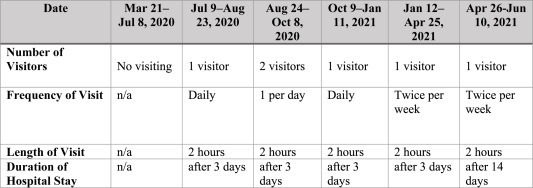
Early in the COVID-19 pandemic restricted family presence in hospitals was a widespread public health intervention to preserve critical resources and mitigate the virus's spread. In this study, we explore the experiences of surgical care providers and family members of hospitalized surgical patients during the period of highly restricted visiting (March 2020 to April 2021) in a large Canadian academic hospital. Thirty-four interviews were completed with hospital providers, family members and members of the hospital's visitor task force. To understand hospital providers' experiences, we highlight the ethical tensions produced by the biomedical and public health ethics frameworks that converged during COVID-19 in hospital providers' bedside practice. Providers grappled with mixed feelings in support of and against restricted visiting, while simultaneously experiencing gaps in resources and care and acting as patient gatekeepers. To understand family members' experiences of communication and care, we use the theory of institutional betrayal to interpret the negative impacts of episodic and systemic communication failures during restricted visiting. Family members of the most vulnerable patients (and patients) experienced short- and long-term effects including anxiety, fear, and refusal of further care. Our analysis draws attention to the complex ways that hospital care providers and families of hospitalized surgical patients sought to establish and reconfigure how trust and patient-centeredness could be achieved under these unprecedented conditions. Practical learnings from this study suggest that if family presence in hospitals must be limited in the future, dedicated personnel for communication and emotional support for patients, families and staff must be prioritized.
Keywords: COVID-19; Ethics; Patient-centered care; Qualitative research; Surgery; Visitor restrictions.
© 2022 Published by Elsevier Ltd.
Conflict of interest statement
The authors declare that they have no known competing financial interests or personal relationships that could have appeared to influence the work reported in this paper.
Figures
Similar articles
-
Family caregivers as essential partners in care: examining the impacts of restrictive acute care visiting policies during the COVID-19 pandemic in Canada.BMC Health Serv Res. 2023 Mar 31;23(1):320. doi: 10.1186/s12913-023-09248-3. BMC Health Serv Res. 2023. PMID: 37004050 Free PMC article.
-
The effects of visitor restrictions on inpatients and family visitors during the COVID-19 pandemic: insights from a cross-sectional survey in China.BMC Public Health. 2024 Nov 14;24(1):3158. doi: 10.1186/s12889-024-20614-6. BMC Public Health. 2024. PMID: 39538206 Free PMC article.
-
The patient experience of patient-centered communication with nurses in the hospital setting: a qualitative systematic review protocol.JBI Database System Rev Implement Rep. 2015 Jan;13(1):76-87. doi: 10.11124/jbisrir-2015-1072. JBI Database System Rev Implement Rep. 2015. PMID: 26447009
-
Healthcare stakeholders' perceptions and experiences of factors affecting the implementation of critical care telemedicine (CCT): qualitative evidence synthesis.Cochrane Database Syst Rev. 2021 Feb 18;2(2):CD012876. doi: 10.1002/14651858.CD012876.pub2. Cochrane Database Syst Rev. 2021. PMID: 33599282 Free PMC article.
-
Consequences of visiting restrictions during the COVID-19 pandemic: An integrative review.Int J Nurs Stud. 2021 Sep;121:104000. doi: 10.1016/j.ijnurstu.2021.104000. Epub 2021 Jun 12. Int J Nurs Stud. 2021. PMID: 34242976 Free PMC article. Review.
Cited by
-
The spiritual needs of surgical patients in Iranian hospital settings: a qualitative study.BMC Res Notes. 2025 Apr 10;18(1):155. doi: 10.1186/s13104-025-07228-w. BMC Res Notes. 2025. PMID: 40205456 Free PMC article.
-
The Enduring Effects of COVID for Cancer Care: Learning from Real-Life Clinical Practice.Clin Cancer Res. 2023 May 1;29(9):1670-1677. doi: 10.1158/1078-0432.CCR-23-0151. Clin Cancer Res. 2023. PMID: 36920243 Free PMC article.
-
Healthcare Provider's Preferences on Open Versus Restricted Visiting Hours in Surgical Intensive Care Unit.Cureus. 2024 Sep 21;16(9):e69871. doi: 10.7759/cureus.69871. eCollection 2024 Sep. Cureus. 2024. PMID: 39435240 Free PMC article.
References
-
- Allinson R.E. The primacy of duty and its efficacy in combating COVID-19. Public Health Ethics. 2020;13(2):179–189. doi: 10.1093/phe/phaa029. - DOI
-
- Annear S. ICU doctor shares heartbreaking impact of hospital visitor bans as coronavirus spreads. Boston Globe. 2020 www.bostonglobe.com/2020/03/30/nation/icu-doctor-shares-heartbreaking-im...
-
- Arakelyan S., Jailobaeva K., Dakessian A., Diaconu K., Caperon L., Strang A., et al. The role of trust in health-seeking for non-communicable disease services in fragile contexts: A cross-country comparative study. Social Science & Medicine. 2021;291 doi: 10.1016/j.socscimed.2021.114473. - DOI - PMC - PubMed
LinkOut - more resources
Full Text Sources
Miscellaneous