


Facial Nerve Paralysis and COVID-19: A Systematic Review
- PMID: 35938708
- PMCID: PMC9538897
- DOI: 10.1002/lary.30333
Facial Nerve Paralysis and COVID-19: A Systematic Review
Abstract
Objective: Several cases of facial nerve paralysis (FNP) post-COVID-19 infection have been reported with varying presentations and management. This study aims to identify FNP clinical characteristics and recovery outcomes among patients acutely infected with COVID-19. We hypothesize that FNP is a potentially unique sequalae associated with COVID-19 infections.
Methods: A systematic review of PubMed-Medline, OVID Embase, and Web of Science databases from inception to November 2021 was conducted following the Preferred Reporting Items for Systematic Reviews and Meta-Analyses guidelines.
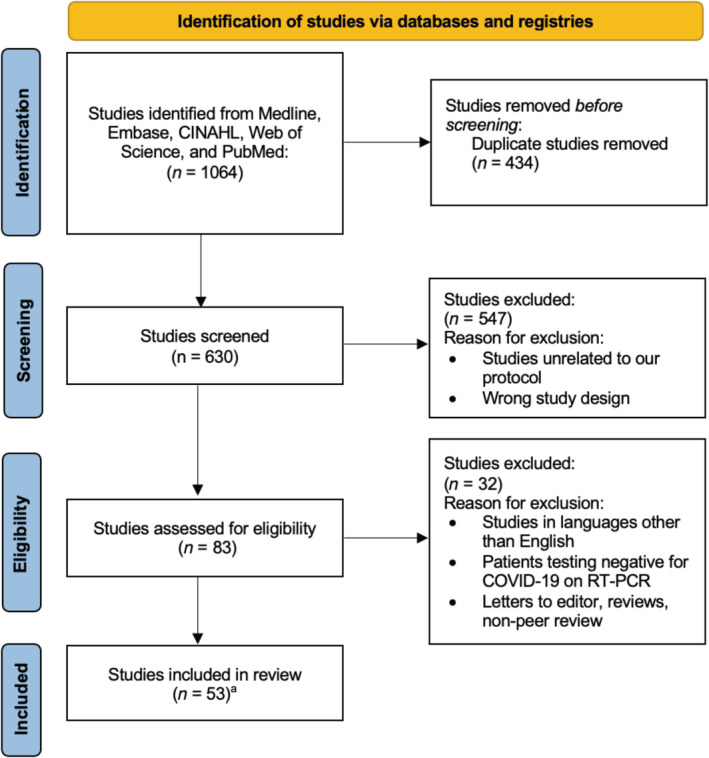
Results: This search identified 630 studies with 53 meeting inclusion criteria. This resulted in 72 patients, of which 30 (42%) were diagnosed with Guillain-Barré Syndrome (GBS). Non-GBS patients were on average younger (36 vs. 53 years) and more likely to present with unilateral FNP (88%) compared to GBS patients who presented predominantly with bilateral FNP (74%). Among non-GBS patients, majority (70%) of FNP presented a median of 8 [IQR 10] days after the onset of initial COVID-19 symptom(s). Treatment for non-GBS patients consisted of steroids (60%), antivirals (29%), antibiotics (21%), and no treatment (21%). Complete FNP recovery in non-GBS patients was achieved in 67% patients within a median of 11 [IQR 24] days.
Conclusion: FNP is a possible presentation post COVID-19 infections, associated with both GBS and non-GBS patients. Although no causation can be assumed, the clinical course of isolated FNP associated with COVID-19 raises the possibility of a unique presentation differing from Bell's palsy, seen with higher proportion of patients developing bilateral FNP and a shorter duration to complete recovery. Laryngoscope, 133:1007-1013, 2023.
Keywords: Bell's palsy; COVID-19; facial nerve; paralysis.
© 2022 The American Laryngological, Rhinological and Otological Society, Inc.
Figures
References
-
- Movérare T, Lohmander A, Hultcrantz M, Sjögreen L. Peripheral facial palsy: speech, communication and oral motor function. Eur Ann Otorhinolaryngol Head Neck Dis. 2017;134(1):27‐31. - PubMed
-
- Lorch M, Teach SJ. Facial nerve palsy: etiology and approach to diagnosis and treatment. Pediatr Emerg Care. 2010;26(10):763‐769. - PubMed
-
- Goh Y, Beh DLL, Makmur A, Somani J, Chan ACY. Pearls & Oy‐sters: facial nerve palsy in COVID‐19 infection. Neurology. 2020;95(8):364‐367. - PubMed
Publication types
MeSH terms
Substances
LinkOut - more resources
Full Text Sources
Medical
