Serial neurocognitive changes following transcatheter aortic valve replacement: comparison between low and intermediate-high risk groups
- PMID: 35939340
- PMCID: PMC9417238
- DOI: 10.18632/aging.204202
Serial neurocognitive changes following transcatheter aortic valve replacement: comparison between low and intermediate-high risk groups
Abstract
Background: Data comparing the neurocognitive trajectory between low and intermediate-high risk patients following transcatheter aortic valve replacement (TAVR) is never reported.
Aims: To report serial neurocognitive changes up to 1 year post-TAVR in low and intermediate-high risk groups as well as overall cohort.
Methods: Prospective neurological assessments (NIHSS and Barthel Index), global cognitive tests (MMSE and Alzheimer Disease Assessment Scale-Cognitive Subtest, ADAS-cog) and executive performances (Color Trail Test A and B and verbal fluency), were applied at baseline, 3 months and 1 year post-TAVR.
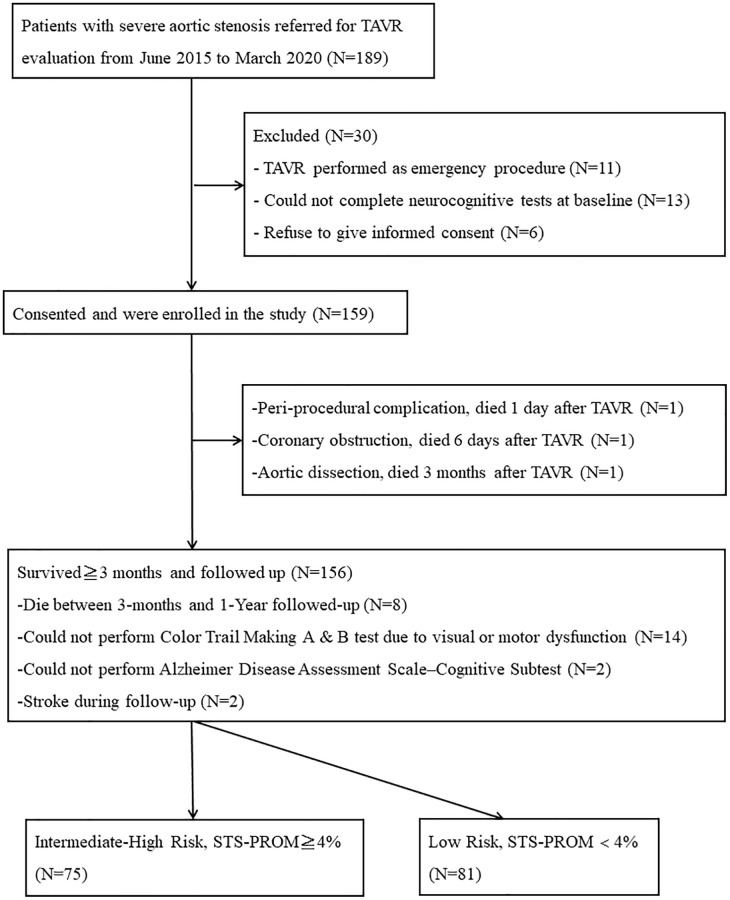
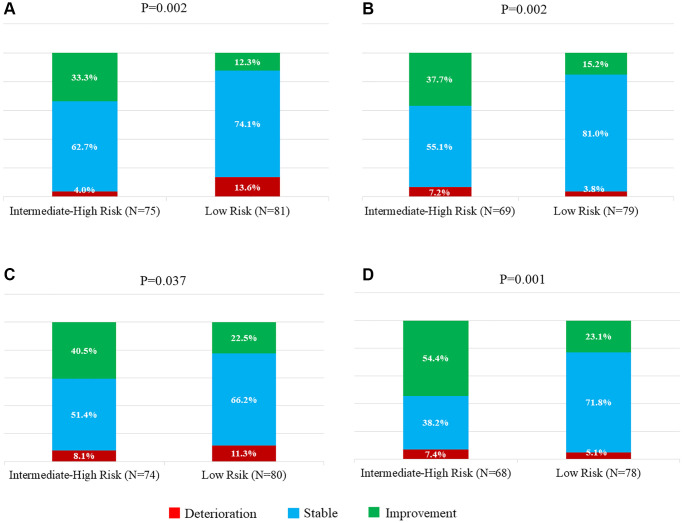
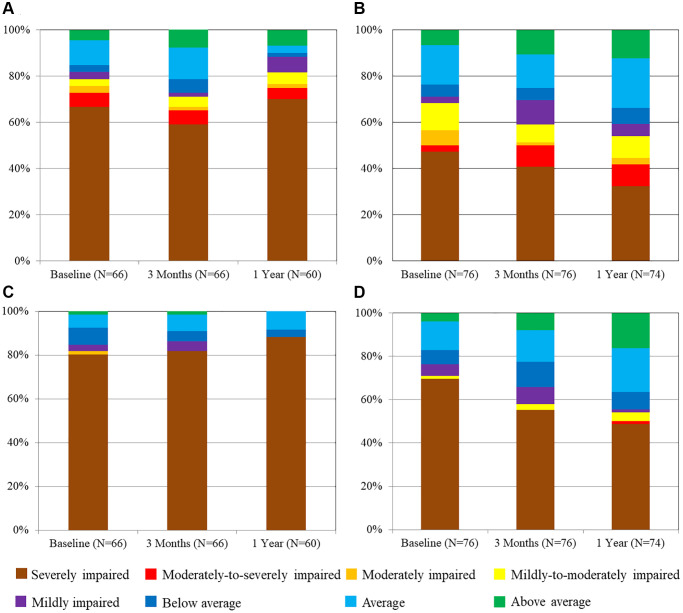
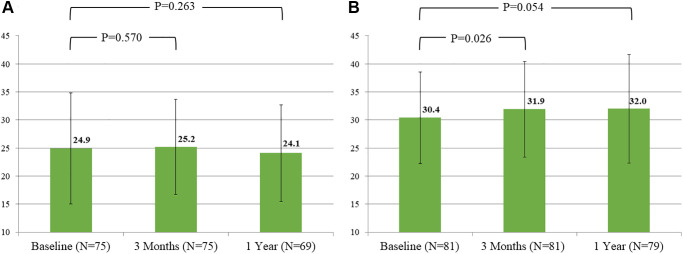
Results: In overall cohort, persistent improvement to 1 year in MMSE, ADAS-cog, Color Trail Test A and B was found. According to the STS score, the study cohort was divided into low (<4%, N = 81) and intermediate-high (≧4%, N = 75) risk groups. The baseline neurologic and cognitive performance was significantly worse in intermediate-high risk group. Slight improvement on general neurological functions (Barthel index and proportion of NIHSS>0 patients) at 1 year could be observed only in intermediate-high risk group. In global cognitive assessments, improvement in MMSE and ADAS-cog at 1 year was found in both groups, but the proportion of cognitive improvement was more obvious in intermediate-high risk group. In Color Trail Tests and verbal fluency, significant and persistent improvement up to 1 year could be observed only in low risk group.
Conclusions: TAVR was associated with persistent improvement in global cognitive function, as well as in attention and psychomotor processing speed, up to 1 year in overall cohort. However, improvement in tests for executive functions can only be seen in low risk group.
Keywords: TAVR; aortic stenosis; neurocognitive function.
Conflict of interest statement
Figures
References
-
- Siontis GC, Praz F, Pilgrim T, Mavridis D, Verma S, Salanti G, Søndergaard L, Jüni P, Windecker S. Transcatheter aortic valve implantation vs. surgical aortic valve replacement for treatment of severe aortic stenosis: a meta-analysis of randomized trials. Eur Heart J. 2016; 37:3503–12. 10.1093/eurheartj/ehw225 - DOI - PubMed
-
- Gargiulo G, Sannino A, Capodanno D, Barbanti M, Buccheri S, Perrino C, Capranzano P, Indolfi C, Trimarco B, Tamburino C, Esposito G. Transcatheter Aortic Valve Implantation Versus Surgical Aortic Valve Replacement: A Systematic Review and Meta-analysis. Ann Intern Med. 2016; 165:334–44. 10.7326/M16-0060 - DOI - PubMed
-
- Mack MJ, Leon MB, Thourani VH, Makkar R, Kodali SK, Russo M, Kapadia SR, Malaisrie SC, Cohen DJ, Pibarot P, Leipsic J, Hahn RT, Blanke P, et al. , and PARTNER 3 Investigators. Transcatheter Aortic-Valve Replacement with a Balloon-Expandable Valve in Low-Risk Patients. N Engl J Med. 2019; 380:1695–705. 10.1056/NEJMoa1814052 - DOI - PubMed
-
- Otto CM, Nishimura RA, Bonow RO, Carabello BA, Erwin JP 3rd, Gentile F, Jneid H, Krieger EV, Mack M, McLeod C, O'Gara PT, Rigolin VH, Sundt TM 3rd, et al. , and Writing Committee Members. 2020 ACC/AHA Guideline for the Management of Patients with Valvular Heart Disease: Executive Summary: A Report of the American College of Cardiology/American Heart Association Joint Committee on Clinical Practice Guidelines. J Am Coll Cardiol. 2021; 77:450–500. 10.1016/j.jacc.2020.11.035 - DOI - PubMed
-
- Vlastra W, van Nieuwkerk AC, Bronzwaer AGT, Versteeg A, Bron EE, Niessen WJ, Mutsaerts HJM, van der Ster BJP, Majoie CBL, Biessels GJ, Nederveen AJ, Daemen MJA, van Osch MJP, et al. Cerebral Blood Flow in Patients with Severe Aortic Valve Stenosis Undergoing Transcatheter Aortic Valve Implantation. J Am Geriatr Soc. 2021; 69:494–9. 10.1111/jgs.16882 - DOI - PMC - PubMed
Publication types
MeSH terms
LinkOut - more resources
Full Text Sources