


The relationship among avian influenza, gut microbiota and chicken immunity: an updated overview
- PMID: 35939896
- PMCID: PMC9386105
- DOI: 10.1016/j.psj.2022.102021
The relationship among avian influenza, gut microbiota and chicken immunity: an updated overview
Abstract
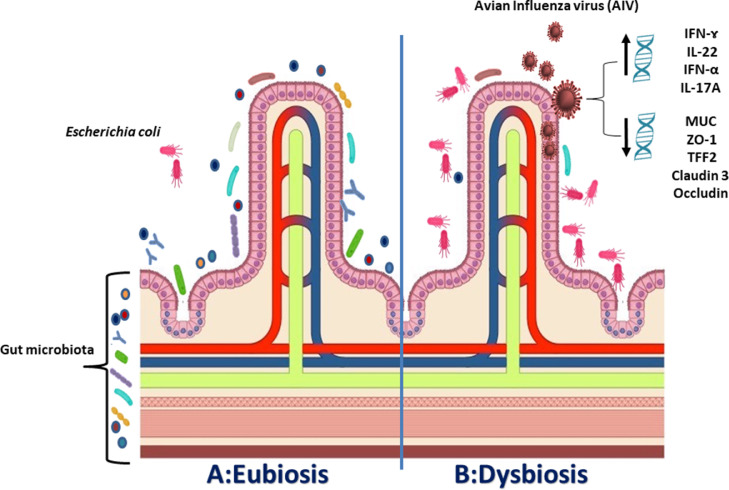
The alimentary tract in chickens plays a crucial role in immune cell formation and immune challenges, which regulate intestinal flora and sustain extra-intestinal immunity. The interaction between pathogenic microorganisms and the host commensal microbiota as well as the variety and integrity of gut microbiota play a vital role in health and disease conditions. Thus, several studies have highlighted the importance of gut microbiota in developing immunity against viral infections in chickens. The gut microbiota (such as different species of Lactobacillus, Blautia Bifidobacterium, Faecalibacterium, Clostridium XlVa, and members of firmicutes) encounters different pathogens through different mechanisms. The digestive tract is a highly reactive environment, and infectious microorganisms can disturb its homeostasis, resulting in dysbiosis and mucosal infections. Avian influenza viruses (AIV) are highly infectious zoonotic viruses that lead to severe economic losses and pose a threat to the poultry industry worldwide. AIV is a challenging virus that affects gut integrity, disrupts microbial homeostasis and induces inflammatory damage in the intestinal mucosa. H9N2 AIV infection elevates the expression of proinflammatory cytokines, such as interferon (IFN-γ and IFNα) and interleukins (IL-17A and IL-22), and increases the proliferation of members of proteobacteria, particularly Escherichia coli. On the contrary, it decreases the proliferation of certain beneficial bacteria, such as Enterococcus, Lactobacillus and other probiotic microorganisms. In addition, H9N2 AIV decreases the expression of primary gel-forming mucin, endogenous trefoil factor family peptides and tight junction proteins (ZO-1, claudin 3, and occludin), resulting in severe intestinal damage. This review highlights the relationship among AIV, gut microbiota and immunity in chicken.
Keywords: avian influenza; chicken; dysbiosis; gut health; immunity; microbiome; probiotics.
Copyright © 2022 The Authors. Published by Elsevier Inc. All rights reserved.
Figures
References
-
- Abd El-Ghany W.A., Shaalan M., Salem H.M. Nanoparticles applications in poultry production: an updated review. Worlds Poult. Sci. J. 2021;77:1001–1025.
-
- Abd El-Hack M.E., Alaidaroos B.A., Farsi R.M., Abou-Kassem D.E., El-Saadony M.T., Shafi M.E., Albaqami N.M., Taha A.E., Ashour E.A. Impacts of supplementing broiler diets with biological curcumin, zinc nanoparticles and Bacillus licheniformis on growth, carcass traits, blood indices, meat quality and cecal microbial load. Animals. 2021;11:1878. - PMC - PubMed
-
- Abd El-Hack M.E., El-Saadony M.T., Saad A.M., Salem H.M., Ashry N.M., Abo Ghanima M.M., Shukry M., Swelum A.A., Taha A.E., El-Tahan A.M., AbuQamar S.F., El-Tarabily K.A. Essential oils and their nanoemulsions as green alternatives to antibiotics in poultry nutrition: a comprehensive review. Poult. Sci. 2022;101 - PMC - PubMed
Publication types
MeSH terms
LinkOut - more resources
Full Text Sources
Other Literature Sources
Medical
