


doi: 10.1016/j.vaccine.2022.07.028.
Epub 2022 Jul 26.
Making more COVID-19 vaccines available to address global needs: Considerations and a framework for their evaluation
Affiliations
- PMID: 35941036
- PMCID: PMC9343170
- DOI: 10.1016/j.vaccine.2022.07.028
Item in Clipboard
Making more COVID-19 vaccines available to address global needs: Considerations and a framework for their evaluation
Vaccine.
.
No abstract available
Conflict of interest statement
Declaration of Competing Interest The authors declare that they have no known competing financial interests or personal relationships that could have appeared to influence the work reported in this paper.
Figures
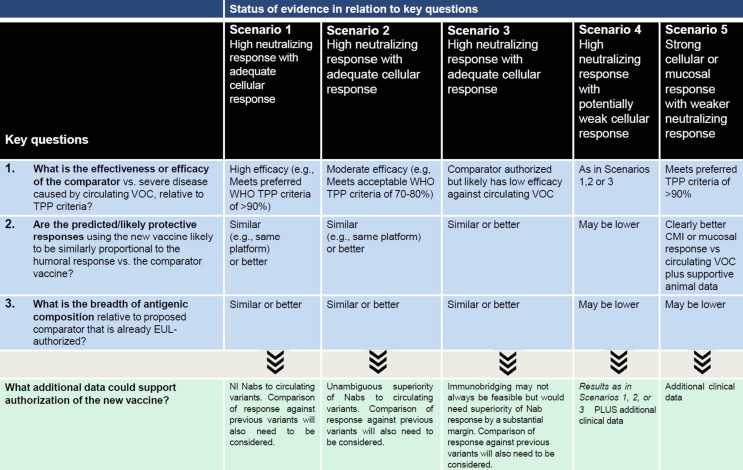
A framework to define approaches to evaluating the effectiveness of new COVID-19 vaccines for possible WHO Emergency Use listing. The Figure should be viewed in concert with the accompanying text, and decisions should be based on the totality of data. Deviations from the considerations in the framework can be justified with additional data and rationales not detailed in the table. Different scenarios (columns) are defined by assessments of key questions (1–3) related to a new vaccine and its proposed comparator. Additional data that could support a favorable evaluation are described in the final row. Scenarios 1–3 implicitly assume that neutralizing responses will be predictive of other (especially cellular) protective responses, but each contemplates using a comparator with different efficacy against severe disease caused by circulating variants, which influences the criteria that could support effectiveness of the new vaccine. In Scenario 1, where the comparator retains high efficacy against severe disease caused by circulating VOCs (e.g. meets the preferred WHO TPP criteria of >90% efficacy), non-inferiority criteria could be used. In Scenario 2, where there is uncertainty about the effectiveness of the comparator or where it is not considered to be highly effective (e.g. meets the “acceptable” WHO TPP criteria of 70–80%) against circulating VOCs, concerns about uncertainty in establishing the efficacy of the comparator and the possibility that non-inferiority criteria could allow for listing of an inferior vaccine, suggest the prudence of using superiority criteria. In cases where this uncertainty is great, or no comparator with adequate efficacy is available (Scenario 3), immunobridging may not be feasible, or it may be possible to contemplate authorization only if superiority of immune response is demonstrated by a substantial margin that could be determined only after careful consideration by regulators, who might also require that additional criteria be met. Where new vaccines with strong humoral responses but a significant likelihood that cellular responses are weaker than the comparator or the antigenic composition is less broad (e.g., Scenario 4), or strong cellular (or perhaps mucosal) responses with the knowledge that systemic humoral responses are too weak to support immunobridging based on neutralizing responses, regardless of breadth of antigenic composition (e.g., Scenario 5), there may be a need for additional clinical effectiveness data (as may be obtained in in-deployment studies or from human challenge studies, if feasible) before issuance of EUL.
References
-
- WHO Target Product Profiles for COVID-19 Vaccines, Revised version, April 2022. Geneva: World Health Organization; 2022. <https://cdn.who.int/media/docs/default-source/blue-print/tpp-6apr-2022-f... [retrieved 31 May 2022].
-
- Khoury D.S., Cromer D., Reynaldi A., Schlub T.E., Wheatley A.K., Juno J.A., et al. Neutralizing antibody levels are highly predictive of immune protection from symptomatic SARS-CoV-2 infection. Nat Med. 2021;27(7):1205–1211. - PubMed
-
- Developing a framework for evaluating new COVID-19 vaccines. Geneva: World Health Organization; 2022. <https://www.who.int/news-room/events/detail/2022/02/23/default-calendar/... [retrieved 31 May 2022].
MeSH terms
Substances
Grants and funding
LinkOut - more resources
Full Text Sources
Medical
