


The magnitude and perceived reasons for childhood cancer treatment abandonment in Ethiopia: from health care providers' perspective
- PMID: 35941600
- PMCID: PMC9361525
- DOI: 10.1186/s12913-022-08188-8
The magnitude and perceived reasons for childhood cancer treatment abandonment in Ethiopia: from health care providers' perspective
Abstract
Background: Treatment abandonment is one of major reasons for childhood cancer treatment failure and low survival rate in low- and middle-income countries. Ethiopia plans to reduce abandonment rate by 60% (2019-2023), but baseline data and information about the contextual risk factors that influence treatment abandonment are scarce.
Methods: This cross-sectional study was conducted from September 5 to 22, 2021, on the three major pediatric oncology centers in Ethiopia. Data on the incidence and reasons for treatment abandonment were obtained from healthcare professionals. We were unable to obtain data about the patients' or guardians' perspective because the information available in the cancer registry was incomplete to contact adequate number of respondents. We used a validated, semi-structured questionnaire developed by the International Society of Pediatric Oncology Abandonment Technical Working Group. We included all (N = 38) health care professionals (physicians, nurses, and social workers) working at these centers who had more than one year of experience in childhood cancer service provision (a universal sampling and 100% response rate).
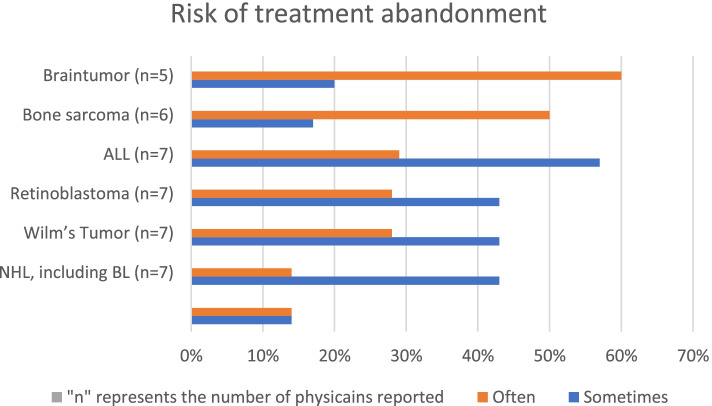
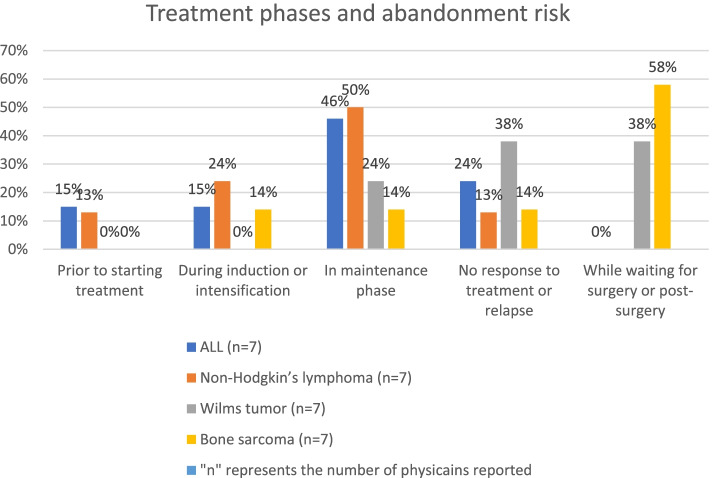
Results: The perceived mean abandonment rate in Ethiopia is 34% (SE 2.5%). The risk of treatment abandonment is dependent on the type of cancer (high for bone sarcoma and brain tumor), the phase of treatment and treatment outcome. The highest risk is during maintenance and treatment failure or relapse for acute lymphoblastic leukemia, and during pre- or post-surgical phase for Wilms tumor and bone sarcoma. The major influencing risk factors in Ethiopia includes high cost of care, low economic status, long travel time to treatment centers, long waiting time, belief in the incurability of cancer and poor public awareness about childhood cancer.
Conclusions: The perceived abandonment rate in Ethiopia is high, and the risk of abandonment varies according to the type of cancer, phase of treatment or treatment outcome. Therefore, mitigation strategies to reduce the abandonment rate should include identifying specific risk factors and prioritizing strategies based on their level of influence, effectiveness, feasibility, and affordability.
Keywords: Childhood cancer; Ethiopia; Low-income countries; Sub-Saharan Africa; Treatment abandonment.
© 2022. The Author(s).
Conflict of interest statement
The authors declare no competing interests.
Figures

References
-
- Gelband H, Jha P, Sankaranarayanan R, Horton S. Disease Control Priorities, Third Edition : Volume 3. Cancer. Washington, DC: World Bank; 2015 - PubMed
-
- Pui C-H, Pei D, Pappo AS, Howard SC, Cheng C, Sandlund JT, et al. Treatment outcomes in black and white children with cancer: results from the SEER database and St Jude Children's Research Hospital, 1992 through 2007. J Clin Oncol. 2012;30(16):2005–2012. doi: 10.1200/JCO.2011.40.8617. - DOI - PMC - PubMed
MeSH terms
Grants and funding
LinkOut - more resources
Full Text Sources
Medical
