


The Efficacy and Safety of Epidermal Growth Factor Combined with Fractional Carbon Dioxide Laser for Acne Scar Treatment: A Split-Face Trial
- PMID: 35942017
- PMCID: PMC9345195
The Efficacy and Safety of Epidermal Growth Factor Combined with Fractional Carbon Dioxide Laser for Acne Scar Treatment: A Split-Face Trial
Abstract
Background: Epidermal growth factor (EGF) stimulates collagen production and supports the wound healing process. However, there are no studies on fractional carbon dioxide (CO2) laser combined with EGF for acne scar treatment.
Objective: We sought to evaluate the efficacy and safety of fractional CO2 laser combined with topical EGF versus fractional CO2 laser alone in the treatment of acne scars.
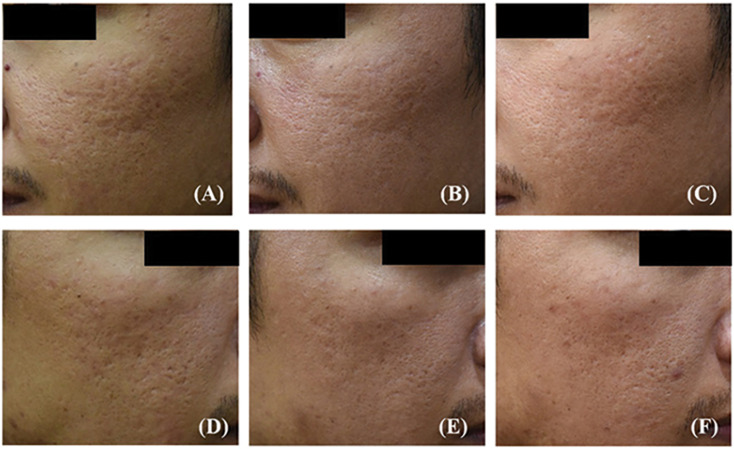
Methods: Twenty-three patients with atrophic acne scars underwent three monthly sessions of randomized split-face application of fractional CO2 laser combined with topical EGF or placebo twice daily for seven days following each laser session. Scar improvement was evaluated at one month and three months posttreatment by two blinded dermatologists and the Antera 3D® skin analysis system. Wound healing response and adverse events were also evaluated.
Results: Twenty-one patients completed the trial. According to dermatologist grading and skin analysis system, EGF showed significant superiority at three months posttreatment compared to placebo. The wound healing response did not differ between the groups. Surprisingly, the melanin index on the EGF side showed a significant decrease at three months posttreatment, compared to placebo. There was no allergic reaction to the topical EGF.
Conclusion: Treatment with topical EGF after ablative fractional CO2 laser improves the clinical appearance of atrophic acne scars, and EGF may help decrease skin pigmentation after laser treatment. The use of topical EGF is safe when applied to post-laser ablation.
Keywords: Epidermal growth factor; acne scar; fractional carbon dioxide laser.
Copyright © 2022. Matrix Medical Communications. All rights reserved.
Conflict of interest statement
DISCLOSURES: The authors report no conflicts of interest relevant to the content of this article.
Figures
References
-
- Boen M, Jacob C. A Review and Update of Treatment Options Using the Acne Scar Classification System. Dermatol Surg. 2019;45(3):411–422. - PubMed
-
- Boonstra J, Rijken P, Humbel B et al. The epidermal growth factor. Cell Biol Int. 1995;19(5):413–430. - PubMed
-
- Demidova-Rice TN, Hamblin MR, Herman IM. Acute and impaired wound healing: pathophysiology and current methods for drug delivery, part 2: role of growth factors in normal and pathological wound healing: therapeutic potential and methods of delivery. Adv Skin Wound Care. 2012;25(8):349–370. - PMC - PubMed
-
- Yang S, Geng Z, Ma K et al. Efficacy of topical recombinant human epidermal growth factor for treatment of diabetic foot ulcer: a systematic review and meta-analysis. Int J Low Extrem Wounds. 2016;15(2):120–125. - PubMed
-
- Stoddard MA, Herrmann J, Moy L et al. Improvement of atrophic acne scars in skin of color using topical synthetic epidermal growth factor (EFG) serum: a pilot study. J Drugs Dermatol. 2017;16(4):322–326. - PubMed
LinkOut - more resources
Full Text Sources