


Variations in comorbidity burden in people with type 2 diabetes over disease duration: A population-based analysis of real world evidence
- PMID: 35942273
- PMCID: PMC9356197
- DOI: 10.1016/j.eclinm.2022.101584
Variations in comorbidity burden in people with type 2 diabetes over disease duration: A population-based analysis of real world evidence
Abstract
Background: The prevalence of type 2 diabetes (T2DM) is increasing, but increasing longevity among persons with diagnosed diabetes may be is associated with more extensive and diverse types of morbidity. The extent and breadth of morbidity and how this varies across sub-groups is unclear and could have important clinical and public health implications. We aimed to estimate comorbidity profiles in people with T2DM and variations across sub-groups and over time.
Methods: We identified approximately 224,000 people with T2DM in the Discover-NOW dataset, a real-world primary care database from 2000 to 2020 covering 2.5 million people across North-West London, England, linked to hospital records. We generated a mixed prevalence and incidence study population through repeated annual cross sections, and included a broad set of 35 comorbidities covering traditional T2DM conditions, emerging T2DM conditions and other common conditions.We estimated annual age-standardised prevalence of comorbidities, over the course of the disease in people with T2DM and several sub-groups.
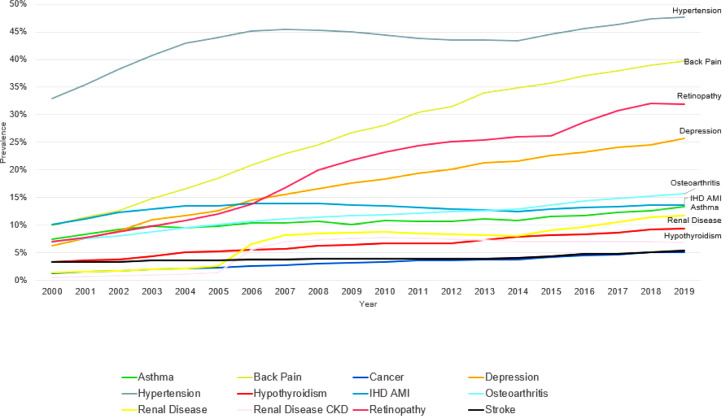
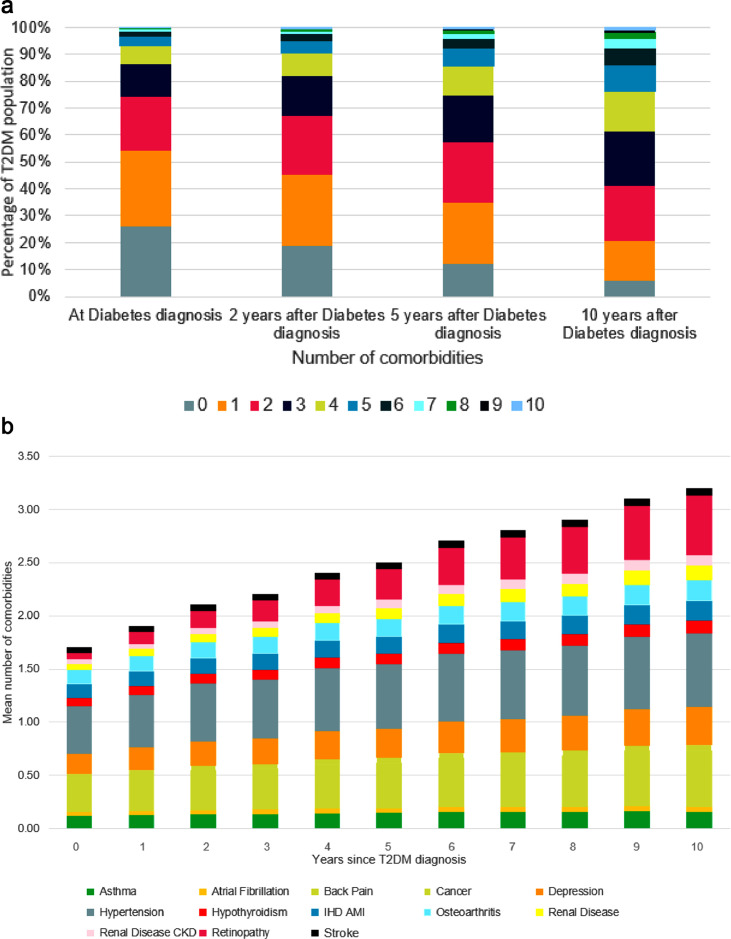
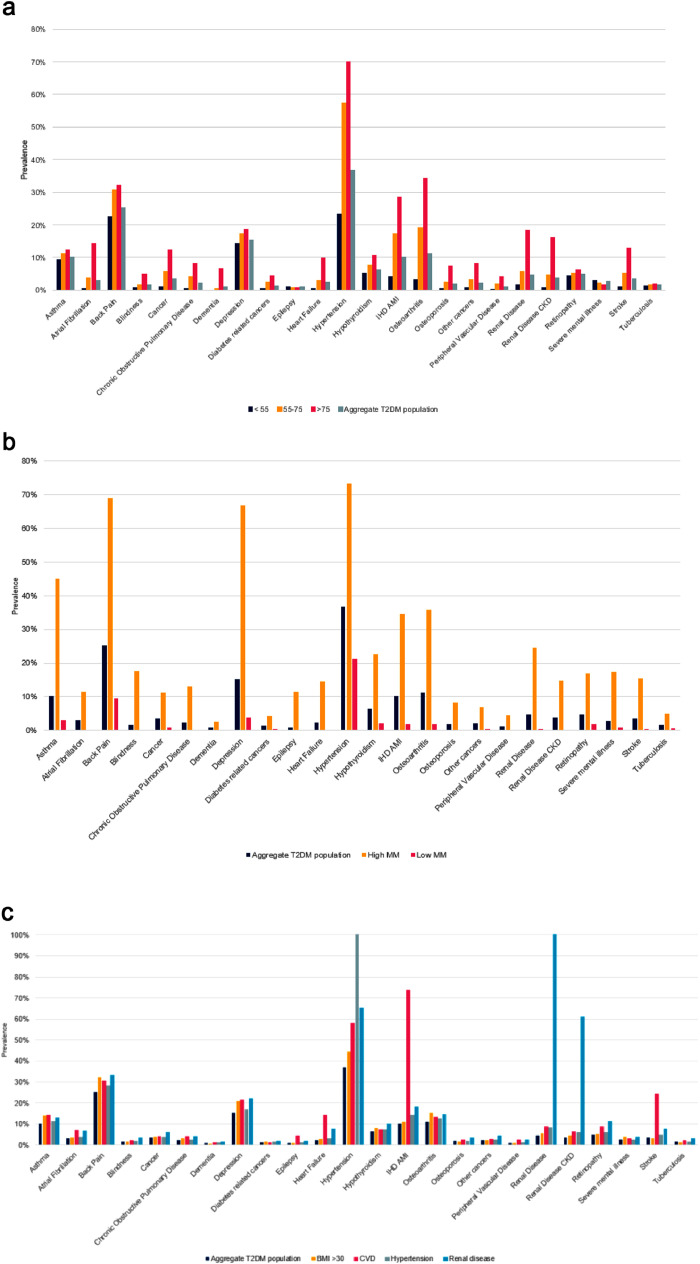
Findings: Multimorbidity (two or more chronic conditions) is common in people with T2DM and increasing, but the comorbidity profiles of people with T2DM vary substantially. Nearly 30% of T2DM patients had three or more comorbidities at diagnosis, increasing to 60% of patients ten years later. Two of the five commonest comorbidities at diagnosis were traditional T2DM conditions (hypertension (37%) and ischaemic heart disease (10%)) the other three were not (depression (15%), back pain (25%) and osteoarthritis (11%)). The prevalence of each increased during the course of the disease, with more than one in three patients having back pain and one in four having depression ten years post diagnosis.People with five or more comorbidities at diagnosis had higher prevalence of each of the 35 comorbidities. Hypertension (73%) was the commonest comorbidity at diagnosis in this group; followed by back pain (69%), depression (67%), asthma (45%) and osteoarthritis (36%). People with obesity at diagnosis had substantially different comorbidity profiles to those without, and the five commonest comorbidities were 50% more common in this group.
Interpretation: Preventative and clinical interventions alongside care pathways for people with T2DM should transition to reflect the diverse set of causes driving persistent morbidity. This would benefit both patients and healthcare systems alike.
Funding: The study was funded by the National Institute for Health and Care Excellence (NICE).
Keywords: Diabetes; Epidemiology; Multimorbidity.
© 2022 Published by Elsevier Ltd.
Conflict of interest statement
JP-S reports personal fees from Novo Nordisk A/S and Pfizer Ltd outside of the submitted work and is chair-elect of the Royal Society for Public Health. All other authors report no competing interests.
Figures
References
-
- Saeedi P, Petersohn I, Salpea P, et al. Global and regional diabetes prevalence estimates for 2019 and projections for 2030 and 2045: results from the international diabetes federation diabetes atlas, 9. Diabetes Res Clin Pract. 2019;157 - PubMed
-
- Gregg EW, Cheng YJ, Srinivasan M, et al. Trends in cause-specific mortality among adults with and without diagnosed diabetes in the USA: an epidemiological analysis of linked national survey and vital statistics data. Lancet. 2018;391(10138):2430–2440. - PubMed
-
- Harding JL, Pavkov ME, Magliano DJ, Shaw JE, Gregg EW. Global trends in diabetes complications: a review of current evidence. Diabetologia. 2019;62(1):3–16. - PubMed
-
- Harding JL, Shaw JE, Peeters A, Davidson S, Magliano DJ. Age-specific trends from 2000 to 2011 in all-cause and cause-specific mortality in Type 1 and Type 2 diabetes: a cohort study of more than one million people. Diabetes Care. 2016;39(6):1018–1026. - PubMed
LinkOut - more resources
Full Text Sources
