


Increased symptom severity in adults and adolescents admitting to an inpatient psychiatric hospital during the COVID-19 pandemic
- PMID: 35944372
- PMCID: PMC9338827
- DOI: 10.1016/j.psychres.2022.114758
Increased symptom severity in adults and adolescents admitting to an inpatient psychiatric hospital during the COVID-19 pandemic
Abstract
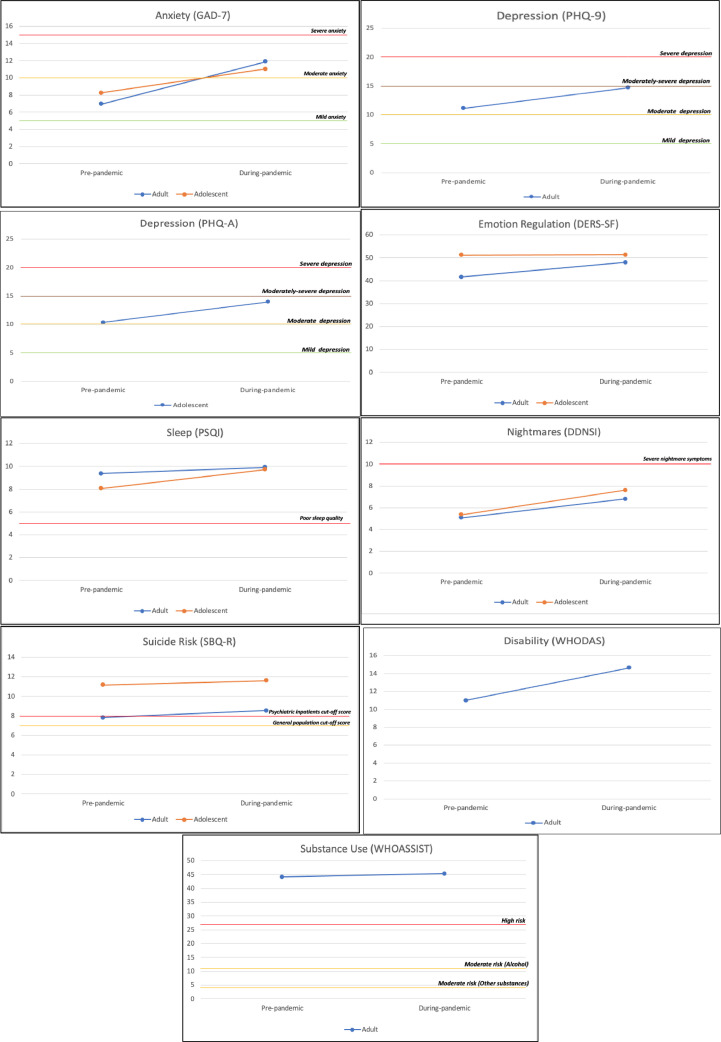
While the negative effects of Coronavirus Disease-2019 (COVID-19) on general mental health are well-established, less is known about the impact on those with severe mental illness. Thus, this study examined symptom severity among psychiatric inpatients admitted prior to versus during the COVID pandemic. Self-reported anxiety (GAD-7), depression (PHQ-9), emotional dysregulation (DERS-SF), sleep quality (PSQI), nightmares (DDNSI), and suicidal ideation (SBQ-R) were examined in 470 adults (n = 235 admitted pre-pandemic) and 142 children and adolescents (n = 65 admitted pre-pandemic) at admission. Adults also completed measures of disability (WHODAS) and substance use (WHOASSIST). Adults admitted during the COVID pandemic reported significantly higher levels of anxiety [p < .001, partial η2=0.18], depression [p < .001, partial η2=0.06], emotion dysregulation [p < .001, partial η2=0.05], nightmares [p = .013, partial η2=0.01], and disability [p < .001, partial η2=0.04] compared to adults admitted pre-COVID. Levels of anxiety [p = .005, partial η2=0.05], depression [p = .005, partial η2=0.06], and sleep quality [p = .011, partial η2=0.05] were significantly higher among adolescents admitted during COVID compared to pre-COVID. The findings help identify areas of prioritization for future mental health prevention/intervention efforts for future disease outbreaks.
Keywords: Adolescent; Adult; COVID-19; Inpatient; Mental health; Psychiatry.
Copyright © 2022. Published by Elsevier B.V.
Conflict of interest statement
Declaration of Competing Interest No authors have conflicts of interest to declare.
Figures
References
-
- Ammar A., Mueller P., Trabelsi K., Chtourou H., Boukhris O., Masmoudi L., Bouaziz B., Brach M., Schmicker M., Bentlage E., How D., Ahmed M., Aloui A., Hammouda O., Paineiras-Domingos L.L., Braakman-Jansen A., Wrede C., Bastoni S., Pernambuco C., .…, Consortium E.-C. Psychological consequences of COVID-19 home confinement: the ECLB-COVID19 multicenter study. PLoS One. 2020;15(11) doi: 10.1371/journal.pone.0240204. - DOI - PMC - PubMed
-
- Amorós-Reche V., Belzunegui-Pastor A., Hurtado G., Espada J.P. Emotional problems in Spanish children and adolescents during the COVID-19 pandemic: a systematic review. Clín. Salud. 2022;33(1):19–28. doi: 10.5093/clysa2022a2. - DOI
-
- Axelsson E., Lindsäter E., Ljótsson B., Andersson E., Hedman-Lagerlöf E. The 12-item self-report World Health Organization disability assessment schedule (WHODAS) 2.0 administered via the internet to individuals with anxiety and stress disorders: a psychometric investigation based on data from two clinical trials. JMIR Ment. Health. 2017;4(4):e58. doi: 10.2196/mental.7497. - DOI - PMC - PubMed
-
- Bartak A., Spreeuwenberg M.D., Andrea H., Holleman L., Rijnierse P., Rossum B.V., Hamers E.F., Meerman A.M., Aerts J., Busschbach J.J., Verheul R., Stijnen T., Emmelkamp P.M. Effectiveness of different modalities of psychotherapeutic treatment for patients with cluster C personality disorders: results of a large prospective multicentre study. Psychother. Psychosom. 2010;79(1):20–30. doi: 10.1159/000254902. - DOI - PubMed
Publication types
MeSH terms
LinkOut - more resources
Full Text Sources
Medical
