


Unique mutations in SARS-CoV-2 Omicron subvariants' non-spike proteins: Potential impacts on viral pathogenesis and host immune evasion
- PMID: 35944840
- PMCID: PMC9356572
- DOI: 10.1016/j.micpath.2022.105699
Unique mutations in SARS-CoV-2 Omicron subvariants' non-spike proteins: Potential impacts on viral pathogenesis and host immune evasion
Abstract
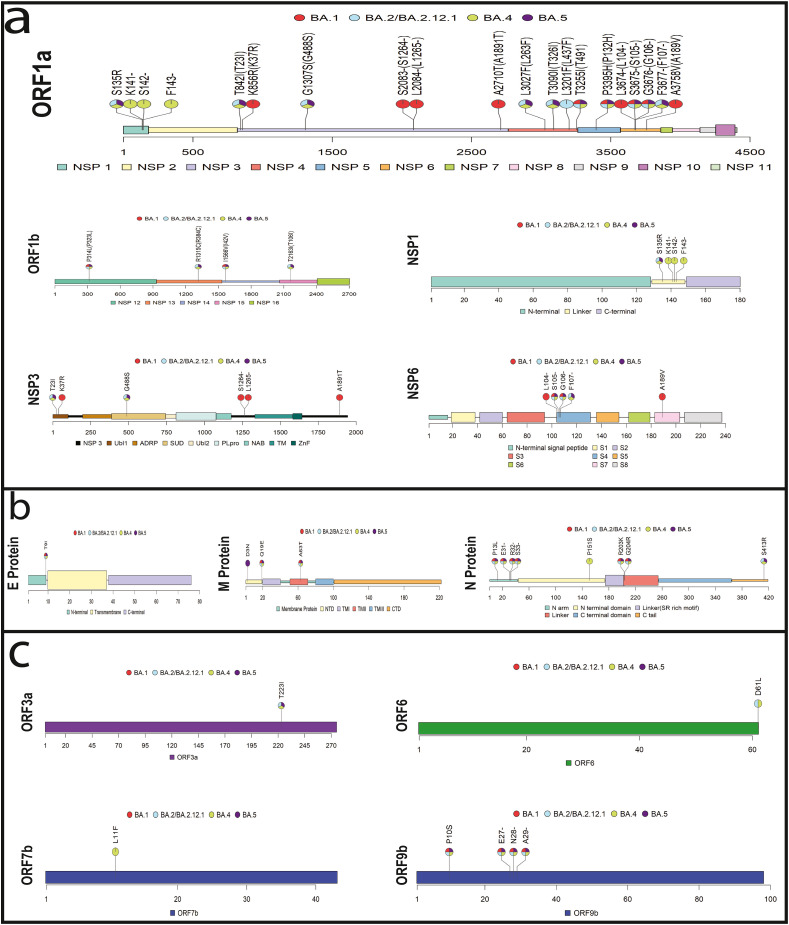
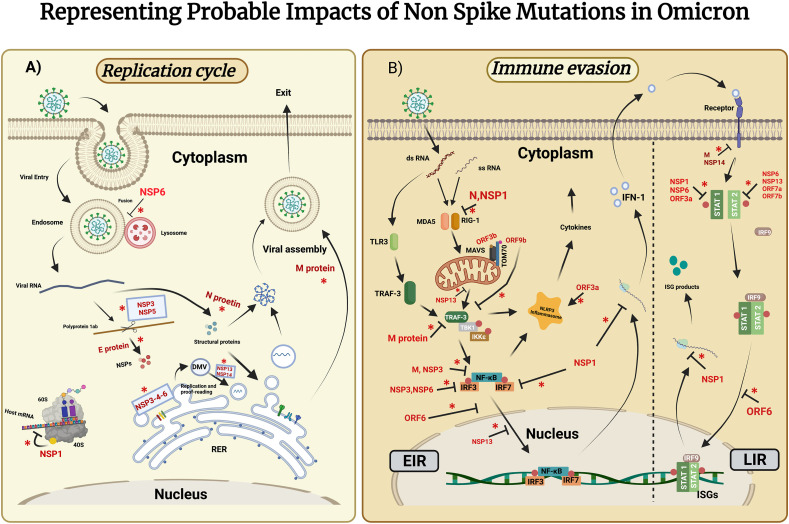
SARS-CoV-2 is the causative agent behind the ongoing COVID-19 pandemic. This virus is a cumulative outcome of mutations, leading to frequent emergence of new variants and their subvariants. Some of them are a matter of high concern, while others are variants of interest for studying the mutational effect. The major five variants of concern (VOCs) are Alpha (B.1.1.7), Beta (B.1.315), Gamma (P.1), Delta (B.1.617.2), and Omicron (B.1.1.529.*/BA.*). Omicron itself has >100 subvariants at present, among which BA.1 (21K), BA.2 (21L), BA.4 (22A), BA.5 (22B), and BA.2.12.1 (22C) are the dominant ones. Undoubtedly, these variants and sometimes their progeny subvariants have significant differences in their spike region that impart them the unique properties they harbor. But alongside, the mutations in their non-spike regions could also be responsible elements behind their characteristics, such as replication time, virulence, survival, host immune evasion, and such. There exists a probability that these mutations of non-spike proteins may also impart epistatic effects that are yet to be brought to light. The focus of this review encompasses the non-spike mutations of Omicron, especially in its widely circulating subvariants (BA.1, BA.2, BA.4, BA.5, and BA.2.12.1). The mutations such as in NSP3, NSP6, NSP13, M protein, ORF7b, and ORF9b are mentioned few of all, which might have led to the varying properties, including growth advantages, higher transmission rate, lower infectivity, and most importantly better host immune evasion through natural killer cell inactivation, autophagosome-lysosome fusion prevention, host protein synthesis disruption, and so on. This aspect of Omicron subvariants has not yet been explored. Further study of alteration of expression or interaction profile of these non-spike mutations bearing proteins, if present, can add a great deal of knowledge to the current understanding of the viral properties and thus effective prevention strategies.
Keywords: Accessory proteins; Epistasis; Immune-evasion; Non-spike mutations; Non-structural protein; Omicron; Subvariants; Variants of concern.
Copyright © 2022 Elsevier Ltd. All rights reserved.
Conflict of interest statement
Declaration of competing interest The authors declare that they have no known competing financial interests or personal relationships that could have appeared to influence the work reported in this paper.
Figures
References
-
- Latinne A., Hu B., Olival K.J., Zhu G., Zhang L., Li H., Chmura A.A., Field H.E., Zambrana-Torrelio C., Epstein J.H., Li B., Zhang W., Wang L.F., Shi Z.L., Daszak P. Origin and cross-species transmission of bat coronaviruses in China. Nat. Commun. 2020;11 doi: 10.1038/s41467-020-17687-3. - DOI - PMC - PubMed
-
- Naqvi A.A.T., Fatima K., Mohammad T., Fatima U., Singh I.K., Singh A., Atif S.M., Hariprasad G., Hasan G.M., Hassan M.I. Since January 2020 Elsevier has created a COVID-19 resource centre with free information in English and Mandarin on the novel coronavirus COVID- 19 . The COVID-19 resource centre is hosted on Elsevier Connect , the company' s public news and information. BBA - Mol. Basis Dis. 2020:1–17.
-
- Lu R., Wang Y., Wang W., Nie K., Zhao Y., Su J., Deng Y., Zhou W., Li Y., Wang H., Wang W., Ke C., Ma X., Wu G., Tan W. Complete genome sequence of Middle East respiratory syndrome coronavirus (MERS-CoV) from the first imported MERS-CoV case in China. Genome Announc. 2015;3 doi: 10.1128/genomeA.00818-15. 2014–2015. - DOI - PMC - PubMed
Publication types
MeSH terms
Supplementary concepts
LinkOut - more resources
Full Text Sources
Medical
Miscellaneous
